
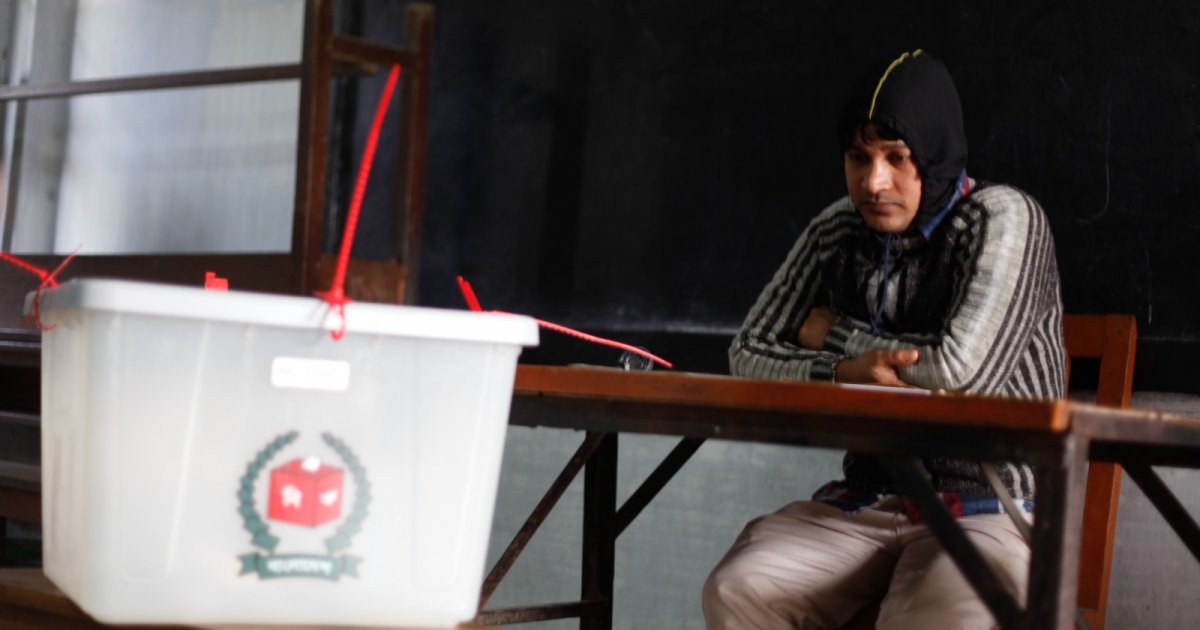
With 2,582 candidates in the fray, Bangladesh is heading towards its 13th national parliamentary election, scheduled for February 12.
According to the Election Commission (EC), a total of 3,407 nomination forms were collected for the country’s 300 constituencies, with the deadline for submission ending on Monday.
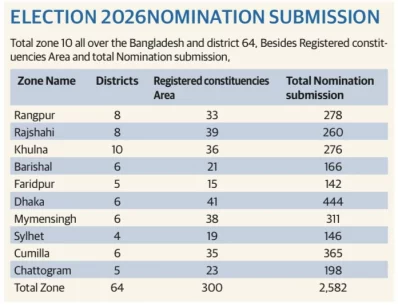
By the close of the final day, 2,582 candidates had submitted nomination papers nationwide. The Dhaka region recorded the highest number, with 444 nominations across 41 constituencies, while the Faridpur region saw the lowest, with 142 nominations from 15 constituencies.
The EC has divided the country’s 300 constituencies into 10 regional zones. The final day of nomination submission witnessed a significant rush, as candidates filed their papers across the country.
This election will be held alongside a referendum on implementing the July Charter—the first time Bangladesh will conduct a national parliamentary election and referendum on the same day.
With the long-ruling and now deposed Awami League barred from contesting, and several of its former allies—including the Jatiya Samajtantrik Dal (JASAD) and the Workers’ Party—boycotting the polls, the spotlight has shifted to the Bangladesh Nationalist Party (BNP), Jamaat-e-Islami, Jatiya Party (GM Quader), and the National Citizens’ Party (NCP).
Several smaller parties and independent candidates are also contesting across the country, alongside major leftist parties such as the Communist Party of Bangladesh (CPB) and BASOD, as well as Islamic parties, including Islamic Andolan Bangladesh.
Key nominations: BNP, Jamaat, Japa and NCP
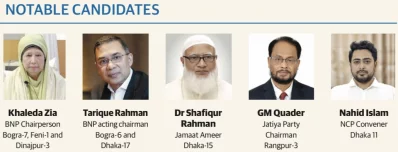
BNP chairperson Khaleda Zia’s nomination papers were submitted on her behalf by party leaders in multiple constituencies, as she remains hospitalized. In Feni-1, Rafiqul Alam Majnu filed her nomination, while Helaluzzaman Talukder (Lalu) submitted her papers in Bogra-7 (Gabtoli–Shahjahanpur). Due to her illness, her thumb impression was used in place of her signature.
BNP acting chairman Tarique Rahman filed nomination papers for Dhaka-17 at the Dhaka divisional commissioner’s office in Segunbagicha through Dr Farhad Halim Donar of the Doctors Association of Bangladesh. He also filed for Bogra-6 (Sadar).
BNP Secretary General Mirza Fakhrul Islam Alamgir personally submitted his nomination in Thakurgaon-1.
Jamaat-e-Islami Ameer Dr Shafiqur Rahman’s nomination papers were submitted for Dhaka-15 by senior party leaders.
Bangladesh Jamaat-e-Islami Secretary General and former MP Mia Golam Porwar submitted his nomination papers for the Khulna-5 constituency on Monday. Accompanied by party leaders and activists, he submitted the papers to Deputy Commissioner and returning officer Jashed Khandakar.
Meanwhile, Jamaat-nominated candidate Krishna Nandy also filed his nomination for the Khulna-1 seat. This marks the first time Jamaat has nominated a candidate from a minority community.
In coordination with the 10-party Jamaat-led alliance, NCP candidates are expected to contest several constituencies in Dhaka and other districts.
Sources said names under discussion include Nahid Islam (Dhaka-11), Javed Rasin (Dhaka-9), Engineer Nabila Tahsin (Dhaka-20), Dilshana Parul (Dhaka-19), and Nasiruddin Patwary (Dhaka-8), along with additional candidates in Rangpur, Panchagarh, Chittagong and other districts. The final list is yet to be officially announced by the NCP.
The Jatiya Party, led by GM Quader and which served as the opposition in recent parliaments, is participating in the polls. Party Chairman GM Quader submitted his nomination from Rangpur-3, while Secretary General Barrister Shamim Haider Patwary filed from Gaibandha-1 and Gaibandha-5.
According to Shamim Haider Patwary, around 200 candidates from the Jatiya Party have submitted nomination papers nationwide.
However, another faction of the Jatiya Party, led by former party leader Anisul Islam Mahmud and Jatiya Party (JP) Chairman Anowar Hossain Manju, has not submitted any nomination papers so far, despite speculation that the alliance might participate.
14-party alliance opts out
The Awami League-led 14-party alliance, which dominated national politics from 2008 to August 2024, is effectively absent from this election.
The Awami League remains banned, while former allies JASAD and the Workers’ Party have opted out, citing what they describe as an “unconstitutional and one-sided” election process.
JASAD Secretary Sajjad Hossain alleged that the interim government is not neutral and that the EC is facilitating the ruling administration’s political agenda. The Workers’ Party echoed similar concerns, pointing to exclusionary practices that, it said, hinder broad political participation.
Registered parties and electoral participation
The EC currently recognises 57 registered political parties eligible to contest elections.
Following the suspension of the Awami League’s registration and the cancellation of three other parties’ registrations, the remaining parties will compete across all 300 constituencies.
The final number of participating parties will become clear after the nomination verification process concludes on December 29.
Election schedule
Nomination scrutiny: December 30–January 4
Appeals: January 5–9
Appeal decisions: January 10–18
Candidate withdrawal: January 20
Symbol allocation: January 21
Campaign period: January 22–February 10 (until 7:30am)
Voting day: February 12
Emerging political reality
With the Awami League sidelined and its former allies boycotting the polls, BNP, Jamaat and the NCP have emerged as key players in shaping the country’s political landscape.
Analysts say the election will not only determine the next government but also shape the future trajectory of Bangladesh’s democratic institutions and broader political order.