

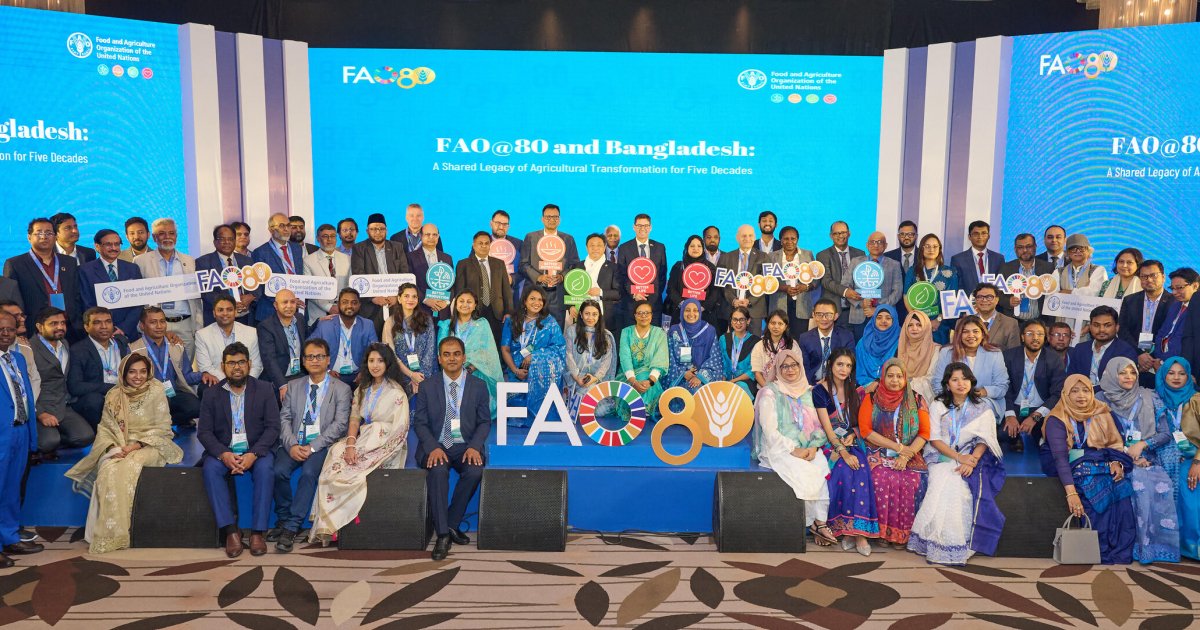
Bangladesh and the UN Food and Agriculture Organization (FAO) on Sunday marked a historic dual milestone—FAO’s 80th anniversary and 50 years of partnership with the country—at a daylong celebration titled “FAO@80 and Bangladesh: A Shared Legacy of Agricultural Transformation for Five Decades” held at a city hotel in Dhaka.
The event reflected on FAO’s global journey in combating hunger and transforming agrifood systems, alongside Bangladesh’s remarkable agricultural progress achieved through decades of collaboration. Senior government officials, FAO leadership, diplomats, development partners, private sector representatives, civil society, youth innovators, and farmers participated to celebrate achievements and chart a roadmap for the next decade.
The program opened with a youth-focused session, “Innovators’ Brew with Youth,” featuring 15 young agri-entrepreneurs who shared ideas on reshaping agriculture through innovation and technology.
The high-level inaugural session brought together senior representatives from the Government of Bangladesh and FAO, followed by a keynote address highlighting milestones achieved through the long-standing partnership. A panel discussion, “Dialogue for Impact – Partnering Hand in Hand for Inclusive Transformation,” explored how collective action can drive Bangladesh’s next phase of agricultural growth.
“For over five decades, Bangladesh and FAO have worked hand in hand to strengthen policies, build resilience, and drive innovation across our food and agriculture sectors,” said Md Shahriar Kader Siddiky, secretary of the Economic Relations Division (ERD), Ministry of Finance, speaking as chief guest. “As we approach LDC graduation, this partnership remains vital for advancing sustainable growth, boosting exports, and shaping a more food-secure and resilient future.”
Special guest Md Mahmudur Rahman, additional secretary of the Ministry of Agriculture, highlighted FAO’s support in climate adaptation, nutrition-sensitive agriculture, and emergency response. “As we advance the Agriculture Transformation Outlook 2050, Bangladesh deeply values FAO’s leadership in guiding reforms and building a competitive, climate-resilient, market-oriented agriculture sector,” he said.
FAO Representative in Bangladesh Jiaoqun Shi emphasized the shared nature of Bangladesh’s agrifood transformation. “Today’s milestone reminds us that this journey is powered by communities, innovators, and partners,” he said. Deputy FAO Representative Dia Sanou delivered a keynote highlighting Bangladesh’s agricultural progress and emerging opportunities.
Distinguished panelists included AKM Sohel, additional secretary, ERD; Jean Pesme of the World Bank; Norwegian Ambassador Hakon Arald Gulbrandsen; Italian Ambassador HE Antonio Alessandro; and private sector leader Uzma Chowdhury of PRAN-RFL Group and MCCI.
In the afternoon, technical sessions discussed flagship initiatives, including the closure of the Pesticide Risk Reduction project and a debrief on the EAF-Nansen 2025 Survey in the Bay of Bengal. The day concluded with a cultural and culinary segment led by Farida Akhter, adviser to the Ministry of Fisheries and Livestock, showcasing “Forgotten Foods and Diversified Dishes of Bangladesh” and highlighting the potential of heritage foods for sustainable, nutritious food systems.
Through the celebration, FAO reaffirmed its commitment to working “Hand in Hand” with Bangladesh to advance a sustainable, inclusive, resilient, and food-secure future—anchored in better production, better nutrition, a better environment, and a better life for all.