

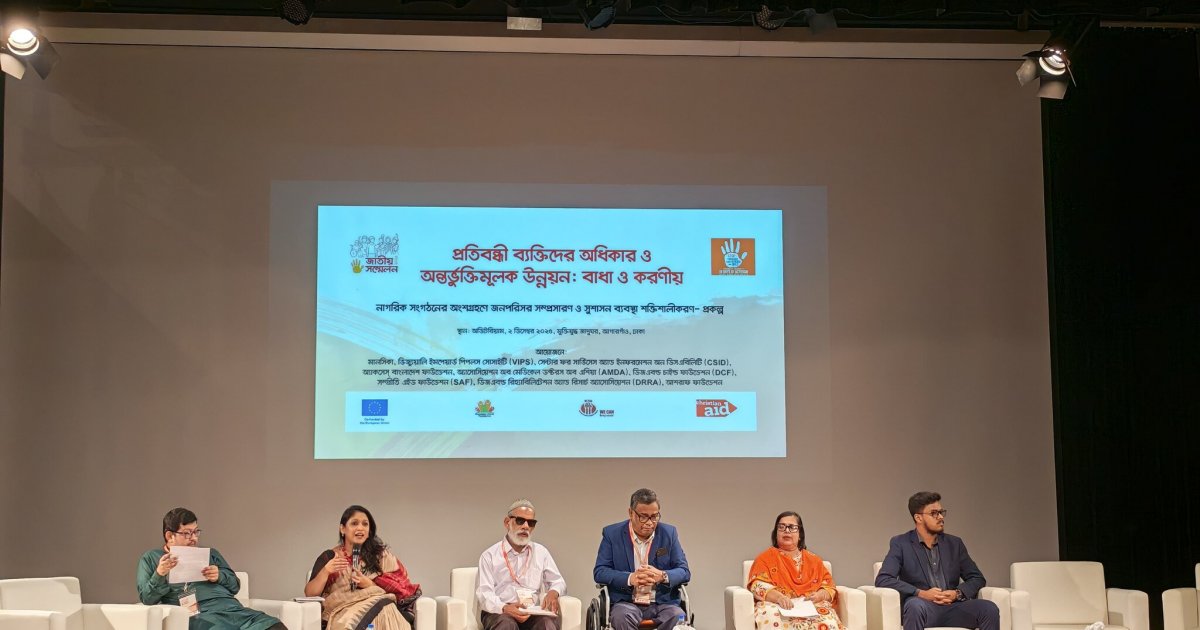
A national convention held Tuesday in Dhaka highlighted persistent barriers faced by persons with disabilities and urged government agencies, civil society, and development partners to scale up coordinated, inclusive action.
The day-long event, “National Convention: Amplifying Voices of Marginalized Communities,” was organized under the ECSAP Project, supported by the European Union and implemented by Christian Aid, Manusher Jonno Foundation (MJF), WE CAN, and 40 partner CSOs. The program took place at the Liberation War Museum and brought together government officials, disability rights activists, civil society representatives, development agencies, media, and youth advocates.
Parallel session highlights gaps despite policy commitments
A dedicated parallel session focused on the current status of persons with disabilities, the major challenges they face in accessing their rights, and the path forward for inclusive national development.
A discussion paper presented during the session was developed by nine disability-focused CSOs, including Access Bangladesh Foundation, AMDA Bangladesh, Ashraf Foundation, Disabled Child Foundation (DCF), Samprity Aid Foundation, MANOSIKA, Visually Impaired People’s Society (VIPS), Center for Services and Information on Disability (CSID), and Disabled Rehabilitation and Research Association. Kabery Sultana, trainee sub-editor at the Dhaka Tribune, presented the paper.
The paper highlighted Bangladesh’s constitutional commitment to equality and social security but warned of a significant gap between policy and lived experiences. According to the National Survey on Persons with Disabilities 2021, 2.8% of the population has a disability, while other national estimates indicate at least 3.8 million people. Many continue to face exclusion from education, training, healthcare, employment, and public life.
Alarming data: Education, health, and employment gaps
Key findings presented at the convention revealed:
- 60% of children with disabilities aged 5–17 remain out of school
- 81% do not reach the minimum education level required for vocational training
- Only 21% have received formal training; among them, women with disabilities represent just 0.13%
- 66% of persons with disabilities are out of employment; 87% of them are women
- Persons with disabilities face three times more barriers in accessing healthcare
- Nearly three-fourths of girls and women with disabilities report emotional abuse; over one-third report physical abuse, and 10% report sexual violence
Panelists call for stronger accountability, family awareness, and inclusive systems
Panelists offered clear, action-oriented insights on breaking the cycle of exclusion.
Dr. Tania Haque, Professor, Department of Women and Gender Studies, said,
“Change begins in the family. Families need awareness so they can support inclusion at home and in the community. We also need stronger research and accurate data to plan better.”
Khandaker Jahurul Alam, Executive Director of CSID, emphasized ministerial clarity,
“Disability inclusion must not be vague. Decentralization is key so that every ministry can fulfill its responsibilities with proper allocation.”
Md. Abdullah, a young activist with speech and hearing disabilities, said,
“The support system must be stronger. All types of persons with disabilities must be involved at every stage of decision-making.”
Nasrin Jahan, Founder and Executive Director of DCF, highlighted gaps in education,
“Inclusive education is essential. Children with disabilities need accessible schools, trained teachers, and proper learning support.”
Speakers stressed that family-level attitudes, inaccessible infrastructure, low income, lack of information, and weak service delivery continue to push many persons with disabilities away from basic services. Coordination gaps between ministries and across government and civil society also remain a major barrier.
Recommendations for meaningful inclusion
The session issued recommendations to strengthen disability inclusion across national systems:
- Update the Rights and Protection of Persons with Disabilities Act 2013 and related regulations
- Collect disability data disaggregated by gender, type, and age
- Enforce local government circulars on disability inclusion
- Ensure a 5% enrollment quota for persons with disabilities in technical training
- Expand access to primary, secondary, higher, and vocational education
- Improve employment opportunities and support entrepreneurship
- Ensure accessible and disability-responsive healthcare, including mental and reproductive health
- Strengthen prevention of violence and improve access to justice
- Increase disability-inclusive budgeting at national and local levels
- Engage media, CSOs, and government to reduce stigma and raise awareness
- Ensure meaningful participation of persons with disabilities in all decision-making spaces
- Strengthen political participation with dedicated representation
- Improve accessibility in buildings, transport, communication, and digital services
- Enhance cross-ministerial and inter-agency coordination
Session hosted by disability leaders
The parallel session was jointly hosted by Ahmad Ibn Saleh, program officer and self-advocacy lead at AMDA Bangladesh, and Advocate Mosharraf Hossain Mojumder, president of VIPS; Md Shohel Rana, head of program at Access Bangladesh Foundation, coordinated the event and delivered the vote of thanks.
A collective call for commitment
The convention concluded with a unified call for stronger political will, increased resources, and meaningful participation of persons with disabilities in all areas of development—echoing the broader mission of building an equitable, inclusive society where no one is left behind.