
Farida Akter, Adviser at the Ministry of Fisheries and Livestock, on Tuesday highlighted long-standing gaps in the recognition of women’s work.
Speaking as chief guest at a discussion, she said: “Women have always been a positive force in our society. Yet women workers remain deprived—both as humans and as women. In a patriarchal system, they face constant obstacles, and even our major economic assessments fail to recognize their contribution. Without women’s labour, the country cannot progress. When a person’s work remains invisible, it becomes a deep violation of human rights.”
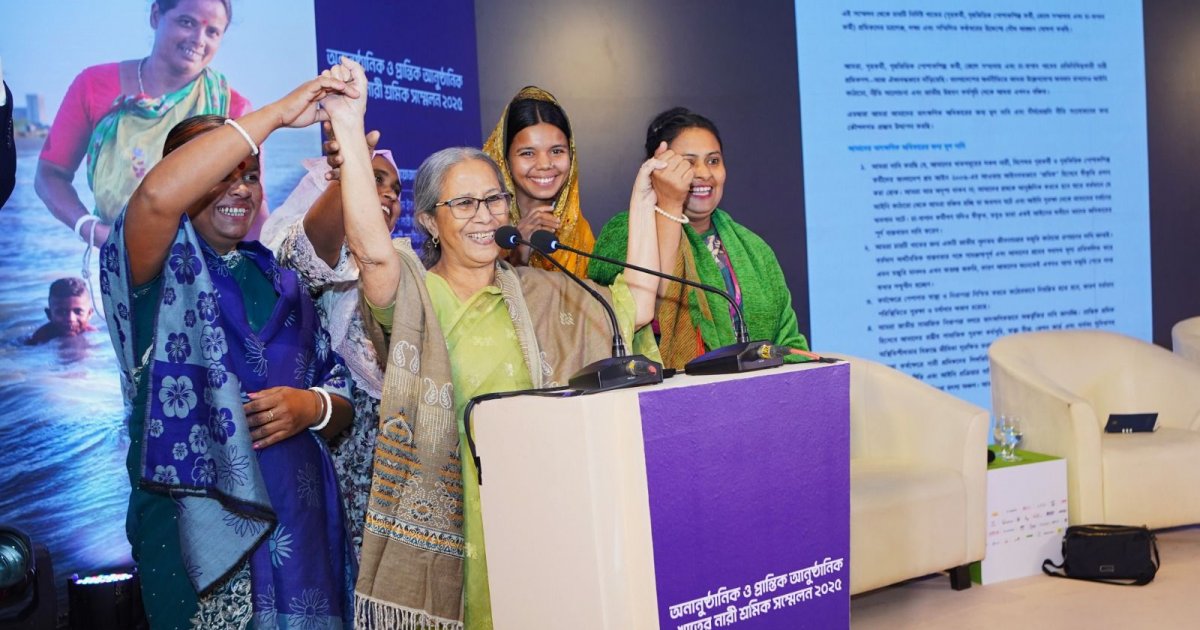
Women workers from tea gardens, fisheries, domestic work, and home-based garment production gathered in the capital for the Informal & Marginalized Formal Women Workers Convention 2025, where they announced the formation of a National Non-Unionized Women Workers Forum.
The forum aims to bring informal women workers under one platform to strengthen representation in national policy discussions.
The convention took place in the capital under Oxfam in Bangladesh’s EU co-funded Empowering Women Through Civil Society Actors in Bangladesh (EWCSA) project.
The initiative has worked with 33 civil society partners and reached 45,000 women workers across multiple sectors, focusing on rights awareness, collective organizing, and access to institutional processes.
Former head of the Labour Reform Commission Syed Sultan Uddin Ahmed underscored the value of unity across sectors.
“From the tea gardens to the fisheries, our collective strength is our only path to recognition and justice. Women workers must be present where decisions are made, and the nation must acknowledge their labour as the backbone of our economy.”
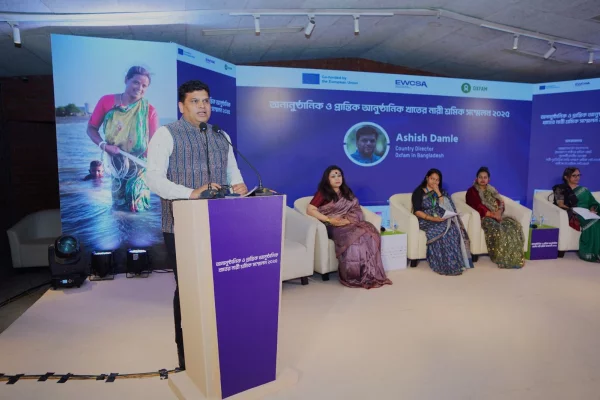
Ashish Damle, country director of Oxfam in Bangladesh, said the convention marks a step in strengthening women’s collective voice.
“This convention shows what becomes possible when women organize, speak, and lead. Bangladesh’s development journey must recognize and protect the rights, dignity, and leadership of informal women workers.”
Representing the European Union Delegation, Laila Jesmin Banu, program manager for governance and human rights, said: “The EWCSA initiative is powerful because it transforms both systems and lives. Its impact is visible in the leadership, confidence, and collective organizing of women workers. We hope this momentum continues to shape inclusive, evidence-based policy reforms in Bangladesh.”
She also said that the learnings and challenges experienced at the EWCSA project will be evaluated and addressed in future CSA-related projects.
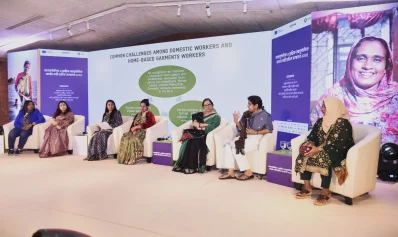
In a panel discussion, Dr Snigdha Rezwana, professor at Jahangirnagar University, addressed gaps in current policy and research frameworks.
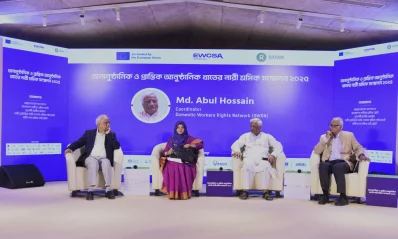
She noted the need to revise social and institutional norms that influence labour identities and said Bangladesh requires a centralized database of informal women workers to support planning, service delivery, and legal reform.
The event concluded with the formal introduction of the National Non-Unionized Women Workers Forum by leaders from the four sectoral networks.
The forum will work to advance recognition of informal workers in national labour frameworks, promote access to social protection, and support continued advocacy with government agencies and civil society actors.
Razekuzzaman Ratan, former member of Labour Reform Commission, Md Abul Hossain, coordinator of the Domestic Workers Rights Network (DWRN); EWCSA partners; worker leaders; and workers also joined the convention.
Must formally recognize women workers
The core idea of the EWCSA project is to support grassroots Civil Society Organizations (CSOs) and Women’s Rights Organizations (WROs), build their capacity, and strengthen their ability to engage with state and non-state actors (employers, government agencies) to influence policies, practices, and social norms.
It was implemented in 20 districts across 8 divisions of the country, under 6 city corporations, and spanning 32 upazilas.
Mahmuda Sultana, program director at Oxfam in Bangladesh, opened the convention with a presentation.
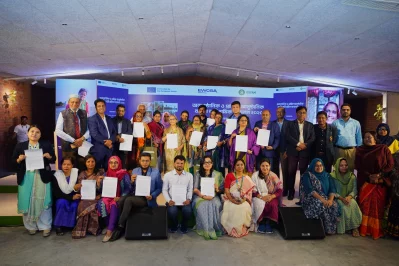
She outlined the EWCSA project’s achievements on how it was able to empower domestic workers, informal readymade garment (RMG) workers, tea garden workers, and women fisherfolk in various aspects, such as raising awareness about their working rights, driving collective bargaining for equal pay, and more.
Case studies were also presented on how informal workers were transformed as sectoral women network leaders. The workers were also trained to recognize and support each other.
Md Abul Hossain, coordinator at Domestic Workers Rights Network, also said that there should be no discrimination between formal and informal workers.
He also supported the formation of a women workers’ federation, which could elevate their collective bargaining at a national level.
Razekuzzaman Ratan, former member of the Labour Reform Commission, said that women workers, especially informal workers, had worked very hard to break barriers and come this far.
Syed Sultan Uddin Ahmed, former head of the Labour Reform Commission, shared an anecdote where women fisherfolk in Khulna, once they are out in the rivers, lack access to drinking water. This forces them to make a long walk, often waist-deep in mud, without the ability to change clothes.
The social stigma from other people in society looking down upon their contribution does not affect them, and their resilience forms the women workers’ success stories, he also said.
Taslima Akter, president of the Trade Union Federation, said that out of 75-80 million workers in the country, only 15 million were formal workers, while the others were informal and out of the government’s support system.
But recognizing domestic workers as informal workers has been a step in the right direction, she added.
AKM Ashraf Uddin, executive director of the Bangladesh Labour Foundation, said that support for informal workers needed to increase; otherwise, it would be difficult for Bangladesh on its path to LDC graduation.
Adviser Farida Akter emphasized her ministry’s efforts to provide workplace identities for all informal workers so that they could avail government services such as NID cards and other facilities.
“While other state agencies such as the Bangladesh Bureau of Statistics (BBS) reveal numbers, they do not highlight the plight of our informal workers. Even economists fail to showcase their contribution to the economy. Not recognizing them ahead of International Human Rights Day is a major human rights violation.”
The adviser also said that their workplace hazards need to be looked into, as well as their healthcare benefits and other grievances at work, such as harassment of all sorts.
As women left the venue, forum leaders stated that they aim to initiate regular dialogue with policymakers and expand representation across all districts.
The convention closed with a collective call for legal recognition, workplace protection, and inclusion of women workers in national policy processes, marking a step toward stronger representation in Bangladesh’s labour landscape.
Rabiul Hasan also contributed to this report.