

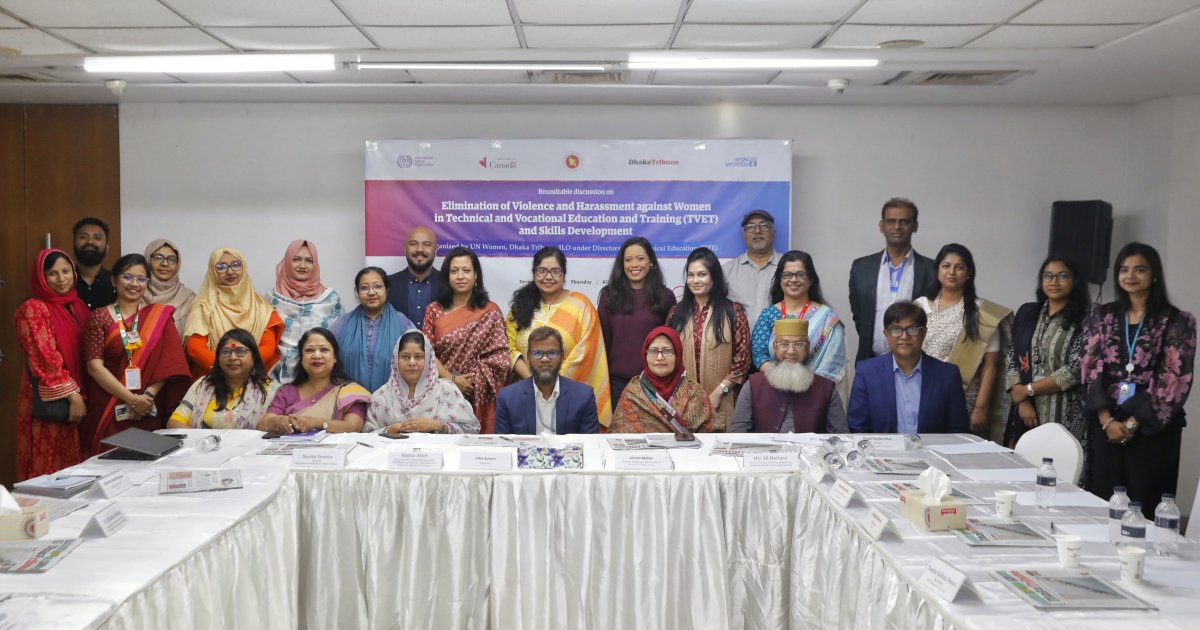
Systemic violence, harassment, and institutional neglect continue to shut women out of Bangladesh’s technical and vocational training pipeline, experts warned at a national roundtable in Dhaka on Thursday, saying that without safe learning environments the country’s skills agenda cannot succeed.
The roundtable, titled “Elimination of Violence and Harassment Against Women in Technical and Vocational Education and Training (TVET) and Skills Development,” convened policymakers, gender specialists, education leaders and civil society representatives to address one of the most persistent barriers to women’s meaningful participation in Bangladesh’s skills ecosystem.
The event was jointly organized by UN Women, the International Labour Organization (ILO) and Dhaka Tribune, in collaboration with the Directorate of Technical Education (DTE).
Moderating the high-level discussion, Esha Aurora, business editor at New Age, underscored the media’s crucial role in exposing gender-based violence within learning institutions and workplaces.
She said that despite rising female enrolment in TVET, harassment, stereotyping, and institutional silence continue to constrain women’s career pathways.
Many incidents, she added, remain invisible due to stigma, fear of retaliation, and weak complaint mechanisms: “Without transparency and accountability, progress will remain uneven.”
Delivering the keynote presentation, Md Siddikur Rahman, program analyst and unit manager for women’s economic empowerment at UN Women, outlined the systemic challenges restricting women’s participation in the skills workforce.
He said Bangladesh’s economic ambitions, to graduate from LDC status by 2026 and reach developed-country status by 2041, depend on closing gender gaps, yet women remain overwhelmingly in vulnerable jobs, own only a fraction of formal enterprises, and are concentrated in low-wage sectors.
Female enrolment in TVET must rise to at least 30% by 2030 to meet national targets, he said, but persistent safety issues in agriculture, garments, logistics and other trades continue to deter women.
Rahman highlighted pervasive underreporting of sexual harassment in training institutes and apprenticeships, coupled with unsafe hostels, inadequate campus security and limited institutional capacity to support survivors.
Gender stereotypes still discourage women from entering mechanical, electrical, ICT and other non-traditional trades, while weak industry partnerships expose trainees to unsafe work placements.
“Women drop out not because they lack talent but because they lack safety,” he said, calling for a gender-responsive TVET system to build an equitable, future-ready workforce.
He presented a multi-pillar action plan focused on institutional strengthening, robust reporting systems, gender-sensitive policies and deeper collaboration with the private sector.
Representatives from DTE, NSDA, UCEP, civil society organizations and NGOs echoed similar concerns.
Rowshon Ara, project director at Naripokkho, described efforts to ensure safe training spaces through community engagement and monitoring to prevent dropout driven by violence, stigma or early marriage.
ProGRESS Project Coordinator Shafia Sami discussed work to strengthen institutional policies, improve gender-responsive curricula and create safer, more inclusive environments for girls pursuing non-traditional trades.
Tania Sharmin, director of food security and livelihoods/child poverty, said her organization integrates skills development with broader economic empowerment support, ensuring vulnerable young women receive safe training, mentorship and market linkages.
Arunava Sah, lead of World Vision’s livelihood program, emphasized building employability skills through community-based training, industry partnerships and continuous safety monitoring so women can transition into employment without harassment.
Nazma Yesmin, director of the Bangladesh Institute of LabourStudies (BILS), highlighted efforts to promote women’s labour rights through unions, training providers and employers, focusing on gender-sensitive practices and grievance mechanisms aligned with international labourstandards.
Dhaka Ahsania Mission’s Coordinator Dr Rahena said their programs emphasize safe learning environments, psychosocial support and community outreach to ensure marginalized women can participate without intimidation or discrimination.
UCEP’s Shajadi Sultana noted that bias and stigma continue to push girls out of training programs: “We cannot expect girls to thrive when the system does not protect them.”
ILO representatives reiterated the urgent need for safe apprenticeships, while DTE officials acknowledged gaps in enforcing existing anti-harassment policies.
Closing the session, Humaira Binte Faruque, program support officer at UN Women, stressed that eliminating violence in skills development requires collective action.
The roundtable concluded with a joint pledge by UN Women, ILO, DTE and Dhaka Tribune to strengthen institutional systems, enforce accountability and work toward a Bangladesh where every woman can learn, train and work free from violence and harassment.