
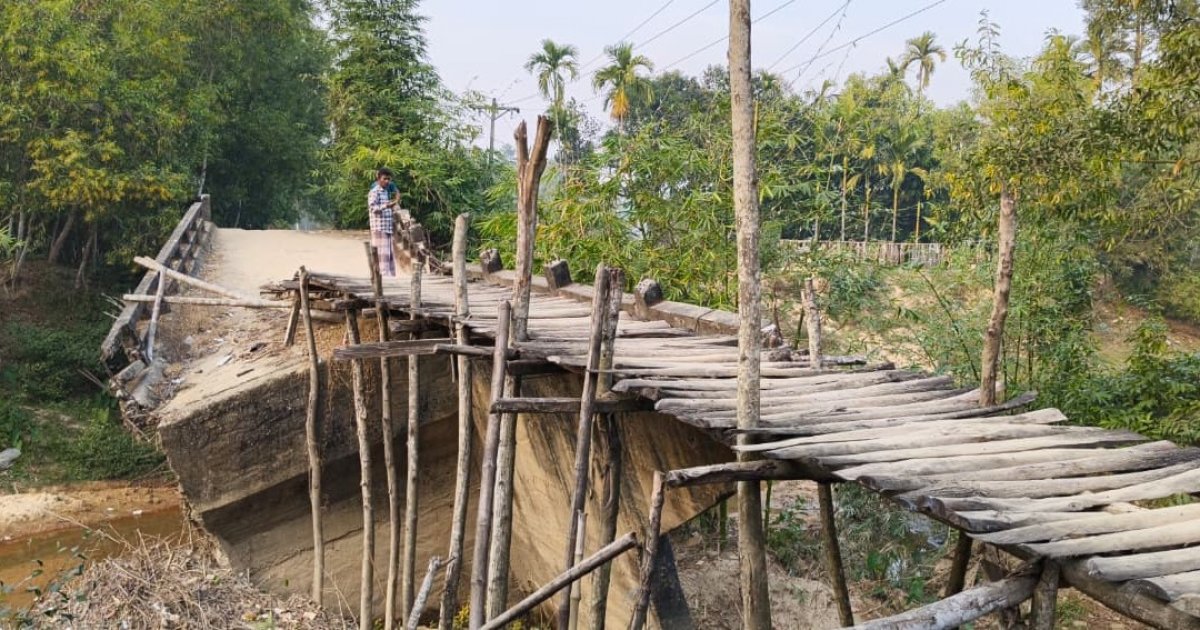
People’s suffering has mounted after the devastating flood washed away the Gorzonia North Barobil–South Baishari Bridge in Naikhongchhari upazila of Bandarban 14 years ago. Now the residents of Baishari union in Bandarban and Gorzonia union in Ramu upazila of Cox’s Bazar use this broken bridge, risking their lives. But steps have not been taken yet to rebuild the bridge, forcing nearly 45,000 people to cross the wooden bridge every day.
The original concrete bridge collapsed during devastating floods in 2012. In its place, locals built a makeshift wooden bridge that has long outlived its intended lifespan. Residents describe the structure as unstable, shaking violently underfoot, and capable of collapsing at any moment—yet it remains their only route to schools, markets, agricultural fields, and healthcare.
“We do not understand how a bridge can remain in such a state for 14 years,” said Md. Jamir, a resident of Baishari Union’s Ward 7. “It feels like no one cares about people’s lives.”
The dangers are not hypothetical. In 2023, a school student fell from the bridge and was seriously injured. Every day, over a hundred children cross the fragile structure on their way to school, parents say, often clutching their books while balancing on unstable bamboo poles.
Local farmer Md. Yusuf says repeated appeals to the authorities have yielded nothing. “We have spoken about the bridge many times. But no steps have been taken yet. Without a proper bridge, we struggle to transport our crops to the market,” he said.
Residents claim both the Local Government Engineering Department (LGED) and the Chittagong Hill Tracts Development Board have avoided taking responsibility. The bridge’s location—on the border of Bandarban and Cox’s Bazar districts—appears to have further complicated matters. Locals believe administrative ambiguity has left the structure in bureaucratic limbo.
“When the bridge collapses, everything stops. We can’t bring vegetables and crops from Gorzonia to Baishari market,” said Md. Siraj of Gorzonia Union’s Ward 1.
Local representatives share the frustration. “Thousands of people suffer every day. Students are at the highest risk. I urge the authorities to take immediate steps,” said Md. Nurul Kabir, UP member of Baishari Union’s Ward 7.
Similarly, Md. Firoz Ahmed, UP member of Gorzonia Union’s Ward 1, noted that officials frequently visit and inspect the site, but no progress has been made. “Journalists have written about this repeatedly, yet nothing changes,” he said.
Baishari Union Parishad Chairman Md. Alam confirmed submitting a formal request to the Bandarban District Council for reconstruction, but said no visible progress has been made yet.
Naikhongchhari Upazila Engineer Md. Nazrul Islam said uncertainty remains regarding which upazila is officially responsible for the bridge. “If it falls under Naikhongchhari, we will verify and take necessary steps,” he said.
Residents said the solution is straightforward: since the bridge connects two unions across district lines, both upazila administrations must work together. Until they do, the long-neglected bridge will continue to endanger lives and hinder the daily movement of thousands of people.
Locals said what should be a lifeline between the people of two unions has instead become a risk—a bridge in name only, and a death trap in reality.