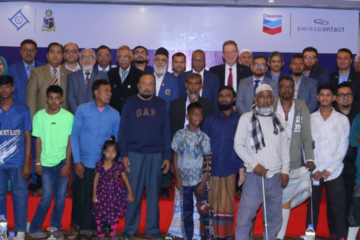


Michael Miller, ambassador and head of delegation of the European Union to Bangladesh, on Saturday visited the outdoor photo exhibition “From Shadows to Leadership” at Justice Shahabuddin Ahmed Park, highlighting the critical role of women in Bangladesh’s informal economy and the power of collective action in advancing rights, dignity, and leadership.
Organized by Oxfam in Bangladesh, the three-day exhibition brings women’s voices into public spaces through photographs and stories that document journeys from invisibility to leadership. During the visit, Ambassador Miller received a guided tour alongside representatives from development partners, NGOs, civil society organizations, and other stakeholders.
Reflecting on the exhibition, Ambassador Miller said: “The exhibition demonstrates how storytelling and civic engagement can strengthen democratic spaces. It brings the stories of women, determination, and change into a public, accessible space.”
He emphasized that the exhibition went beyond visual documentation. “What we see here are not just photographs, but visible proof that when advocacy, skills training, leadership development, and strong civil society partnerships come together, women working in an informal and invisible economy can change their realities.”
From Shadows to Leadership features ten stories of women from across Bangladesh’s informal economy, including domestic workers, tea garden workers, home-based garment workers, and women from the floating Manta fishing community. Captured across rivers, tea estates, coastal belts, and urban settlements, the photographs show how women organize, negotiate wages, secure identification documents, form collectives, and engage with policy processes to claim recognition and rights.
For Panna, a domestic worker from Narayanganj whose story is featured, the change has been transformative. “Before, we did not even know what our entitlements were,” she said. “Now we understand our rights—our wages, our leave, and our dignity—and we can speak directly with employers and communities.”
Ashish Damle, country director of Oxfam in Bangladesh, said, “Every smile we see here is not just a moment of joy—it is a smile of empowerment, confidence, and hope, reflecting a transformative change that goes beyond individuals and begins to reshape society itself.”
He stressed the need for long-term commitment. “This partnership is only the beginning. Real empowerment requires time, sustained support, and collective strength so that, in the years ahead, these women emerge as leaders in their own right,” Damle added.
Sumaiya Islam, executive director of BNSK, said, “This work is exceptional because it is built by workers identifying their challenges, supporting one another, and proving that collective effort can create real and meaningful change.”
The event was also attended by Laila Jesmin Banu, program manager, governance and human rights, European Union to Bangladesh; Md Sariful Islam, head of influencing, communications, advocacy, and media, Oxfam in Bangladesh; and Shahajadi Begum, program coordinator, Oxfam in Bangladesh.
The exhibition is part of the Empowering Women through Civil Society Actors (EWCSA) project, funded by the European Union and implemented by Oxfam Bangladesh with 33 civil society organizations across 19 districts. The initiative has directly supported more than 45,000 women working in some of the most insecure segments of the labor market.