

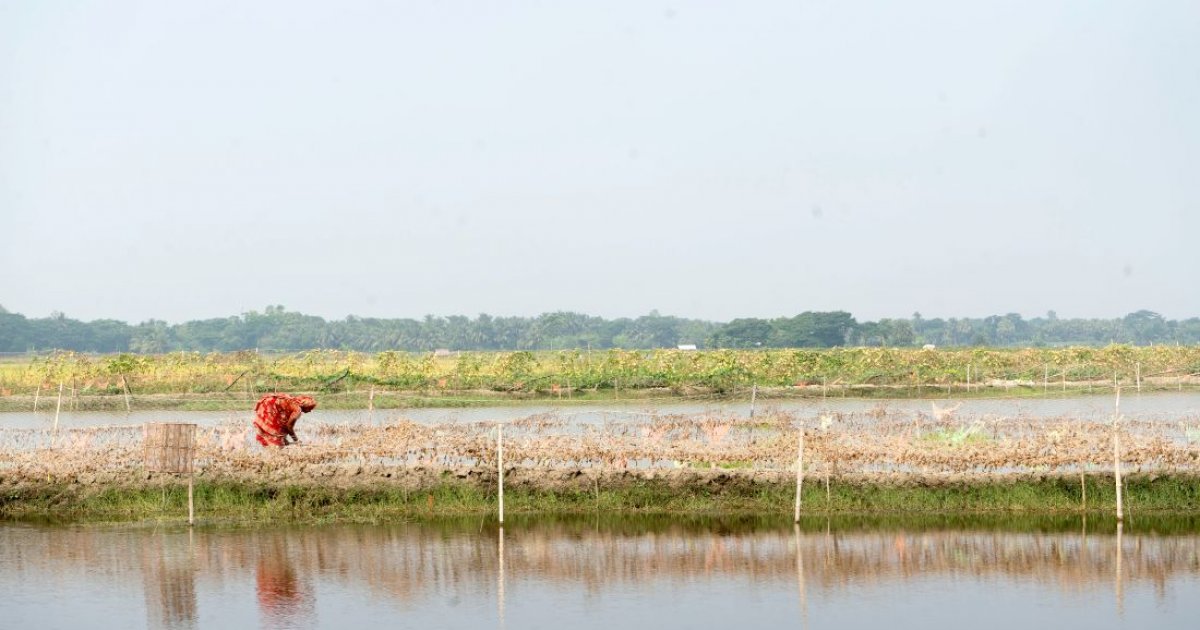
Bangladesh, a pioneer of climate change adaptation and climate resilience, faces an existential threat to its food security from intensified climate impacts. While the nation has made progress in improving food production and security, rice, the staple food for millions of citizens, provides 48% of rural employment and accounts for 70% of daily caloric intake.
The low-lying terrain and geographic location of Bangladesh make it highly susceptible to soil and water salinization. On the coast, the saltwater intrusions are now devastating water resources, agriculture, and human health. The rising sea levels and increasingly frequent cyclones are pushing saline water inland, contaminating rivers and waterbeds. Varying degrees of salinity intrusion affect 1.02 million hectares (about 70%) of arable land, threatening rice production crop highly sensitive to salt (Ashrafuzzaman et al., 2022).
The effects cascade through society: farmers face devastating livelihood loss, leading to forced migration to urban centers. This creates a ripple effect of social disruption, strains urban resources, and exacerbates health issues due to a lack of fresh water and nutritious food. It is precisely this complex, localized cascade of effects that renders top-down solutions inadequate and underscores the necessity of a bottom-down: Locally Led Adaptation (LLA) approach.
Why is the LLA Approach Necessary?
For decades, top-down interventions like large infrastructure projects had failed because they lacked community input and neglected local context-how a farmer’s choice of crops affects their income, nutrition, and their decision to migrate. Therefore, LLA counters this by empowering communities to diagnose their own specific vulnerabilities and design integrated solutions. For instance, a community might collectively decide to combine the cultivation of saline-tolerant rice varieties with rainwater harvesting for irrigation and homestead aquaculture, thereby simultaneously addressing food production, income diversity, and nutrition.
LLA is distinct from and goes far beyond traditional consultative, participatory, or inclusive (Yee et al., 2025). LLA operates on the principle that those on the frontlines of climate change are best positioned to design and implement solutions. They possess local knowledge of the land, water flow patterns, and social structures. An LLA approach empowers communities to become architects of their own resilience. Instead of receiving prescribed solutions, farmers are provided with resources, training, and decision-making power. They choose which saline-tolerant rice varieties (like BRRI dhan67) to test in their specific soil, design their own rainwater harvesting systems, and harvest suitable crops like sunflower or watermelon for high salinity (Rahman et al., 2023; Parsons, R., 2024).
Therefore, the LLA approach is widely adopted by communities as it leads to more appropriate, adopted, and sustainable solutions. When a community invests its own knowledge and labor into an initiative, it ensures the intervention’s long-term sustainability and success. In the fight to climate-proof our rice bowl, investing in local leadership is the most effective strategy we have.
Alignment with LLA Principles
Employing the eight LLA principles in adaptation planning and delivery contributes to greater equity in the distribution of benefits. These principles can help shift the agriculture sector from isolated technical fixes to systemic, inclusive adaptation. Agricultural adaptation works best when farmers and local groups (like WMGs) make decisions on crop choices, land management, and farming practices, ensuring solutions reflect real needs. This also means ensuring women and indigenous farmers have equal access to seeds, technology, land, water, and decision-making spaces. Agricultural communities already have deep traditional knowledge (e.g., mixed cropping, seasonal calendars), which should be integrated with scientific innovations. Regarding finances, farmers need long-term, reliable financing for soil restoration, climate-smart irrigation, and crop diversification. Farmers should have clear information on subsidies, crop insurance, water allocations, and extension services, and local institutions need to be held accountable for delivering support. Adaptation in agriculture requires collaboration between farmers, local governments, researchers, the private sector (e.g., suppliers, market systems), and civil society to co-create proper market linkages and innovative climate solutions.
Where We Fall Short
The LLA approach fails in agriculture when it becomes procedural, simply used to tick boxes but not actually shift power, resources, and knowledge to farmers. Farmers are “consulted” but not genuinely involved in decision-making, and local voices are collected for reports but ignored in final project designs. Local leadership roles, such as those in WMGs, are dominated by wealthier or politically connected farmers, leaving marginalized groups excluded from real benefits. Women’s involvement is highlighted in reports, but in reality, they still lack land rights, decision-making power, or access to finance. Alongside these issues, short-term project funding often fails to sustain systemic changes in agriculture. Farmers adopt changes during a project but drop them in time once the financial support is depleted. Furthermore, weak stakeholder engagement, such as insufficient support from extension services, also limits the farmers’ ability to sustain and scale innovations.
PARIBARTAN
The PARIBARTAN (Participatory Action Research on locally led Iterative Learning and Inclusive Business Models for Adaptive Transformation in Bangladesh Polders) Project aims to lead by example by focusing solely on farmers’ needs and increasing their stakeholder engagements, hence building their capacity to form long-term, sustainable solutions. The project is led by the International Maize and Wheat Improvement Centre (CIMMYT), in partnership with the International Centre for Climate Change and Development (ICCCAD) and Shushilan NGO, with support from the Australian Centre for International Agricultural Research (ACIAR).
Yee, M., Piggott-McKellar, A., McMichael, C., & McNamara, K. E. (2025). Framing locally led adaptation in a planned relocation in Fiji. Geoforum, 159, 104196. https://doi.org/10.1016/j.geoforum.2024.104196
Rahman, M. F., Falzon, D., Robinson, S., Kuhl, L., Westoby, R., Omukuti, J., Schipper, E. L. F., McNamara, K. E., Resurrección, B. P., Mfitumukiza, D., & Nadiruzzaman, M. (2023). Locally led adaptation: Promise, pitfalls, and possibilities. AMBIO, 52(10), 1543–1557. https://doi.org/10.1007/s13280-023-01884-7
Parsons. R., (2024). Bangladesh’s Shift Toward Salt-Tolerant Agriculture Offers Lessons in Climate Resilience. Earth Island Journal. https://pulitzercenter.org/stories/bangladeshs-shift-toward-salt-tolerant-agriculture-offers-lessons-climate-resilience