
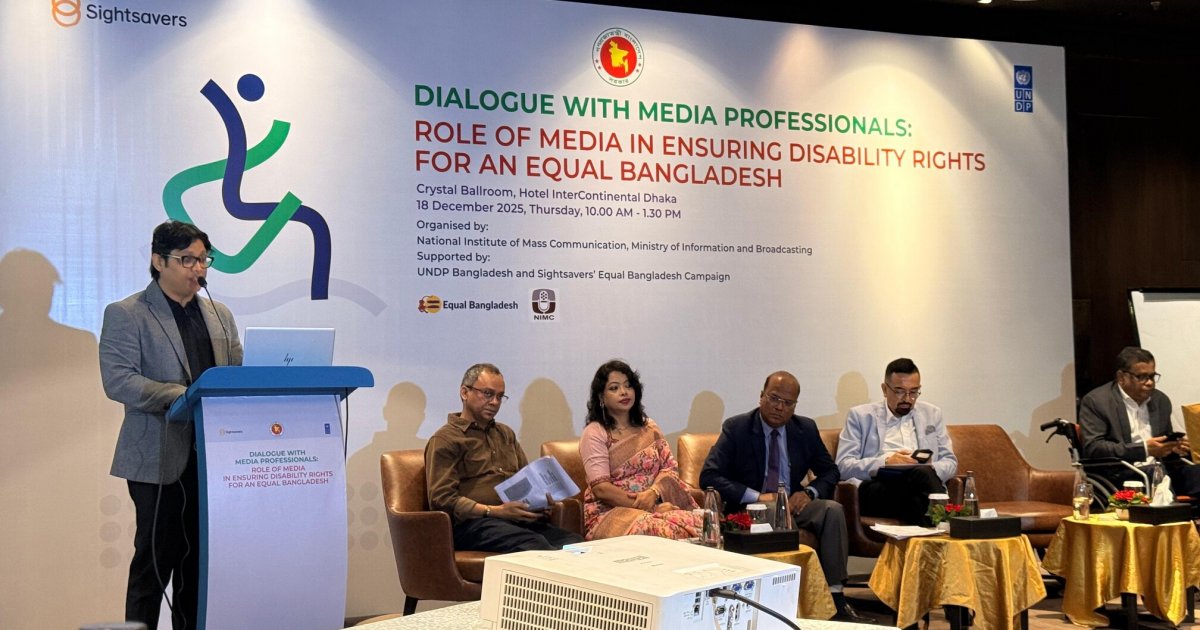
Speakers at a dialogue in Dhaka on Thursday urged media professionals to take a stronger and more responsible role in promoting disability rights and inclusive representation to help build an “Equal Bangladesh.”
The workshop, titled “Dialogue with Media Professionals: Role of Media in Ensuring Disability Rights for an ‘Equal Bangladesh’,” was organized by the National Institute of Mass Communication (NIMC) under the Ministry of Information and Broadcasting, in collaboration with UNDP Bangladesh and Sightsavers’ Equal Bangladesh campaign. It took place at Hotel InterContinental, Dhaka.
Amrita Rejina Rozario, country director of Sightsavers Bangladesh, delivering the welcome remarks, said: “Ensuring proper implementation of the law is our core mission, and the role of the Ministry of Information and the media is extremely important in this regard.”
She added that the Ministry could produce and broadcast disability-focused documentaries, while the media could contribute through consistent reporting and positive representation. “It is possible to build capacity by directly engaging persons with disabilities within the media,” she said.
Speaking on behalf of UNDP, Andres Del Castillo Sanchez, chief technical advisor of UNDP’s Electoral Support BALLOT/DRIP Projects, emphasized the political dimension of disability inclusion. “Disability issues and candidates with disabilities must be included in political party manifestos,” he said, adding: “The media has a huge role to play in highlighting how large a segment of the population persons with disabilities represent in the country.”
A joint keynote was delivered by Salma Mahbub of B-SCAN and Ayon Debnath of Sightsavers, followed by a panel discussion involving Equal Bangladesh campaign partners and senior journalists, focusing on inclusive reporting and ethical media practices.
Dr Md Maruf Nawaz, director (Training Program) of NIMC, said: “The National Institute of Mass Communication is working on media capacity development through various workshops and documentaries involving grassroots journalists.” He added, “The media can play a strong role in ensuring what kind of commitments each political party makes for persons with disabilities.”
Chairing the session, Muhammad Hiruzzaman ndc, director general (additional secretary) of NIMC, highlighted the transformative power of media. “The media plays a unique role in raising public awareness, building sensitivity, and bringing positive change to prevailing social perceptions,” he said. He also stressed that public services, funded by taxpayers including persons with disabilities, must ensure equal opportunities for all. “We expect commitments from today’s dialogue so that long-standing mindsets can be changed,” he added.
Journalist Alamgir Swapon stressed the need for specialized reporting, proposing media-related capacity development workshops for persons with disabilities, regular discussions with media professionals, and ensuring digital accessibility.
Sharing newsroom experience, Anando Mostofa, news editor of Dhaka Tribune, said: “Through a joint initiative of Dhaka Tribune and Sightsavers, we have been able to establish our newsroom as an inclusive newsroom.” He added that two persons with disabilities have been recruited and the newsroom adapted to their needs. Referring to a recent 15-day movement by job-seeking graduates with disabilities, he noted, “We prioritized coverage of the movement, but it did not receive the level of attention it deserved in many other media outlets.”
The workshop concluded with a vote of thanks from Asim Dio of UNDP, reaffirming the commitment of all partners to continue working with the media to advance disability inclusion and equal rights in Bangladesh.