
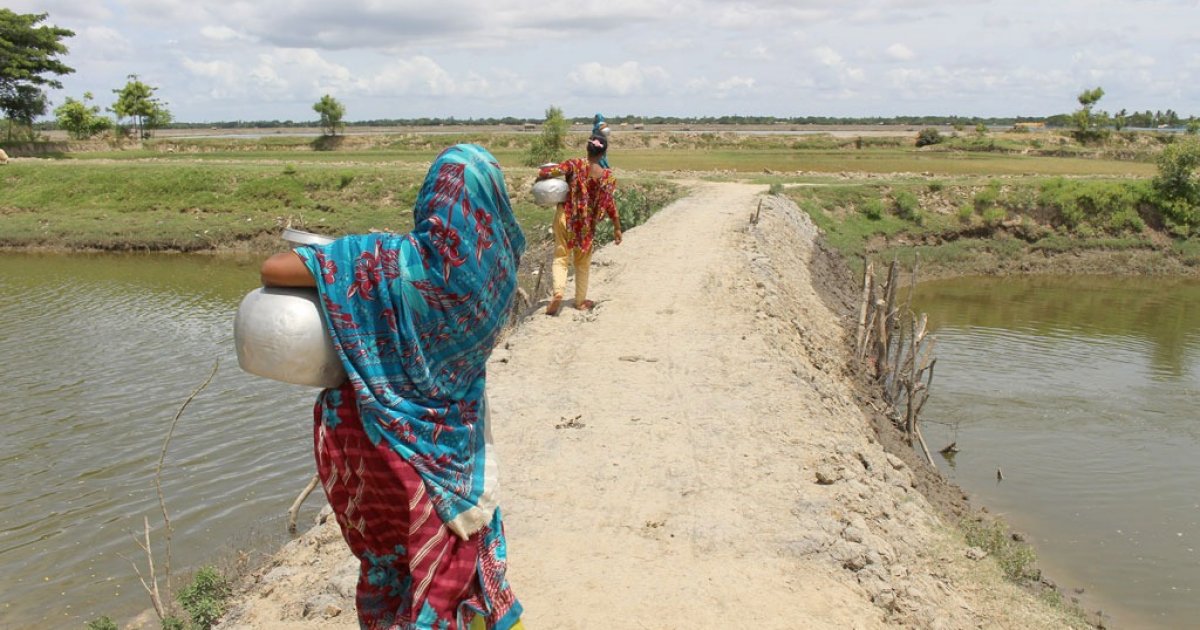
Food security is under threat in the Barind region as water scarcity continues to worsen in Rajshahi, Naogaon, and Chapainawabganj, turning vast areas increasingly arid. Declining rainfall, rising temperatures, and a sharp fall in groundwater levels have created a critical situation, forcing many farmers and fishermen to switch their profession. Experts blame natural factors and man-made actions for the water crisis.
A research paper published in the global food security journal warns that if climate change continues at the current pace, weaknesses in water management could slash food security in northern Bangladesh by more than 50%.
A study conducted by the University of Glasgow, UK estimates that a temperature rise of 3.5–5.7 degrees Celsius, coupled with reduced river flows, could cut food security by up to 55%.
Data shows that rainfall in western and northwestern Bangladesh had been steadily declining between 1948 and 2015. In Rajshahi alone, average annual rainfall is decreasing by about 0.5mm. Besides, water shortages and heatwaves now pose a serious risk to Boro crop. In recent years, temperatures in March and April have exceeded 35°C.
In response to the crisis, the government has imposed restrictions on groundwater use in 4,911 mouzas across Rajshahi, Naogaon and Chapainawabganj, allowing extraction only for drinking water. The use of deep tube wells for irrigation or industry has been banned, and a gazette notification to this effect was issued on November 6.
The Barind Multipurpose Development Authority (BMDA), which supplies irrigation water through deep tube wells, operates around 18,000 deep tube wells in Rajshahi and Rangpur divisions.
Vast areas in 215 unions of 25 upazilas have been declared water-stressed for the next 10 years. Of these, 1,469 mouzas are classified as extremely high-risk, 884 as high-risk, and 1,240 as moderately at risk. Large parts of Godagari and Tanore in Rajshahi, Chapainawabganj Sadar, Niamatpur, Patnitala, Porsha and Sapahar have come under the warning.
Studies show that the average groundwater level in the Barind region was about 26 feet below the surface during the period between 1985 and 1990. Due to relentless extraction, it dropped to 50 feet in 2010, 60 feet in 2021, and in many areas now exceeds 113 feet. Continuous irrigation and industrial use are pushing the Barind tract towards desertification. As a result, the government has banned the installation of new tube wells for any purpose other than drinking water and prohibited groundwater-dependent industries.
River researcher Mahbub Siddiqui stressed that any plan for water and agriculture must involve local elders and experienced farmers.
Rajshahi University anthropology teacher Dr Abhijit highlighted that water is deeply intertwined with life, culture, and politics in the Barind region. He said reducing water inequality requires participatory planning with local communities.
Geology and mining professor Dr Chowdhury Sarwar Jahan, who has been doing research on water resources in the Barind region for a long time, said that the country’s northern region also faces water crisis. “It could threaten the country’s food security.”
Development worker Jahangir Alam Khan said re-excavation of wetlands and canals could irrigate thousands of hectares using surface water, easing pressure on groundwater. Expanding rainwater harvesting technologies and training local communities could also significantly improve livelihoods.
BMDA Executive Director Tarikul Alam said water is being lifted from the Mahananda River using a double-lifting method to reduce dependence on groundwater. When asked about uncontrolled use of deep tube-wells, he said he had no such information.