
Renowned educationist Emeritus Professor Serajul Islam Choudhury on Tuesday said Maulana Abdul Hamid Khan Bhashani never engaged in politics for power, nor did he aspire to positions such as minister or ambassador.
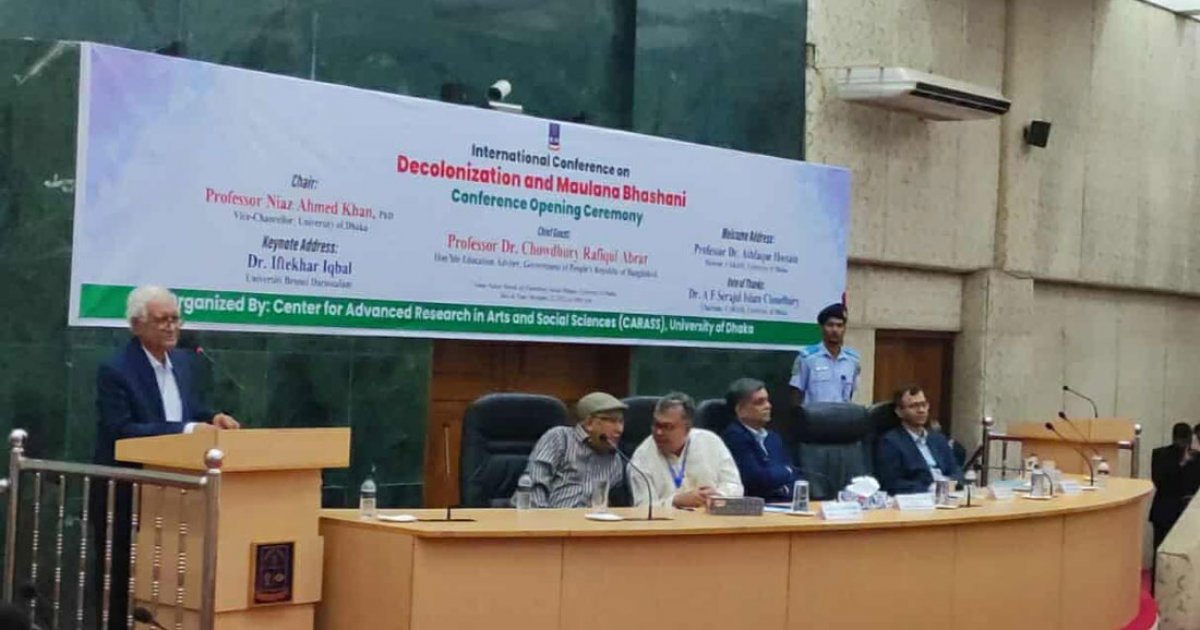
“Bhashani always stood with working people and remained committed throughout his life to their struggle for liberation,” he said while delivering the concluding remarks at the opening session of an international conference titled “Decolonization and Maulana Bhashani” at the Nawab Nawab Ali Chowdhury Senate Building of Dhaka University (DU).
The two-day conference is being organised by the university’s Centre for Advanced Research in Arts and Social Sciences (CARASS).
Professor Serajul Islam described Maulana Bhashani as an anti-imperialist leader, saying the idea of decolonization was central to his political convictions from the outset.
“Although many prominent politicians emerged from the subcontinent, Bhashani did not receive comparable recognition. Yet he was exceptional. We have not seen another leader in this region who practiced politics so consistently in favour of working people,” he said.
Noting that Bhashani believed in socialism rather than private property, he said the Maulana initially joined the Congress but left when capitalist dominance took hold. He later joined the Muslim League in the hope that it would represent farmers and the poor.
“However, Bhashani’s vision of Pakistan was fundamentally different from Quaid-e-Azam’s capitalist state. He imagined a democratic, decentralised country where multiple nationalities would enjoy equal rights,” he said, adding that this vision was reflected in Bhashani’s 21-point, 14-point and 11-point programmes, which focused on issues such as rivers, water and floods.
Professor Serajul Islam said Bhashani viewed Pakistan as a “prison of nationalities” and spoke of liberation not only for Bengalis but also for Punjabis, Sindhis, Baluchis and Pathans.
“He cannot be confined to a single label. He was a social revolutionary who believed in people’s power and carried the dream of liberation throughout his life,” he added.
Addressing the event as chief guest, Education Adviser Professor Dr Chowdhury Rafiqul Abrar said Maulana Bhashani was not merely a political leader but a moral voice and conscience of his time.
“He believed religion could provide moral strength, but governance and civic life must be grounded in equality, justice and human dignity. This perspective sets him apart and remains relevant for Bangladesh today,” he said.
He added that Bhashani prioritised people’s politics over power politics and understood that political independence has meaning only when it ensures economic security, cultural dignity and self-respect.
Describing Bhashani as a symbol of intellectual freedom, the adviser said: “He never compromised on issues of power. This reminds us that educational institutions must allow debate, dissent and truth-telling.”
In the keynote presentation, Associate Professor Dr Iftekhar Iqbal of the University of Brunei Darussalam discussed various dimensions of Bhashani’s political life, saying much remains to be explored.
“The more we listen to Bhashani, the better it will be for us,” he said, stressing the need to compile his writings and establish a dedicated research centre.
The opening session also featured speeches by Professor Ahmed Kamal, while CARASS Director Professor Dr Ashfaque Hossain delivered the welcome address, describing Bhashani as one of the most experienced leaders not only in Asia but globally.
Following the opening ceremony, a photography exhibition by Nasir Ali Mamun was held, after which paper presentations on Maulana Bhashani began.