
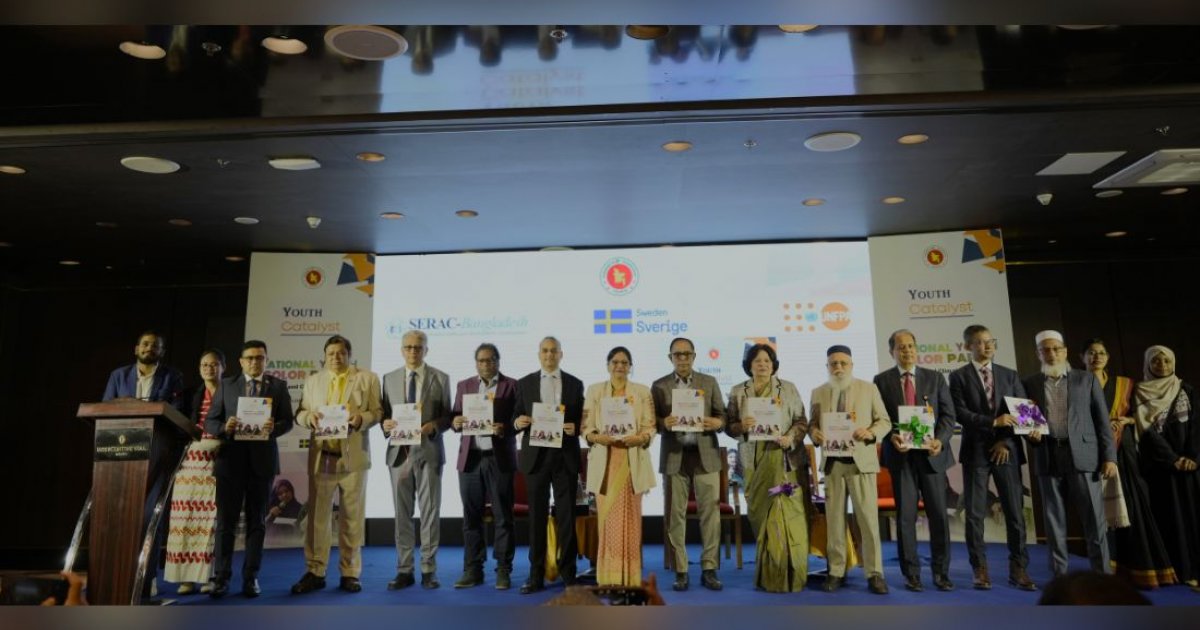
A National Youth Colour Paper outlining 32 key demands and policy reform recommendations on sexual and reproductive health and rights (SRHR) and climate resilience was formally handed over to the Ministry of Health and Family Welfare on Tuesday.
The dissemination meeting, organized by SERAC-Bangladesh, was held as part of the Youth Catalyst Initiative of UNFPA Bangladesh, supported by the Swedish International Development Cooperation Agency (Sida).
The program began with the national anthem, followed by the official handover of the document titled “Sexual and Reproductive Health and Climate Resilience” to the Ministry of Health.
The event was inaugurated by Md Saidur Rahman, secretary of the Health Services Division and the Medical Education and Family Welfare Division of the Ministry of Health and Family Welfare.
In his welcome address, SM Shaikat, executive director of SERAC-Bangladesh, presented an overview of the National Youth Colour Paper, noting that it was developed through extensive youth-led consultations across the country.
He said the paper includes 32 demands and policy recommendations aimed at integrating SRHR concerns with climate adaptation and disaster resilience strategies, reflecting the lived experiences and priorities of young people.
Dr Vibhavendra Singh Raghuvanshi, chief of health at UNFPA Bangladesh, underscored the critical role of youth in shaping the country’s future.
He said the recommendations emerged from seven thematic areas, focusing on issues such as sexual and reproductive health and rights, child marriage, gender-based violence and climate change.
“Young people are not merely beneficiaries of development initiatives — they are active agents of change,” he said, stressing that youth voices must be meaningfully reflected in both policy formulation and implementation.
Dr Zahirul Islam, health adviser at the Embassy of Sweden, observed that effective intergenerational transition is becoming increasingly challenging, particularly as many young people migrate abroad.
He praised the Youth Colour Paper as a well-developed, youth-centred document that authentically reflects the voices, needs and aspirations of young people. He also highlighted the strong outcomes of SERAC-Bangladesh’s Youth Catalyst Programme, describing it as an impactful initiative for youth empowerment.
Speaking as the chief guest, Md Saidur Rahman said today’s youth are the future of Bangladesh and their challenges must be addressed with urgency and seriousness.
He emphasized the importance of understanding both physical and mental health barriers faced by young people, while expressing concern over the rising rate of child marriage, particularly in rural areas.
“Beyond parents, teachers, educational institutions and other social influencers must be sensitized,” he said, adding that coordinated efforts involving youth and all stakeholders are essential to addressing these challenges.
A plenary session followed, focusing on commitments to reproductive health, climate resilience and a sustainable future for adolescents and young people.
The session was attended by Professor Dr Md Abu Zafar of the Directorate General of Health Services, Dr Ashrafi Ahmed of the Directorate General of Family Planning, Professor Dr Mahmud Hossain of NDF, and Dr Halida Hanum Akhter of the Bangladesh Red Crescent Society. It was moderated by Dr Abu Sayed Mohammad Hasan, SRHR specialist at UNFPA Bangladesh.
Discussions highlighted the need for public–private collaboration, youth-friendly reproductive health services, addressing climate-related risks and ensuring meaningful youth participation in policymaking. Speakers called for building an inclusive and resilient health system to secure a sustainable future.
The event also featured remarks from Dr Sarwar Bari, former secretary of the Health Services Division; Syed Azad Sobhani, secretary of the District and Sessions Judges at the Law Commission; Md Abdus Salam Khan, additional secretary (Development Wing) of the Medical Education and Family Welfare Division; Md Saidur Rahman Khan, director general of the Department of Social Services; and Dr Sheikh Mohammad Joyaed Hossain, joint secretary (Youth Wing) at the Ministry of Youth and Sports.
More than 50 youth representatives from all divisions of Bangladesh took part in the event, sharing their experiences and challenges during an open discussion session. Representatives from development partners and SERAC-Bangladesh were also present.