
Policymakers, development practitioners, and disability rights advocates on Tuesday called for reforms to make Bangladesh’s social protection system more inclusive of persons with disabilities, particularly in disaster- and climate-affected areas.
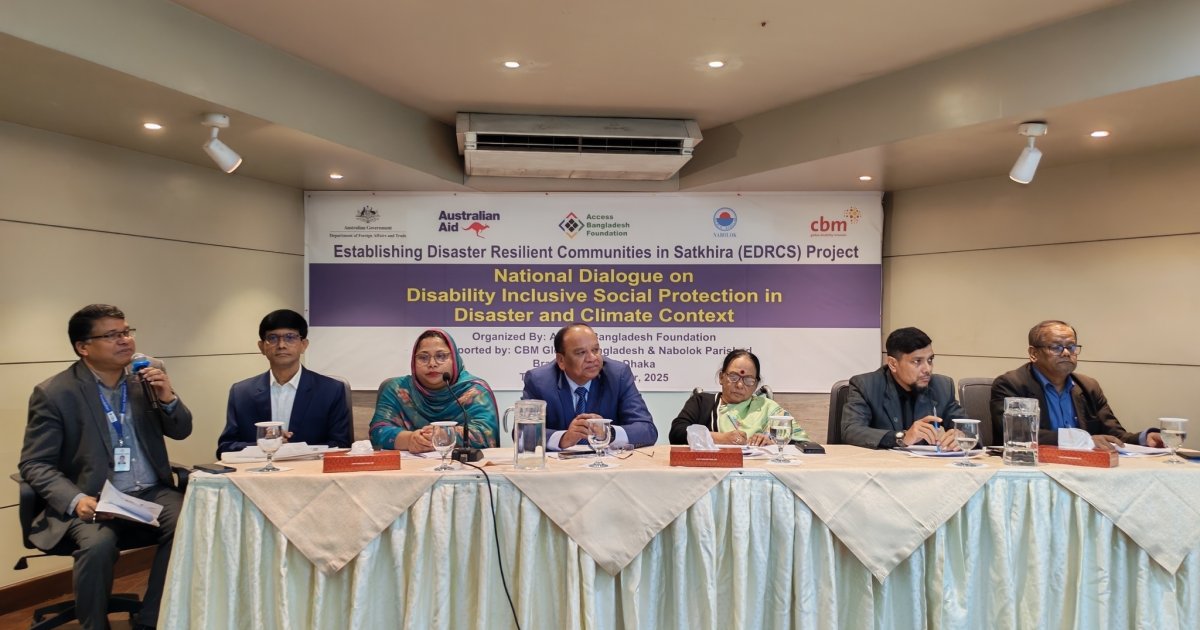
The call came during the National Dialogue on Disability Inclusive Social Protection in Disaster and Climate Context at Brac Centre INN in Mohakhali. The event was organized by Access Bangladesh Foundation in collaboration with CBM Global Bangladesh and Nabolok Parishad under the Establishing Disaster Resilient Communities in Satkhira project.
A total of 53 participants attended, including representatives from government agencies, NGOs, INGOs, civil society, universities, organizations of persons with disabilities (OPDs), and persons with disabilities from Shyamnagar, Satkhira.
Md Kamal Uddin Biswas, additional secretary of the Ministry of Social Welfare and chief guest, stressed the need to review social protection programs through a disability inclusion lens to ensure effectiveness and necessary adjustments.
Special guests included Sarmin Ara, assistant director of the Department of Women Affairs; Md Faruk Ahmed, deputy director and deputy secretary of the Jatiyo Protibondhi Unnayan Foundation (JPUF); Netai Chandra Dey Sarker, director of the Department of Disaster Management; and Dr Muhammad Nazmul Hoque, director of the Bangladesh Climate Change Trust.
Netai Chandra Dey Sarker said the dialogue’s recommendations would inform the review of the Standing Orders on Disaster 2019 and the National Plan for Disaster Management 2026–2030. He added that several social protection programs under the Ministry of Disaster Management and Relief could include persons with disabilities.
Dr. Hoque said the Climate Change Trust is open to collaborating with NGOs to implement initiatives addressing the disproportionate impacts of climate change on persons with disabilities. Sarmin Ara highlighted ongoing social protection projects in Shyamnagar and committed to increasing the inclusion of women with disabilities and ensuring proper disability-disaggregated data collection. Md Faruk Ahmed said JPUF would strengthen coordination with the Ministry of Social Welfare on disability-inclusive initiatives.
The dialogue, chaired by Mohua Paul, co-founder and chairperson of Access Bangladesh Foundation, emphasized that negative attitudes among duty-bearers remain a major barrier to inclusion. “Without changing mindsets, policy commitments alone will not deliver meaningful inclusion,” she said.
Albert Mollah, co-founder and executive director of Access Bangladesh Foundation, moderated the session, urging policymakers to move away from a “one-size-fits-all” approach and adopt customized, life-cycle-based social protection solutions. Taslim Zahan, inclusion lead of the organization, facilitated the program.
Md Shohel Rana, head of program at Access Bangladesh Foundation, presented a discussion paper outlining Bangladesh’s social security programs, participation of persons with disabilities, existing gaps, and proposed solutions. According to the paper, Bangladesh implements 95 social security programs across 24 ministries and divisions in FY 2025–26, of which 19 are linked to disaster and climate change. Only seven programs are disability-related, with just one—the Disability Allowance and Education Stipend Program—dedicated exclusively to persons with disabilities.
The paper also noted that when disability-related costs such as medication, transportation, and assistive devices are considered, the national poverty rate rises from 23% to 34%, with households with persons with disabilities facing an average of 13% additional costs.
Participants identified policy- and system-level challenges, including one-size-fits-all benefit design, lack of disability-disaggregated data, absence of mandatory inclusion criteria, weak inter-ministerial coordination, insufficient budgets, and limited consideration of disability-related costs in targeting mechanisms. Implementation-level challenges included nepotism, malpractice in beneficiary selection, limited awareness among duty-bearers and recipients, lack of participation of persons with disabilities in program design, inaccessible environments, and weak monitoring and accountability mechanisms.
To address these gaps, the dialogue proposed adopting a twin-track approach combining disability-specific and mainstream measures; strengthening disability-disaggregated data systems; allocating dedicated budget lines; ensuring meaningful participation of persons with disabilities in planning and resource allocation; and integrating disability as a mandatory inclusion criterion across all social safety-net schemes.
Other recommendations included pre-registering persons with disabilities in disaster- and climate-prone areas, sensitizing duty-bearers on disability inclusion and CRPD obligations, implementing a life-cycle-based approach to universal social protection as outlined in the National Social Security Strategy (NSSS) and National Adaptation Plan (NAP) 2023–2050, and introducing clear accountability mechanisms with measurable inclusion indicators.
Participants from government, civil society, and development partners collectively underscored the need to make the 2026–27 social protection budget more inclusive and responsive to the needs of persons with disabilities, particularly amid growing climate and disaster risks.