

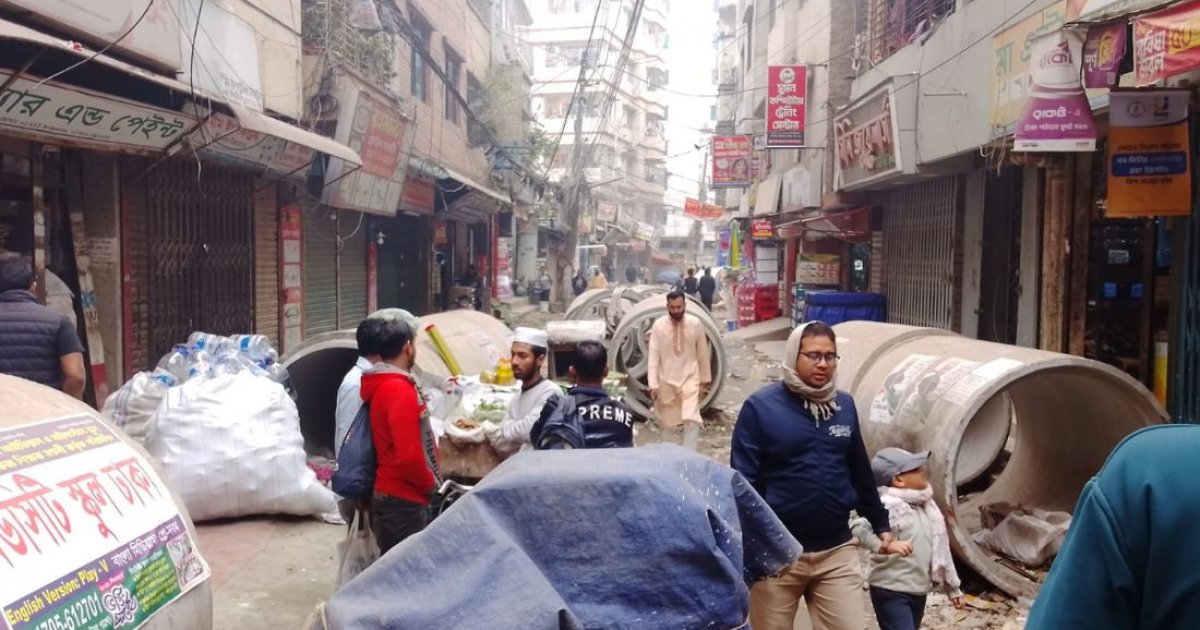
Residents of Ward 39 under Dhaka North City Corporation (DNCC) have been suffering for a long time due to deplorable road conditions, with repair work in the Khilbari Tek area remaining stalled for months.
Ward 39, which falls under Vatara Police Station adjacent to the upscale Gulshan area, is part of DNCC Zone-9 and the Dhaka-11 parliamentary constituency. A visit to the area shows that most of the busy roads in Khilbari Tek have become virtually unusable. Nearly one to one-and-a-half kilometres of road have been left dug up for an extended period under the pretext of renovation.
Most roads in the area are narrow and filthy, posing serious risks to pedestrians—particularly children, women and the elderly. In some sections, large mounds of soil block passage, while elsewhere deep potholes have turned daily movement into a struggle. Residents say people are injured almost every day while navigating the broken roads, with the situation becoming particularly dangerous at night.
Poor lighting, scattered bricks, open manholes and large pipes left on the roads have further increased the risk of accidents after dark.
The elderly are among the worst affected. Stagnant sewage water from nearby houses emits a foul stench and has worsened mosquito infestation in the area. Transporting goods has also become extremely difficult, with heavy items such as sacks of rice often carried on people’s heads. Walking is hazardous, while movement by bicycle, rickshaw or van is nearly impossible.
The dilapidated roads have also created serious obstacles for patients in need of medical care. Both residential buildings and shops line the roads, while vegetable vendors operate from floating vans in some areas, adding to congestion.
Residents allege that although election campaigns are being carried out in the area, no attention is being paid to repairing the roads. They also claim that juvenile gangs have stepped up antisocial activities under the cover of electioneering. Many residents say they do not understand why the roads have been left in such a state.
Local resident Md Saiful Islam said: “The roads have been like this for a long time. Every day we struggle just to commute. People fall and get injured right in front of us. Sometimes children fall into potholes. I even gave space from my own property for road widening, but
the work has not progressed.”
Rice trader Nuru Mia said work began three months ago but has remained halted for the past two months. “Movement has become extremely difficult and our business has come to a standstill. Stagnant water has created unhygienic conditions and increased mosquito breeding. The foul smell also spreads germs,” he said.
Housewife Aleya said she fears for her children’s safety. “I have three sons and one daughter who go to school. I am afraid to send them alone along this road. My youngest child recently fell and got injured. Many other children are also getting hurt in the potholes. Under these conditions, I cannot let my children go out alone,” she said.
Residents further alleged that following the removal of previous councillors after the public uprising, ward-level operations were abruptly disrupted. Although councillor secretaries were placed under the executive officer, civic services have yet to fully resume. The absence of an elected councillor has affected public service delivery, they said.
The ward is also facing acute shortages of gas and WASA water, along with a severe mosquito infestation. Road repair work in the area is currently being supervised by the 24th Brigade of the Bangladesh Army.
Responding to the allegations, DNCC Chief Engineer Brigadier General Md Moeen Uddin said road construction requires around 20 feet of space, as drains are built through the middle of the road during repair work.
“When we ask residents for space, most cooperate, but around 10% refuse. Some initially agree but later withdraw, saying they will not give space if others do not. Previously, councillors helped resolve these issues. Without them, the process has become more difficult,” he said.
He added: “This resistance from a small portion of residents is what causes delays. While most people cooperate, the refusal of a few creates complications. The ministry has now instructed us to complete the work with whatever space is available.
“Earlier, 14 to 16 feet of space was sufficient with councillor approval, but now we require 20 feet. That is the main challenge. We will sit with all stakeholders to find a solution. This is the road construction season, and necessary steps will be taken promptly.”