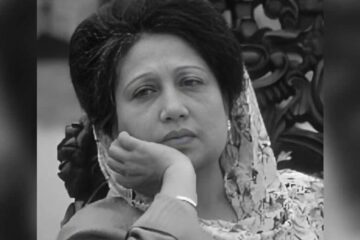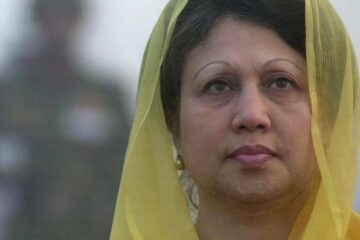

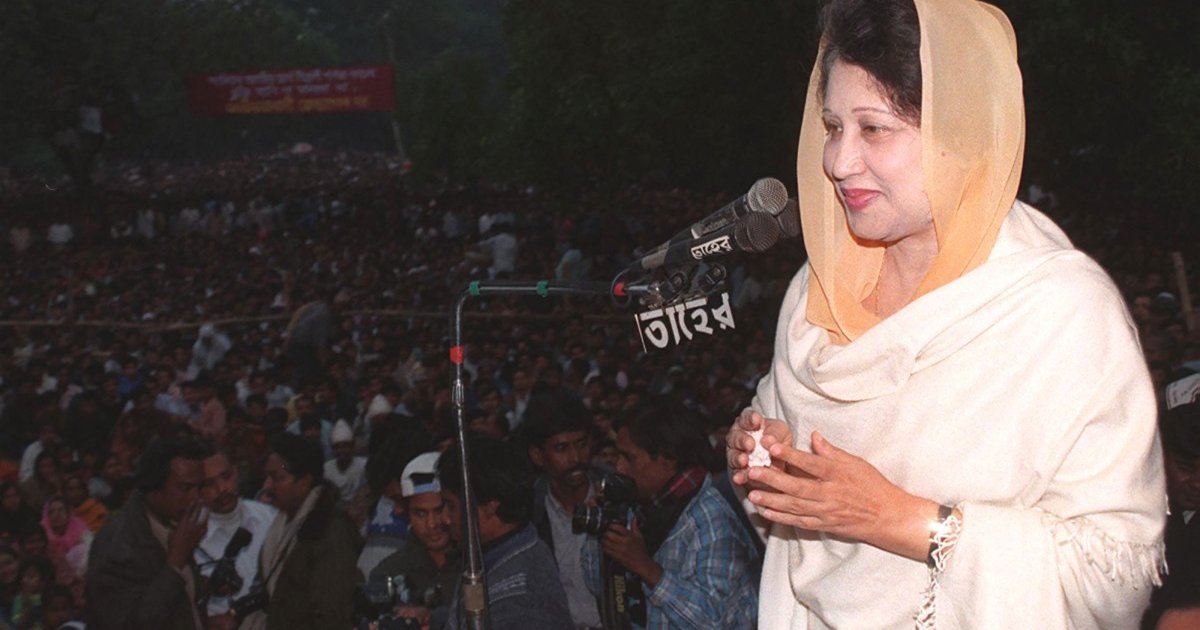
Khaleda Zia remains unmatched in Bangladesh’s electoral history as the country’s first elected female prime minister and a leader who never lost a parliamentary election she contested.
From Feni and Bogra to Dhaka, Chittagong, Lakshmipur and Khulna, she won every constituency in which she stood, setting a record unparalleled in national politics.
Khaleda Zia contested a total of 23 parliamentary seats across five general elections and won all of them, an achievement unique in the country’s electoral history.
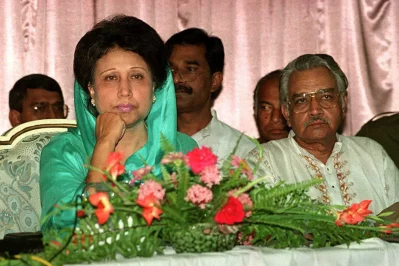
Even in elections where the Bangladesh Nationalist Party (BNP) failed to form the government, she emerged victorious in every seat she contested.
Following the fall of military ruler Hussain Muhammad Ershad in the 1990 mass uprising, Khaleda Zia contested five constituencies – Bogra-7, Dhaka-5, Dhaka-9, Feni-1 and Chittagong-8 – in the fifth parliamentary election held on February 27, 1991.
She won all five seats by large margins.
After the BNP formed the government, she became Bangladesh’s first female prime minister and the second woman to lead a Muslim-majority country as head of government.
The seventh parliamentary election, held in June 1996, resulted in an Awami League government.
Despite the BNP’s defeat, Khaleda Zia again won all five seats she contested – Bogra-6, Bogra-7, Feni-1, Lakshmipur-2 and Chittagong-1 – maintaining her personal electoral record.
In the eighth parliamentary election on October 1, 2001, she once again contested five seats – Bogra-6, Bogra-7, Khulna-2, Feni-1 and Lakshmipur-2 – and won all of them decisively.
Following the BNP’s victory, Khaleda Zia assumed office as prime minister for the third time.
Earlier, in the sixth parliamentary election held on February 15, 1996, the BNP returned to power, and Khaleda Zia won from Feni-1, Feni-2, Bogra-7, Sirajganj-2 and Rajshahi-2.
She was sworn in as prime minister for a second consecutive term. However, the election was widely criticized as one-sided.
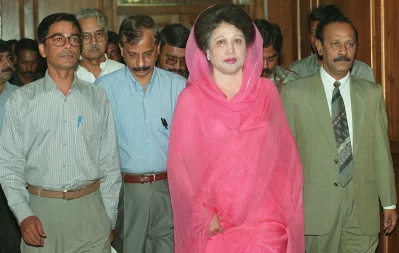
During that short-lived parliament, the bill introducing a non-partisan caretaker government was passed.
Khaleda Zia resigned just 11 days after taking office, and parliament was subsequently dissolved.
In the 2008 parliamentary election, after the Election Commission imposed a limit of three constituencies per candidate, Khaleda Zia contested from Bogra-6, Bogra-7 and Feni-1, winning all three seats.
Khaleda Zia did not contest any elections after 2008.
The BNP boycotted the disputed parliamentary elections of 2014 and 2018.
In the 2018 election, she submitted nomination papers for three seats, but her candidacy was rejected following a court conviction, amid allegations of widespread irregularities in the polls, later referred to as the “night vote”.
She had intended to contest the upcoming 13th parliamentary election from Bogra-7, Dinajpur-3 and Feni-1.
Although nomination papers were submitted on her behalf, she ultimately did not take part in the voting process.