

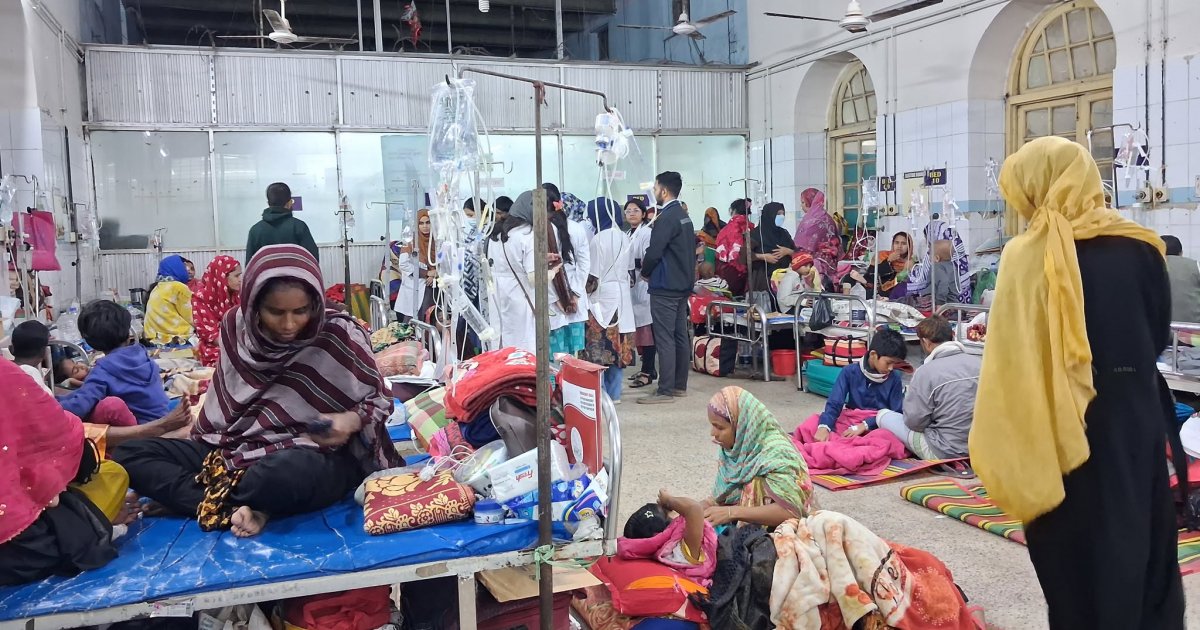
Dhaka Medical College Hospital (DMCH) is witnessing an unprecedented surge in cold-related illnesses among children, as biting cold and dense fog sweep across the country, disrupting daily life. Morning and evening temperatures have dropped sharply, while sunlight remains scarce throughout the day.
Pediatric wards at DMCH are overflowing with patients suffering from cold, cough, pneumonia, respiratory distress, fever, and viral diarrhea. In some wards, admissions have doubled or tripled compared to bed capacity, leaving children struggling for space.
Emergency and outpatient departments have been inundated. On Monday, long queues of mothers holding their children were seen at the pediatric outpatient section. Most children exhibited cold-related symptoms, including runny noses, diarrhea, fever, and cough. Parents said their children had been ill for three days to a week, with some having previously sought treatment elsewhere without full recovery.
One-year-old Adiyat, admitted with pneumonia, first visited DMCH on Saturday but returned home as his condition initially seemed stable. His health worsened, forcing a second visit. Prior to DMCH, he received treatment at Azimpur Maternity Hospital, which referred him due to the severity of his illness. While urine and stool tests have been completed, a sputum test is pending to determine the full extent of the infection.
Dr Md Shahedur Rahman, resident doctor and consultant at the pediatric department, said cold and cough cases dominate the ward year-round, particularly among children aged six months to six years. “Normally, around 60% of our patients suffer from cold-related illnesses, but during winter this figure rises sharply,” he said.
“From this morning, nearly 100% of admitted patients have presented with cold-related illnesses, including pneumonia, diarrhea, bronchiolitis, RSV infections, and rhinovirus-induced colds and coughs,” Rahman added.
Addressing a common misconception about influenza, Rahman said long-term research by the National Influenza Surveillance Team shows that influenza season in Bangladesh typically runs from June to September, occasionally extending into October. “Winter influenza is common in Western countries, but it does not occur in Bangladesh during the cold season,” he noted.
He further warned that children who have not received the Rota vaccine face a higher risk of diarrhea during winter. The vaccine, not yet included in the government’s Expanded Program on Immunization (EPI), is recommended for children aged 1.5 to six months. It requires three doses at one-month intervals and costs around Tk3,000–4,000, with plans underway to include it in the national EPI.
Rota-related diarrhea usually lasts five to seven days, starting with infrequent stools that gradually increase. Doctors emphasized maintaining hydration, using oral rehydration solution (ORS) as directed. Children over six months can safely receive ORS at home.
Respiratory syncytial virus (RSV) infections are contributing significantly to rising cases of bronchiolitis and pneumonia, which may be viral or bacterial. Rhinovirus infections causing cold and cough have also increased, with recovery often taking seven to 14 days, sometimes extending up to three weeks or a month.
Doctors cautioned parents against administering medication without medical guidance, as improper use can lead to serious complications, including sleep disorders, depression, or kidney problems in severe cases.
Overcrowding is severe. In Ward-210, a single bed is often shared by two to three patients. Although the ward has only 20 beds, around 91 children are receiving treatment. Similar overcrowding is reported across all pediatric wards at DMCH.
Dr Preety Ghosh, a pediatrician at DMCH, said most patients arrive in critical condition, referred from district hospitals, making it impossible to turn them away. Diarrhea patients requiring specialized treatment are referred to icddr,b.
Four-year-old Arian, currently on oxygen support, struggles to breathe. His mother said they traveled from Kushtia, where he had been hospitalized for two days before being referred to DMCH. Despite five days of treatment, his breathing difficulties persist.
Three-year-old Tawhid, referred from Noakhali Hospital and admitted on December 15 with cold and cough, was later diagnosed with pneumonia at DMCH. After eight days of treatment, his condition has slightly improved, though he is not yet fit to return home.
Like Tawhid and Arian, many children remain confined to overcrowded wards. Some are on oxygen support, others on feeding tubes, receiving nebulization, injections, and medication. Parents are sometimes forced to carry their children to balconies in search of fresh air, as these young patients battle illness instead of enjoying playtime.