
The year 2025 ended amid sustained protest movements, with teachers’ demands remaining largely unresolved despite repeated assurances from the government.
Teachers’ movements over various demands continued until December, while sections of non-government teachers also prepared for fresh protests. Although teachers at different levels of education achieved some gains through sustained agitation, honors-level teachers remained deprived. The government assured assistant primary school teachers that their demands would be addressed. However, despite the year’s end, teachers’ demands remain unmet, with affected groups preparing to reassert their claims from next year.
Following the fall of the Awami League government—now with activities suspended—on August 5, 2024, and the formation of an interim government on August 8, professionals from various sectors launched protest movements to press their demands. While the interim government accepted some demands under pressure, most were either left at the assurance stage or ignored altogether. Throughout 2025, educational institutions experienced widespread disruption, with protests by teachers and other professional groups continuing year-round. Among these, teachers’ movements received particular attention for multiple reasons.
Teachers and stakeholders say the demands are justified, while acknowledging that meeting them poses challenges for the interim government. They warn that failure to meet even minimum demands will lead to continued protests, adversely affecting students’ academic lives.
Professor Dr Nazrul Islam Khan, principal of International Education College and president of the Private Teachers’ Training College Teachers’ Association, said prolonged protests harmed students but could have been avoided. “The teachers’ demands are justified. Teachers protested in the past, they are protesting now, and they will protest in the future if the problems persist. The government must seriously identify teachers’ problems and resolve them quickly. Improving education quality requires prioritizing teachers and the education system,” he said.
He added that the crisis would continue unless a separate pay scale for teachers is introduced, urging the state to reconsider the issue.
Assistant primary teachers’ movement
Assistant teachers of government primary schools announced an indefinite hunger strike on October 17, demanding salary fixation in the 11th grade and resolution of promotion-related complications. They later suspended the program following government assurances. When no progress followed, they began a sit-in at Dhaka’s Central Shaheed Minar on November 8 to press three demands, including placement in the 10th grade.
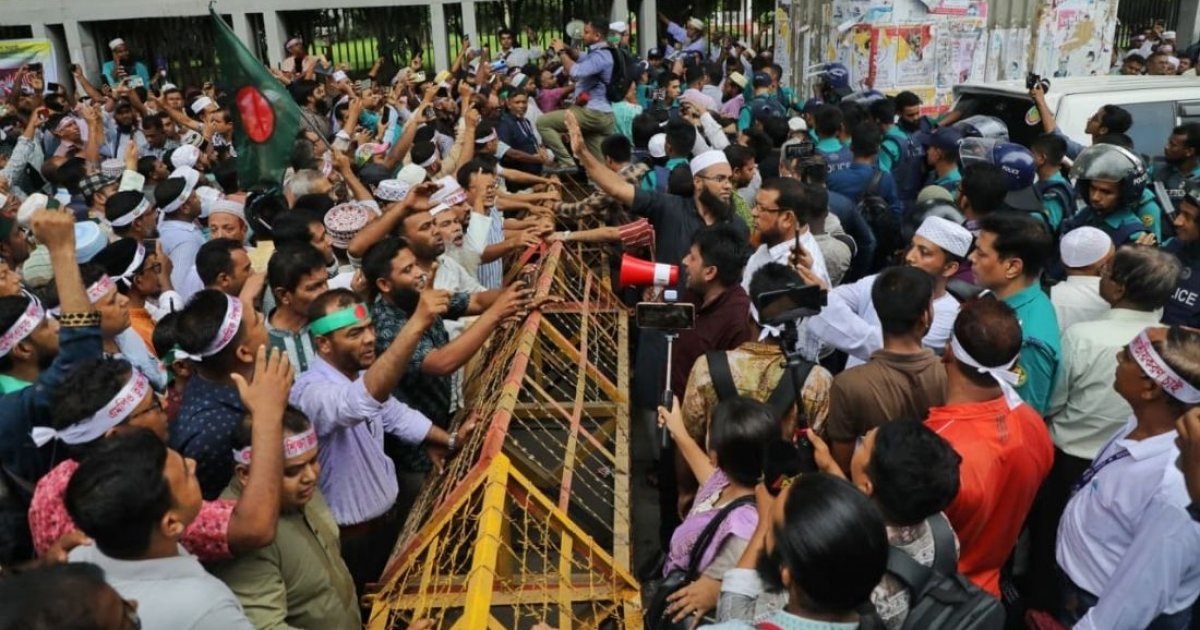
After police action on November 9, teacher organizations announced continuous work stoppages while maintaining the sit-in. The strike was again suspended on November 10 after renewed assurances. With no visible progress by the end of November, assistant teachers announced fresh protests from November 30.
After suspending sit-ins and work stoppages, teachers announced new programs on December 2. From December 3, they boycotted examinations, including annual exams, and declared a “complete shutdown” to press their three demands. Although they announced continuation of protests from December 7 until demands were met, they later adjusted programs to allow examinations to proceed.
The Ministry of Primary and Mass Education sent letters to the Pay Commission and the Finance Division regarding salary fixation in the 11th grade and urged teachers to return to classrooms.
Head teachers’ movement
Head teachers of government primary schools also launched protests, demanding four measures, including salary fixation in the 10th grade. Their demands included 11th-grade placement for assistant teachers, issuance of a government order granting 10th-grade status to all head teachers retroactive to March 9, 2014, 100% promotion for senior teachers including those in acting positions, and higher grades after 10 and 16 years of service.
The government approved 10th-grade status for head teachers, prompting them to suspend protests.
Director General of the Directorate of Primary Education Abu Nur Md Shamsuzzaman said head teachers had been upgraded to the 10th grade and expressed optimism that implementation of the 11th grade for assistant teachers would also see progress soon.
Police action against primary teachers
During peaceful protests, government primary school teachers faced baton charges, water cannons, and sound grenades. At least 109 teachers were injured, and five were detained before being released. Protesting police action, teachers demanded the resignation of Home Adviser Lt Gen Md Jahangir Alam Chowdhury (retd) and Primary and Mass Education Adviser Dr Bidhan Ranjan Roy Poddar.
Basis of assistant teachers’ demands
Assistant teachers at practice schools affiliated with Primary Training Institutes receive salaries in the 10th grade, while assistant teachers in government primary schools receive salaries in the 13th grade, despite holding identical positions.
Teachers cited long-standing discrimination, noting that police sub-inspectors, nurses, sub-assistant agriculture officers, union parishad secretaries, and various administrative officials receive 10th-grade pay. Despite holding advanced degrees, assistant primary teachers have failed to secure even 11th-grade placement.
Bangladesh Primary Teachers’ Association President Md Abul Kasem said teachers need both dignity and sufficient income to sustain families. He noted that entry-level assistant teachers earn around Tk17,000, insufficient even in semi-urban areas, while head teachers earn about Tk19,000. He warned that inadequate pay undermines sustainable, quality education.
Bangladesh Primary School Assistant Teachers’ Association President Md Shamsuddin Masud and Bangladesh Primary Teachers’ Association (Shahin–Lipi) General Secretary Khairun Nahar Lipi described the demands as justified.
Punitive transfers
Leaders of the “Primary Teachers’ Demand Realization Council” led protests at the Central Shaheed Minar. They included Md Abul Kasem, Khairun Nahar Lipi, Md Shamsuddin Masud, and 10th-grade implementation coordinator Mu Mahbubur Rahman. Authorities transferred 44 teachers punitively, while all teachers in Noakhali district, including protest leaders, were issued show-cause notices.
Honors and master’s teachers’ protests
Honors and master’s-level teachers from 315 MPO-affiliated private institutions protested early last year, citing decades of unpaid service. From October 15 to 17, they staged demonstrations outside the Education Building. Police dispersed protesters using baton charges, water cannons, and sound grenades, injuring several teachers, including women with children.
Although the Ministry of Education initiated steps to amend the 2018 MPO policy to include these teachers, the policy remains unchanged after a year.
MPO teachers’ allowance movement
MPO-affiliated teachers protested for increased housing, medical, and festival allowances. After 10 days, the Finance Division approved incremental increases in housing allowance, prompting teachers to suspend protests.
Ibtedayi madrasa teachers’ movement
Ibtedayi madrasa teachers launched sit-ins from October 12 demanding nationalization. Police clashed with protesters on October 29, injuring over 50 teachers. The movement ended on November 10 following government decisions on MPO inclusion and grants.
Teachers reported madrasa academic activities remained suspended for more than six weeks due to the protests.
Special education teachers’ movement
Teachers of autistic and disability-focused schools protested for recognition, MPO inclusion, stipends, infrastructure improvements, therapy centers, vocational education, and employment quotas. After nearly a month, their demands remained unmet. Movement leaders accused the government of lacking sincerity.
Registered teacher candidates’ movement
Candidates registered with the Non-Government Teachers’ Registration and Certification Authority continued protests throughout the year, alleging repeated assurances without appointments. They claimed fraudulent certificate holders were appointed while qualified candidates were ignored. The ministry dismissed the movement as unjustified, a claim protesters rejected.
Students’ movements
Student protests caused widespread public disruption throughout the year. Demonstrations at Dhaka College, Dhaka City College, and Ideal College were prominent.
Students from seven colleges demanded a separate university, prompting the interim government to draft the “Dhaka Central University” ordinance. Before finalization, students launched a counter-movement to preserve college autonomy. As 2025 ended, the movement remained unresolved.