
In a land formed by rivers, water is not just a resource. It leads to memories, cultures, lives, and even deaths. Nearly 700 rivers, including some of the largest in Asia, crisscross Bangladesh’s floodplains and deltaic terrain, shaping the nation for years. Human settlements grew alongside riverbanks; it is no surprise that the Bengali language attributes rivers with such poetic charm, as if they were close companions.
Yet, a silent erosion has been underway in this riverine country. As rivers dry, change course, or choke under pollution and encroachment, the stories they carried are vanishing too. The young no longer learn to fish the way their grandparents did. The songs of boatmen are fading. In response to this fading relationship, a silent revolution unfolded in a coastal village in southern Bangladesh: Asia’s first Water Museum.
An unlikely beginning
The story began in 2005 when the Government of Bangladesh declared several Hilsa fish breeding areas as ‘Jhatka’ Sanctuaries, banning fishing during specific periods to protect juvenile Hilsa. While ecologically sound, this policy devastated the local fishing communities whose survival depended entirely on the river. The community suddenly found itself unemployed and pushed toward displacement.
For instance, KM Faridul Islam, a local fisherman from Patuakhali District, was burdened by microcredit loans taken to buy fishing supplies. Many abandoned the village. But Faridul decided to stay. Instead of being hostile, he led with dialogue. He convinced NGOs to forgive debts and helped form small collective groups among the villagers. Through trial, failure, restructuring, and training, a federation of fisherfolk emerged, and under Faridul’s leadership, they envisioned something no one expected: a museum not of artifacts, but of their identity. After securing land with support from ActionAid Bangladesh, the Water Museum started its journey on December 29, 2014.
The museum is now run by the Kalapara Upakuliya Jana Kalyan Sangha (Kalapara Coastal Public Welfare Association), with ongoing support from the AVAS, a well-known NGO working around the Barishal Division.
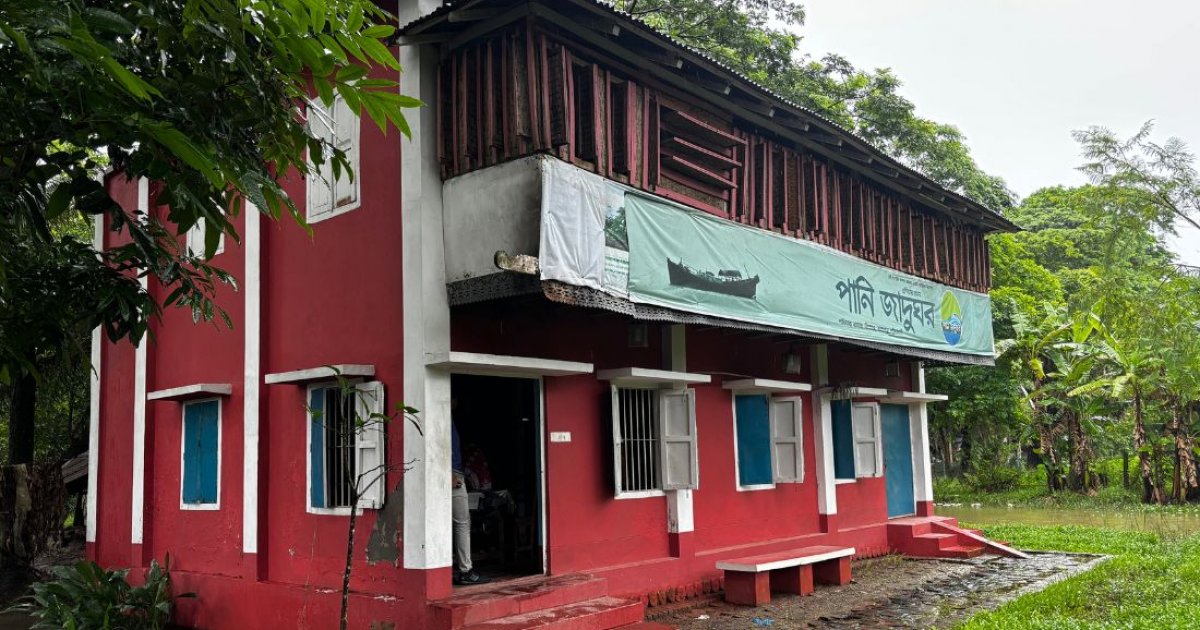
Although the initiative has received support from the organizations, the community’s own sense of ownership truly kept it alive. The museum has a tin-shed structure, located in the Pakhimara village of Nilganj Union in Kalapara Upazila of Patuakhali district. A sculpture of a wooden boat resting on sand sits at the entrance, symbolizing the river’s drying and a tribute to the intimacy between the river and the people. The museum defies expectations with its depth and symbolism. The top floor showcases transparent glass jars holding water from 87 rivers, including international ones. Besides, there are traditional fishing tools such as nets, bamboo baskets, sails, crab traps, and clay utensils, as well as photographs depicting river life: fishermen at work, children swimming, boats drifting at sunset, and women collecting water. Together, the displays tell a story that is more than a collection; it is a living ethnography of Bangladesh’s water culture.

Ruthless causes behind the ecological disturbance
The Water Museum is not only a place to hold memories of rivers, but also a living reminder of how climate and unplanned development are hampering the country’s fragile ecology. Rising sea levels are pushing salinity further inland, leaving once-fresh rivers undrinkable and unfit for farming. Sudden floods wash away localities, while long dry spells leave rivers lifeless. Alongside these climatic scenarios, dams, embankments, sand mining, and unplanned urban expansion continue to disrupt natural river flows, often worsening the damage. The museum’s own origin tells this story.
The struggle of fishing communities, losing their only source of survival, resembles the struggle of countless families, facing climate-induced displacement. By storing water from 87 rivers and preserving the culture that grew around them, the museum does more than showcase history. Unless urgent action is taken, these jars may one day represent not living rivers, but relics of a way of life washed away by the ruthless forces of climate change and reckless development.
A heritage for the upcoming generation
While the first world has its natural history museums and maritime heritage centers, very few museums in the Global South are rooted in the lived realities of climate-vulnerable communities, burdened with different laws and economic instability. This museum stands apart because it was not built by state order or corporate philanthropy; it emerged from the collective will of an economically marginalized local community that refused to be forgotten.
The museum’s location is surrounded by greenery within a small village, and the enthusiastic visitors cannot easily identify its presence without being told by the locals. However, this museum must be visited at least once to understand the positive path of resistance and protest against the loss of rivers, and the silence of those who once thrived on water.
Although located in one of the most attractive tourist destinations of the country, Kuakata, it is both ironic and significant that the water museum does not hold just a distant past, but also a future warning if the existing challenges are considered seriously.
This unique museum now requires its enhanced recognition both within Bangladesh and beyond. It deserves to be seen as more than a local initiative. It is a template for how communities everywhere can preserve environmental memory and initiate climate discourse at its core. It can be a strong local voice to ask for the existence of rivers. In a world where rivers are dammed, diverted, or disappearing, the jars of water at this museum are like time capsules. They hold more than just water samples. They hold stories, grief, and hope altogether in one place. And perhaps, most of all, they hold a question for all of us: What will this country become when its soul, the rivers, are gone?