

The Bangladesh Nationalist Party (BNP) on Sunday sought full cooperation from the media, emphasizing its role in preserving national unity amid what it described as the rise of destabilizing forces in the country.
BNP Standing Committee member Salahuddin Ahmed made the call during an exchange of views with editors and heads of national dailies, electronic media and online news portals at a city hotel.
Referring to recent developments, Salahuddin said a “negative force” had emerged, particularly since August 5, and its nature and activities had become increasingly visible over the past few days.
“The rise of this force has been noticed by many here today. Its form, face and actions are now evident,” he said.
Stressing the need to maintain national unity, Salahuddin said newspapers and electronic media have a crucial role in raising awareness on issues related to national interest.
“To uphold national unity and protect national interest, your cooperation is extremely necessary. This cannot be done otherwise,” he added.
He also urged the media to continue constructive criticism alongside providing overall cooperation to the party.
Later, BNP Senior Joint Secretary General Ruhul Kabir Rizvi and Media Cell Convener Professor Md Maudud Alamgir Pavel also spoke at the event.
The meeting was organized by the BNP at Radisson Blu Dhaka Water Garden in connection with the homecoming of the party’s acting chairman Tarique Rahman. Following the discussion, editors and journalists were hosted at a luncheon.
Speaking at the event, Jai Jai Din Editor Shafik Rehman said criticism is a journalist’s responsibility, but so is acknowledging positive actions.
“When I regained Jai Jai Din, I told the editorial team not to focus only on criticism. If there is even a small positive initiative—whether by individuals or the government—it should be mentioned in editorials,” he said.
Prothom Alo Editor Matiur Rahman said the country is currently experiencing a political vacuum, which he described as risky and challenging, including for the BNP.
He noted that if BNP acting chairman Tarique Rahman had returned earlier, it might have helped create a more favourable political environment.
“His absence has created questions and allowed room for confusion, which has worked negatively for the party,” he said.
Matiur Rahman also said BNP remains the largest political party in Bangladesh, citing public surveys.
“Our surveys suggest that BNP is still the biggest party and is likely to secure the highest number of votes in an election,” he added.
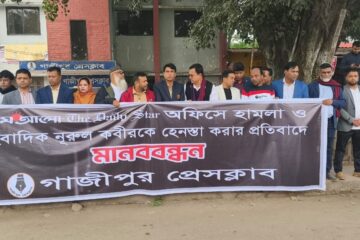
He also expressed gratitude to political parties and people from different professions for standing by Prothom Alo and The Daily Star following attacks and arson incidents targeting their offices.
The Daily Star Editor Mahfuz Anam said that in Bangladesh’s 53-year history, media offices had never been set on fire before the recent incidents.
“For the first time, media offices were attacked and set ablaze. Why? What crime did we commit?” he asked, urging the media to question such incidents collectively.
Looking ahead, he said he wanted to build a constructive relationship with political parties, stressing that freedom of expression—especially the freedom to criticize—must be the foremost principle.
“Freedom of expression means the freedom to criticise. Political parties must accept this,” he said.
Manab Zamin Editor-in-Chief Matiur Rahman Chowdhury described the current period as unstable and deeply divided. “In such a divided environment, speaking out becomes very difficult. Still, I felt encouraged attending today’s programme,” he said.
He added that BNP leaders’ statements on media policy had made their future stance clear and expressed hope that if those commitments were implemented, Bangladesh’s media sector would move forward.
Editors and representatives from various national dailies, television channels and news agencies were present at the program.