
Power, Energy and Mineral Resources Adviser Fouzul Kabir Khan has said ensuring strong and predictable cash flow is now the government’s top priority for attracting investment in Bangladesh’s renewable energy sector.
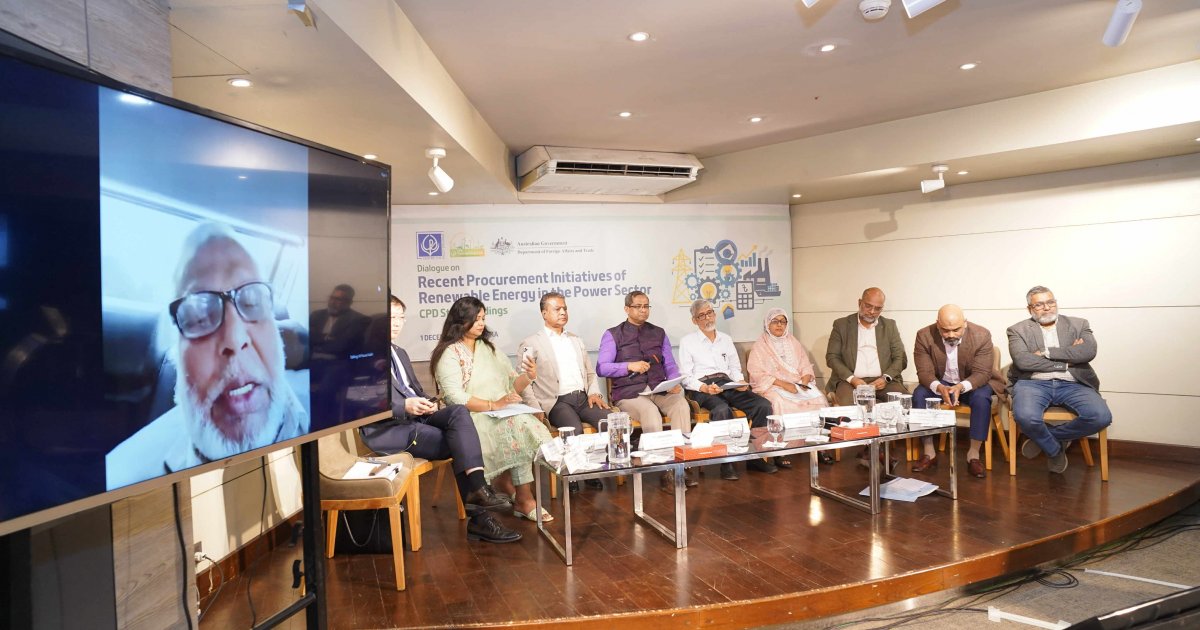
He made the remarks on Sunday at an online dialogue titled “Recent Procurement Initiatives of Renewable Energy in the Power Sector: CPD Study Findings,” organized by the Center for Policy Dialogue (CPD) at the Brac Inn on Monday.
Defending the recent government decision to cancel Implementation Agreements (IAs) for 34 solar power plants, Fouzul Kabir said the agreements had become outdated and largely ineffective.
“The Implementation Agreement is cheaper than the paper it is written on. Nobody even demanded to invoke it. We revoked the IA with good conscience,” he said.
He added that both the PPA (Power Purchase Agreement) and IA frameworks were designed in the 1990s and no longer fit the needs of today’s renewable energy landscape.
Explaining the shift away from IAs, the adviser said investors primarily look for the security of steady cash flow.
“For an investor, it is cash flow and cash flow. For mutual benefit and long-term sustainability, ensuring cash flow is essential,” he said. He noted that viable revenue and cost structures were crucial for building investor confidence.
Fouzul Kabir said the government is introducing direct procurement for upcoming renewable energy purchases and is working with banks and IDCOL to ensure new projects are bankable.
“We have already informed the Banking Division to provide necessary facilities and we are trying to secure guarantee programs from IDCOL,” he added.
Highlighting long-standing structural problems in the power sector, he said bypassing competitive bidding and relying on direct negotiations in previous years had created a cycle of high tariffs and mounting unpaid bills.
“All unsolicited power deals carried high tariffs. Because of these tariffs, BPDB could not pay, which created outstanding bills,” he said.
The adviser said the interim government has already cleared $3.2 billion in unpaid energy import bills as suppliers were charging penalties and higher prices due to delays.
He added that several new solar projects with significantly lower tariffs have been submitted to the purchase committee for approval.
“We are trying to transition from a corrupt process and come out of the 2010 Power and Energy Act,” he said.
Fouzul Kabir said confusion around PPAs and IAs persists because the sector has depended on those outdated frameworks for years.