
On a winter evening in Dhaka, poetry became a bridge between steppes and rivers.
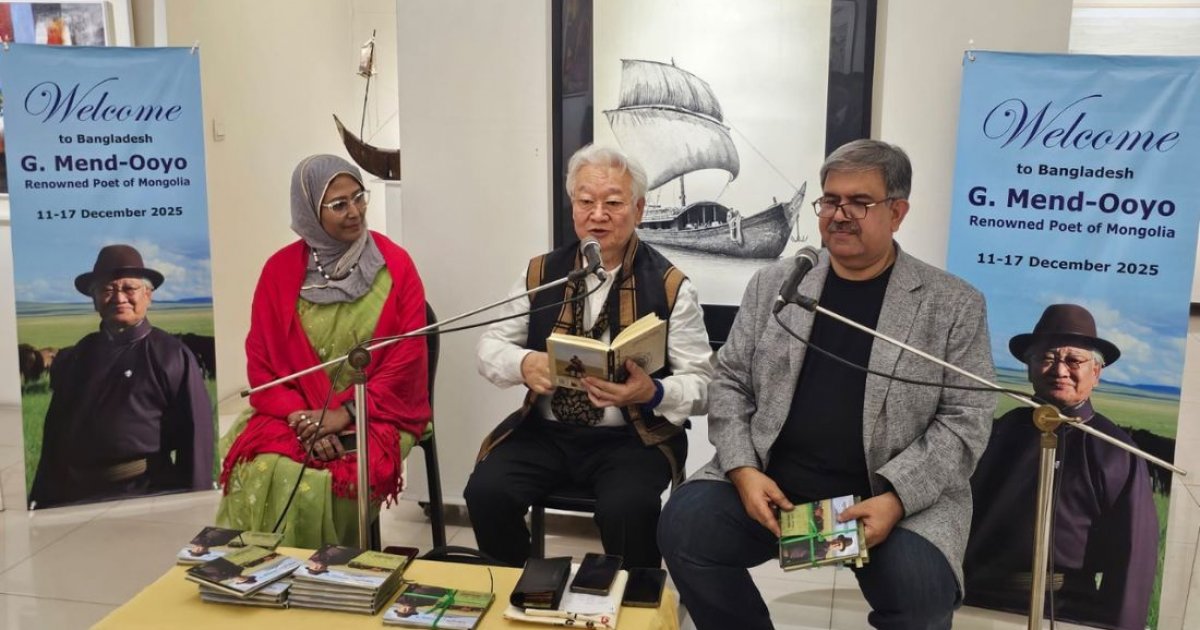
Kathak hosted a moving night of verse and reverence on December 14 at Gallery Chitrak in Dhanmondi, paying tribute to celebrated Mongolian writer, poet and calligraphist Mend-Ooyo Gombojav — a literary voice whose words have travelled continents.
The evening unfolded as both homage and homecoming. At its heart was the launch of a Bengali translation of Mend-Ooyo’s poems by renowned poet and translator Aminur Rahman, who also serves as president of Kathak.
Through his translations, Mongolian metaphors found a new cadence in Bangla, allowing local readers to encounter distant landscapes through familiar rhythms.
Kathak, long recognized for its poetry publications and literary initiatives, most notably the Dhaka International Poets Summit, once again turned poetry into a language of peace and cultural exchange.
Aminur Rahman, a central force behind the summit, has spent decades building such crossings through translation and dialogue.
As the evening progressed, the gallery filled with voices.
Poems from the book were recited by poets Laila Afroz, Mosud Mannan, Shaila Kabir, Golam Kibria Pinu, Ayesha Chowdhury, and Rafi Haque and Reaz Ahmad, editor of Dhaka Tribune, alongside Aminur Rahman himself.
The moment reached a rare stillness when Mend-Ooyo took the floor, reciting in Mongolian — his native tongue echoing softly through the room, untranslated yet deeply felt.
Mend-Ooyo’s literary stature is formidable.
Declared a distinguished cultural figure of Mongolia in 1996, he has received the Altan Ud (Golden Feather) award twice, been named Poet Laureate with Golden Crown by the World Congress of Poets, and honoured with Mongolia’s highest civilian distinction, the Order of Chinggis Khaan, in 2015.
His accolades span continents — from Greece and Korea to India, Japan, Europe and the United States — marking him as a truly global poet.
That night in Dhaka, however, titles faded into silence.
What remained were words — carried across languages, shaped by translation, and shared in collective listening.
In a city far from Mongolia’s vast plains, poetry found common ground, proving once again that verse knows no borders.