
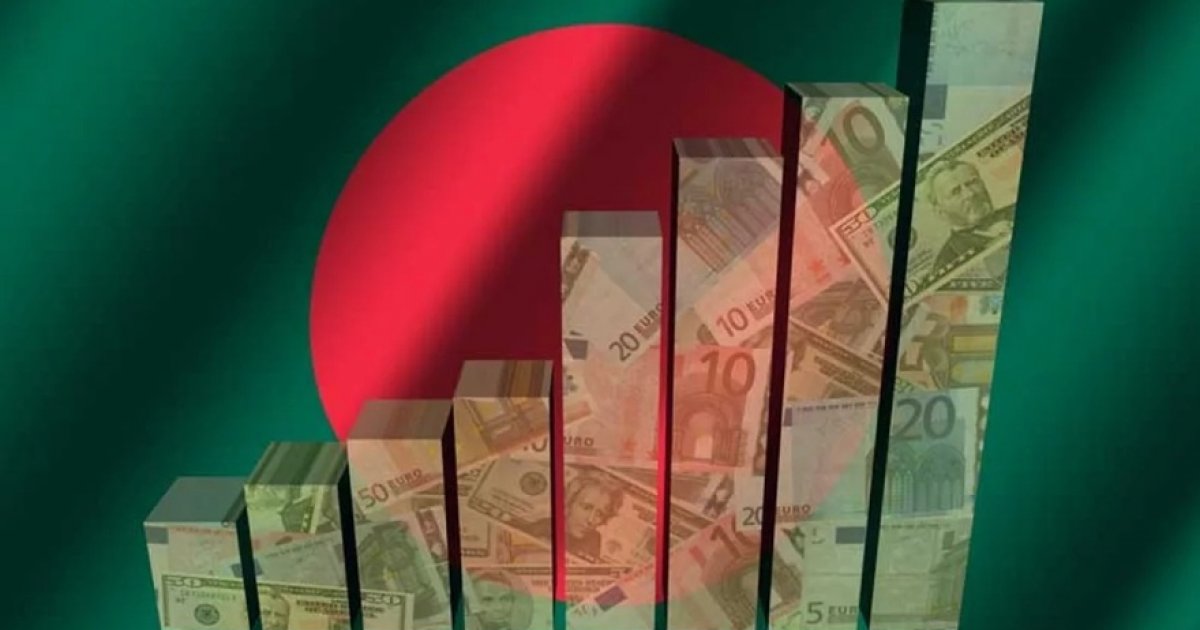
Steep interest rates on loans, energy and power shortages, continuous decline in exports, weak market demand, and overall stagnation are all increasing pressure on the country’s economy.
Trading in the stock market has decreased, inflation has increased, and the burden of foreign debt has doubled compared to before.
In this situation, several major problems in the country’s economy have become clear, which are acting as major obstacles to the country’s economic recovery.
Continuous decline in exports
The downward trend in merchandise exports has continued for four consecutive months.
The latest November export revenue fell by about 6%.
The newly published report of the Export Promotion Bureau (EPB) shows that compared to the same month last year, export revenue decreased by $230 million in November, which is equivalent to about Tk2,000 crore.
Exports in the month stood at $3.89 billion, which is significantly lower than in November last year.
The United States imposed a 20% countervailing duty on Bangladeshi products from August 7. Earlier, exports increased by 25% in July as brands were keen to import in advance to avoid tariffs.
However, the decline began in August: exports fell by 3% in August, 5% in September, and 7% in October.
According to BGMEA Director ABM Shamsuddin Ahmed, China’s aggressive exports to the EU market are reducing Bangladesh’s competitiveness. Due to high tariffs in the US, Chinese products are now entering the EU at higher prices, resulting in a shrinking Bangladesh market.
Mohiuddin Rubel, managing director of Bangladesh Apparel Exchange and former director of BGMEA, told Dhaka Tribune: “Bangladesh has maintained its position despite fluctuations in demand in the global market. However, the decline in orders in the knitwear sector is giving us a clear warning—without new markets, new products and technology investments, it will be difficult to sustain growth in the future.”
Additional tax burden
The National Board of Revenue (NBR) has not been able to meet expectations in revenue collection.
In the first four months of the current FY26 (July-October), the revenue deficit has already exceeded Tk17,000 crore.
Nevertheless, the interim government has increased the NBR’s revenue collection target by another Tk55,000 crore to meet the conditions of the IMF loan program.
With this, the NBR’s new target for the current fiscal year stands at Tk499,000 crore, an additional figure in addition to the set target.
Professor Abu Ahmed, chairman of the board of directors of the Investment Corporation of Bangladesh (ICB) and an economic analyst, said: “Due to the high interest rates on loans, there is no opportunity to do business with bank loans. There is no clear plan to overcome this situation. In such a reality, increasing the tax burden on businessmen is completely unreasonable—it is like a death sentence. The NBR must find alternative ways to collect revenue.”
Syed Nasim Manzur, managing director of Apex Footwear, called the additional pressure related to advance income tax (AIT) and tax at source (TDS) ‘tax terrorism’ at an event.
“Whether we make a profit or a loss, we pay tax in all situations. It has happened that we have made more losses, and we have had to pay more taxes. Businessmen are seeking relief from this unreasonable pressure.”
Regarding high interest rates, he also said: “Businessmen cannot tolerate such high interest rates. Costs have increased. In this situation, it is not possible to compete with our rival countries—Vietnam and India.”
Business registration still complicated
Bangladesh Investment Development Authority (Bida) executive chairman Chowdhury Ashik Mahmud Bin Harun has commented that the business registration process in Bangladesh is still quite complicated.
According to him, the risk of corruption and harassment arises as entrepreneurs have to work in different offices.
No confidence in capital market
The country’s stock market is in a prolonged crisis. Frequent price declines, severe drought in transactions, and lack of confidence among investors are now the main picture in the market.
Brokers and merchant banks say that investors expected a strict investigation into past irregularities, including the 2010 crash, and punishment of the guilty. But the regulatory body has not been able to effectively stabilize the market.
Having lost their trading capacity, most individual investors are inactive in the market. Even big investors are not coming to invest again, as the future policy and economic direction are not certain. As a result, trading has fallen to a 6-month low—on Sunday, only Tk267 crore was traded on the DSE, and the index also fell 141 points.
The economy slowed down again
The economy slowed down again in November. Weakening global demand, pressure on export competition, weak domestic demand, and a tendency to postpone investment amid the national elections all combined to make the slowdown in economic expansion evident in the latest Purchasing Managers Index (PMI) report.
According to the November PMI, jointly prepared by the Metropolitan Chamber of Commerce and Industry (MCCI) and Policy Exchange of Bangladesh, the index fell 7.8 points to 54 in a month. Its value in October was 61.8 points. This figure means that overall economic expansion in November decreased significantly compared to the previous month.
Inflation rises again
Inflation rose again in November. On a point-to-point basis, the overall inflation rate stood at 8.29%, compared to 8.17% in October. The latest report of the Bangladesh Bureau of Statistics (BBS) also said that food inflation increased to 7.36% in November, from 7.08% in the previous month.
In contrast, non-food inflation decreased slightly to 9.08%; in October, the rate was 9.13%.
Rural inflation was 8.26% in November (8.16% in October). Urban inflation was 8.39% (8.33% in October).
Debt repayment pressure increasing rapidly
The World Bank’s newly published International Debt Report 2025 says that Bangladesh’s external debt has increased by 42% in the last five years.
Dr Zahid Hussain, former chief economist of the World Bank’s Dhaka office, said: “The pressure on foreign debt has been increasing since Covid. Development partners are giving stricter conditions than before in all areas—grace period, maturity period, and interest rate. As a result, the burden of interest and principal repayments is increasing noticeably.”
He also said that earlier, Bangladesh was a ‘low’ risk country in the World Bank-IMF debt sustainability index; now it has come up in the ‘moderate’ category.
“If the debt pressure cannot be reduced, the economy may face more hardship in the future.”
Bangladesh receives the most loans from the World Bank’s IDA (International Development Association). Bangladesh, Nigeria, and Pakistan alone receive 30% of the total IDA loans.
Around 26% of Bangladesh’s total external loans come from the World Bank, followed by the Asian Development Bank (ADB) and Japan.