

Experts at a discussion on Thursday said without the ability to execute orderly resolutions, manage failing banks efficiently, and protect depositors while minimizing systemic risks, the Banking Resolution Ordinance will remain a promise only on paper.
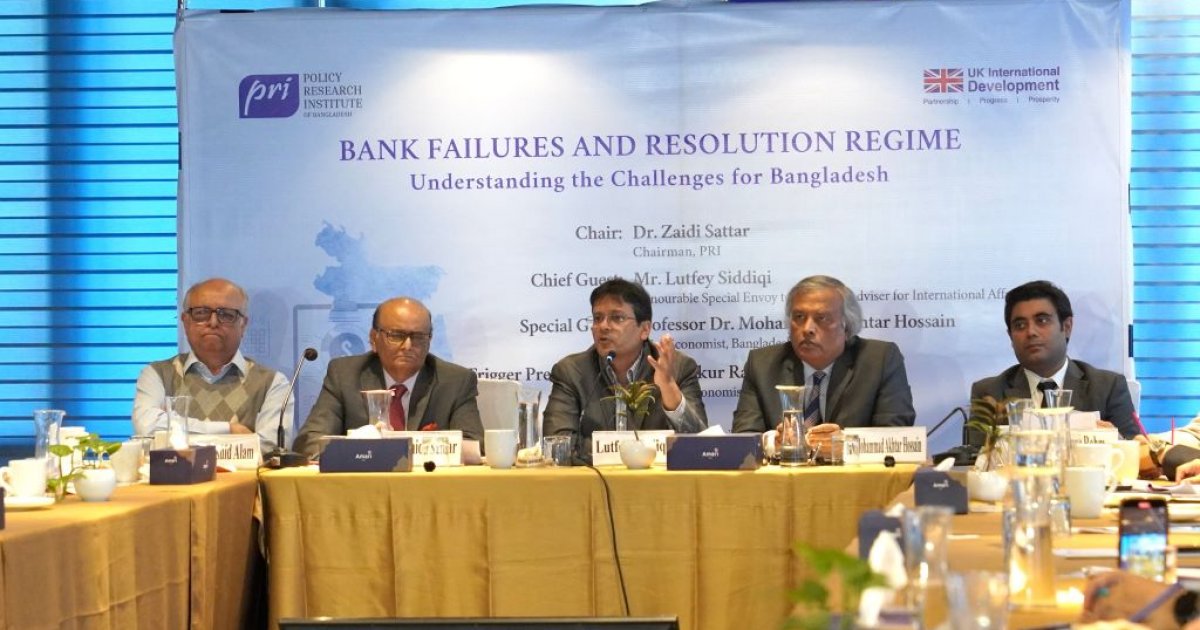
The Policy Research Institute of Bangladesh (PRI), with support from the Foreign, Commonwealth & Development Office (FCDO), hosted a high-level roundtable discussion titled “Bank Failures and Resolution Regime: Understanding the Challenges for Bangladesh” at Hotel Amari, Dhaka.
Lutfey Siddiqi, special envoy to the chief adviser for international affairs, attended the event as chief guest.
Emphasizing the urgency of reform, he stated: “If the banking sector continues with business as usual, nothing will change. Ensuring good governance—regardless of which political party forms the government—is essential.”
A presentation was delivered by Ashikur Rahman, principal economist at PRI.
He mentioned: “Passing the Banking Resolution Ordinance is only half the job. What must follow now is a serious investment in the processes, systems, and institutional capacities that will allow Bangladesh Bank and the financial sector to actually implement the resolution regime.”
The real task ahead is building the operational muscle: supervisory tools, valuation expertise, recovery mechanisms, and clear decision protocols, that can restore confidence and inject new energy into Bangladesh’s financial system. Only then will the Ordinance achieve its purpose: safeguarding stability and laying the foundation for a stronger, more resilient banking sector, he added.
Zaidi Sattar, chairman of PRI, said: “The recent rise of non-performing loans to nearly 35% is unprecedented, not witnessed even in countries hit by the global financial crisis, and requires careful analytical inquiry into how we arrived at this point.”
“In advanced economies, we spoke of institutions being ‘too big to fail’; in Bangladesh, many distressed banks are instead ‘too toxic to fail,’ as allowing them to collapse would transmit severe contagion across the economy. The encouraging sign is that the hemorrhage within the sector has stopped, and the banking sector is seeing some light again,” he further remarked.
Mohammad Zahir Hussain, executive director, Bank Resolution Department, Bangladesh Bank, and Prof Mohammad Akhtar Hossain, chief economist at Bangladesh Bank, attended as special guests.
Akhtar said: “Our FDI-to-GDP ratio is already very low, and the combination of high NPLs and ongoing political uncertainty is making it extremely difficult to attract foreign direct investment.”