
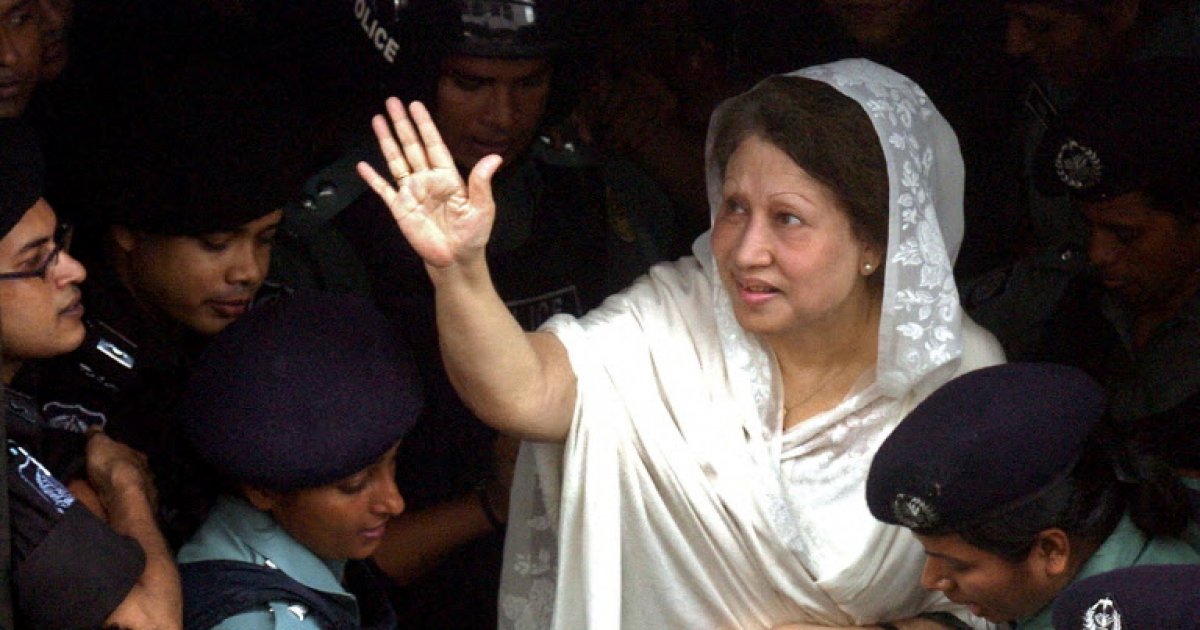
BNP Chairperson and three-time former prime minister Begum Khaleda Zia passed away at 6am on Tuesday while undergoing treatment at Evercare Hospital in Dhaka.
Over the course of her long political career, Khaleda Zia was arrested and imprisoned five times under different political regimes, reflecting Bangladesh’s turbulent political history and her role as a central figure in opposition movements and power struggles.
Arrests during anti-Ershad movement
After formally entering politics on January 3, 1982, Khaleda Zia emerged as a leading figure in the movement against the autocratic rule of president Hussain Muhammad Ershad.
During this period, she was arrested three times while participating in protests and political programs.
She was detained on November 28, 1983, May 3, 1984, and November 11, 1987.
However, these imprisonments were relatively brief, and she did not have to serve extended jail terms during the anti-Ershad movement.
Detention under the caretaker govt
Following the end of her government’s tenure in 2006, Bangladesh entered a period of political crisis marked by violence and the postponement of national elections.
In January 2007, a military-backed caretaker government assumed power.
During this period, corruption cases were filed against Khaleda Zia and her two sons.
She was arrested on September 3, 2007, from her residence on Moinul Haque Road in the cantonment area of Dhaka.
After being produced before the Chief Metropolitan Magistrate’s Court, her bail application was rejected, and she was sent to a special sub-jail established in the National Parliament complex.
While in detention, Khaleda Zia spent Eid-ul-Fitr on October 14, 2007, and Eid-ul-Azha on December 21 that year in jail.
On both occasions, family members were allowed to meet her and provide clothes, food and flowers.
At the time, her two sons—Tarique Rahman and the late Arafat Rahman Koko—were also in prison.
When her mother died in Dinajpur on January 18, 2008, Khaleda Zia was released on parole for six hours the following day to attend the funeral.
After spending a total of 372 days in prison, she was released on bail on September 11, 2008.
Imprisonment during Awami League govt
Khaleda Zia was imprisoned again in 2018 during the Sheikh Hasina-led Awami League government.
She was sentenced to a total of 17 years in prison in the Zia Orphanage Trust and Zia Charitable Trust corruption cases.
On February 8, 2018, she was arrested and sent to the central jail on Nazimuddin Road in Old Dhaka.
As her health deteriorated, she was later transferred to Bangabandhu Sheikh Mujib Medical University (BSMMU) Hospital for treatment.
She remained effectively imprisoned for more than two years.
On March 25, 2020, the government conditionally suspended her sentence, allowing her to receive treatment at home.
The move did not amount to a full release, as she remained under legal restrictions similar to house arrest.
Following changes in the political landscape after the 2024 student uprising, the president commuted her sentence through an executive order.
On November 27, 2024, Khaleda Zia was acquitted in the corruption case.
Leadership of BNP and political struggle
Khaleda Zia served as chairperson of the Bangladesh Nationalist Party for nearly 41 consecutive years.
She joined the BNP as a primary member on January 2, 1982, and was promoted to senior vice-chairperson in March the following year.
After President Justice Abdus Sattar fell ill, she was elected unopposed as acting chairperson on January 12, 1984, and became chairperson on May 10 the same year.
She was subsequently re-elected as party chairperson in the BNP’s fourth council in 1993, fifth national council in 2009, and tenth council in 2016.
After assuming party leadership, Khaleda Zia faced repeated political challenges.
She kept the BNP united and played a key role in building and sustaining the movement against Ershad’s military rule.
In 1983, she led the formation of a seven-party alliance and launched a coordinated anti-military movement later that year.
The movement continued in several phases until 1986 and later intensified into a one-point demand, popularly known as “Ershad Hatao,” from 1987.
Despite political divisions and setbacks, the agitation persisted, contributing to the fall of the Ershad regime and paving the way for parliamentary elections.
Following years of sustained protest, the BNP secured a parliamentary majority in the general election held on February 27, 1991, leading to Khaleda Zia’s first term as prime minister.
Her repeated imprisonments and political struggles remain a defining aspect of her legacy as one of Bangladesh’s most prominent and polarizing political leaders.