
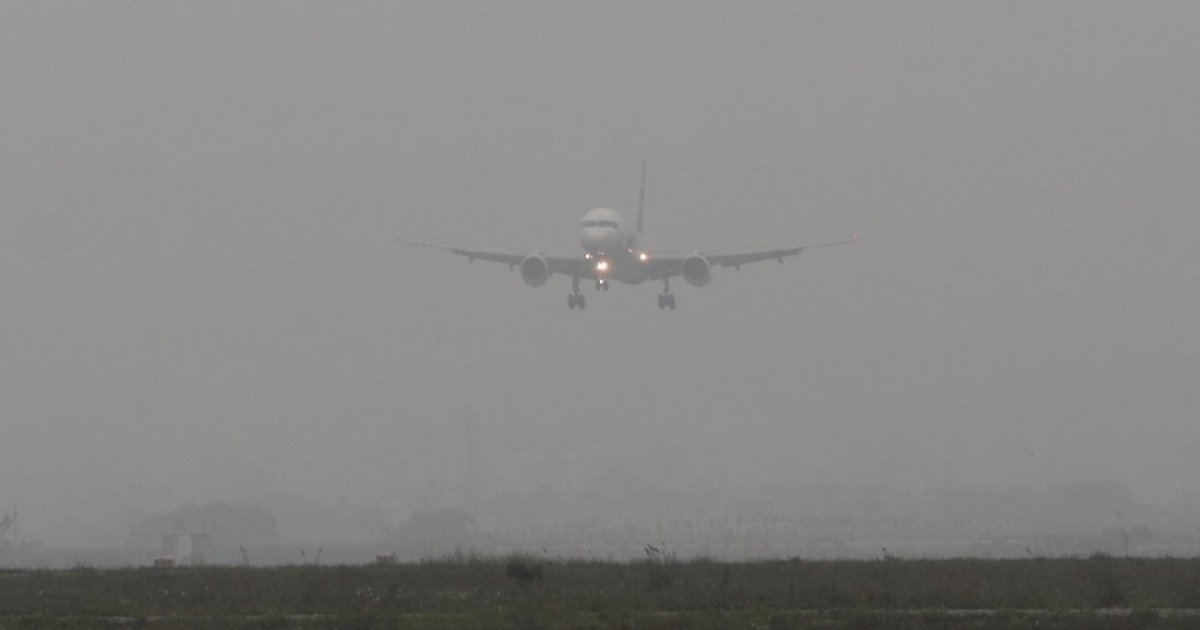
Dense fog is creating major disruptions at Hazrat Shahjalal International Airport, affecting the safe landing and takeoff of aircraft during the winter season.
According to airport sources, runway visibility has fallen below the minimum safe limit, forcing at least 50 flights over the past week to divert to nearby airports including Kolkata, Sylhet, and Chittagong. On Saturday alone, nine flights were diverted.
The disruption is affecting airline operations, causing schedule delays, increasing costs, and creating severe inconvenience for passengers. Airport officials say the inability to keep the full runway lighting system operational has resulted in the loss of the airport’s international-standard ILS (Instrument Landing System) Category-2 facility, which has been downgraded to Category-1.
“Currently, the airport is operating under ILS Category-1 only. Category-2 is crucial for maintaining safe and normal operations during dense fog,” said an aviation source. Without Category-2, many flights cannot land in Dhaka on schedule, and diversions to Chittagong, Kolkata, or other nearby airports have become necessary. Transit passengers are being hit the hardest.
ILS allows pilots to determine the exact position of the runway and land safely even in low visibility. The International Civil Aviation Organization (ICAO) classifies ILS into Category-1, Category-2, and Category-3 (A, B, and C). Category-1 generally requires 1,200 meters of visibility, while Category-2 allows safe landings at 500–750 meters. Category-3 enables landings even in extremely dense fog or near-zero visibility, though experts say implementing Category-3 B or C remains technically complex and costly for Bangladesh.
To maintain ILS Category-2, several technical conditions must be met: the ILS equipment must meet Category-2 standards; at least 95% of the runway lighting system—including approach, centerline, and edge lights—must be operational; and meteorological instruments measuring runway visual range must function accurately. Currently, the runway lighting system is below 95% functionality, preventing authorities from maintaining Category-2 operations.
Aviation expert and former Civil Aviation Authority member Kazi Wahidul Alam said: “Category-2 cannot be ensured just by installing equipment. Continuous monitoring, maintenance, and rapid fault resolution are essential. Even minor negligence can have major consequences. If full inspection and repair of the lighting system had been completed before winter, this situation could have been avoided.”
Passengers are facing severe difficulties, particularly those on international flights during night and early morning hours. Many flights are forced to circle for hours or divert to alternative airports, requiring passengers to return to Dhaka by bus or another flight, increasing both time and costs. Complaints also indicate that diversion information is often delayed, worsening uncertainty and inconvenience.
A private airline official said pilots cannot see the runway properly due to ILS malfunction in dense fog, forcing landings at other airports. “This disrupts schedules, inconveniences passengers, and increases costs. The government should take necessary measures,” the official added.
Muhammad Kawser Mahmud, assistant director (Public Relations) of the Civil Aviation Authority (CAAB), said a Thai Airways aircraft damaged the lighting system during landing on October 29, prompting the downgrade from Category-2 to Category-1. The lights are costly and imported, but a tender has been announced, and installation is expected soon. He confirmed that diversions occur when flights cannot land due to dense fog.
Flight diversions result in additional fuel costs, fines, crew rescheduling, and complications in subsequent flights. According to an airline official: “A single diversion affects multiple subsequent flights, causing operational losses and passenger dissatisfaction. If this problem persists during winter, the entire network schedule comes under pressure.”