
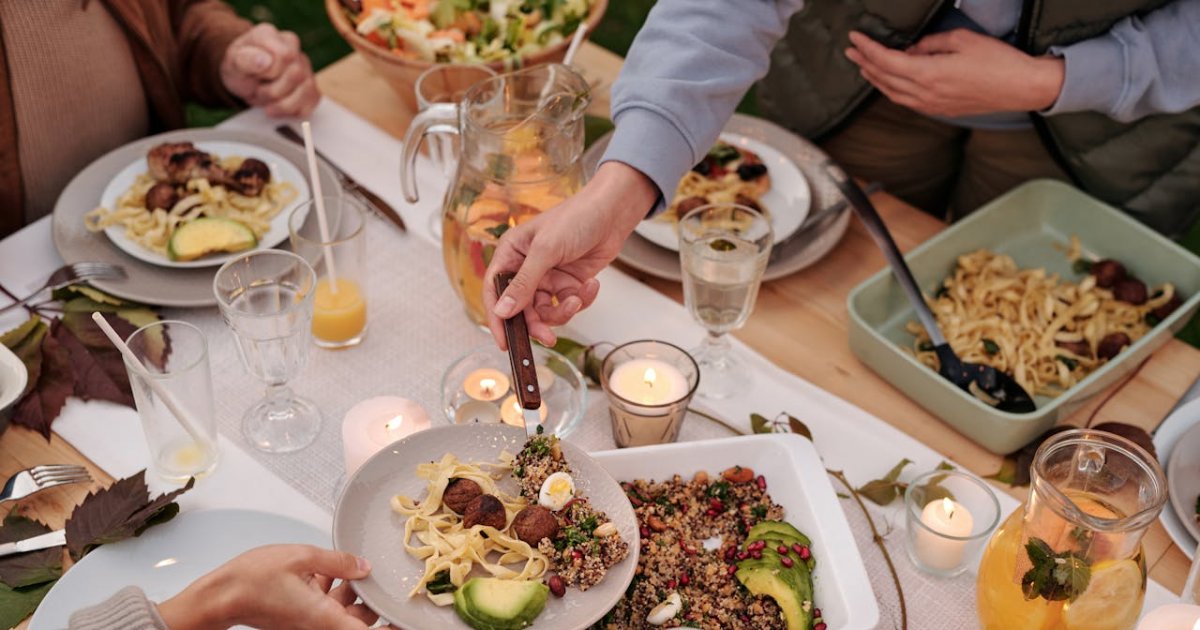
Caden: Would you mind elaborating on how your culinary experiences have affected the way you write poetry?
Lee: I didn’t realize I wrote so much about food. Maybe it’s one of those things that just happens when you love something and it’s such a part of your life, it emerges in what you do. I love food. Growing up in Fresno…it’s such an agricultural city that it’s just a regular part of how we live.
Deya: This idea of food offering a third space for people is very interesting. You read about how in Italy, for example, people sit around the table for hours and they have these lively conversations, and it’s not just a matter of shoving food into your belly.
Lee: I think a culture and its approach to food mirrors its approach to other things. I don’t know if the “potluck” is an American concept…instead of people all cooking together, or the family doing all the cooking, you bring a dish if your last name starts with H through L, or something.
Deya: It’s outsourced.
Lee: Right, it’s outsourced. I’ve done a fair amount of travel in Asia and Latin America, and food in those cultures is looked at in a completely different way. Not as just something to scarf down, but as something meaningful in our lives.
Deya: Yeah, as something to share. In Bangladeshi culture, food is a main staple. People write books about it, it’s a place for humor, it’s a place where the family gets to meet up.
Lee: I think we can take a lot of good lessons from those countries and cultures.
Caden: It really cultivates that connection. Especially in Chinese and Korean cultures, sitting around the table and passing around food, I think that really harkens back to that idea of community. Just being able to share experiences and take care of one another.
Deya: [Later in interview] I did have one question. I don’t know if you’re familiar with Riz Ahmed? He said something that made me think of you, on the difference of being a Muslim with Pakistani origins from England, and how that carries in the States. He said,
“When I was growing up, I felt like I had to qualify and say, ‘I’m British-Pakistani’. But now I feel like this is what ‘British’ looks like. And hopefully, people will see that’s what Americans can look like as well.”
I was wondering, how do you feel about the hyphenated identity that Caden, you, and I all get?
Lee: It’s a great question. I remember when my first book came out, I thought a lot about hyphenation, identity, belonging, how I would be seen. This interviewer asked me if I considered myself an American poet, Asian-American, a Korean poet, a Korean adoptee? What I told her was what I still feel, and that is that I feel like I’m all of them. I agree wholeheartedly with Ahmed’s quote. I can’t fathom and certainly wouldn’t want to live in a place where everyone was the same. But I do also have to say that I don’t want to think that the way I see the world is the way everybody has to see the world.
Deya: I love what you’re saying, that you’re all of them. It’s not an “either-or” situation. You’ve kind of embraced the plurality.
Lee: Yeah. It’s a common logical fallacy, the false dilemma. Either-or. Right or wrong. Coke or Pepsi. Good or bad. Like it or leave it. You know, this room that we’re in is wonderfully diverse. That’s where I feel most alive. I don’t know if it comes from my adoption. Do you have a sense of this kind of plurality, or that California is a place like this?
Caden: The first time I traveled out of California, I was surprised. My first state was North Carolina for some conference, and I was overwhelmed. I felt like I was an actual minority. It was a very weird experience. California was almost like this magical place where everyone coexists at once. Within that scope, being able to be all these things, that’s something I’ve really been able to grasp and hold on to.
Deya: Yeah. I think what I feel when I read your poems is there’s this kind of microcosm of this experience here. I was born in New York and I kind of grew up abroad, but I’ve been visiting [California] since I was young. And there’s no one language, there’s no one home. It’s in the people. I always envision this quilt of mismatched fabrics that is somehow stitched together. It’s been that way since there’s been communities here.
Caden: [Later in interview] There’s this sort of disillusionment about all the different types of Asian. How has this homogenization affected your approach in being seen as a prolific Asian-American author, or even your own self conceptualization?
Lee: “Go back to where you came from.” What’s interesting about that statement is that it’s not concerned with where you’re from as long as you don’t stay here. I think that whether it’s homogenization, disregard, lack of concern, or lack of interest of that nuance or of those cultures, it’s just such a simple, lazy reduction that is wrapped inside of aggression and violence. For me, poetry is almost an antidote to all of those things. Poetry, to me, is rooted in things like attention. Surprise. Nuance. Slowness.
Deya: Slowness, I love that.
Lee: Yeah. All things that the arts can sort of bask in and roll around in to create something vibrant and new and maybe insightful, but at least joyful.
Deya: It’s so interesting you mentioned attention. This is me being very Gen Z — I don’t know if you’ve seen the film Ladybird?
Lee: I have not, but I want to!
Deya: This character who’s very angsty, she’s grown up in Sacramento, she thinks, I want to get out, there’s no culture here. She says to her mom, “I just want to live through something!” It’s very tongue-in-cheek. But she wants to go out to the East Coast. And at one point, a counselor says to her, “I was really enjoying reading your college essay and seeing how much you love California, how much you love Sacramento.” And she goes, “I mean, I guess I pay attention.” And [the counselor] says, “Well, don’t you think they’re the same thing? Love, and attention?”
Lee: I love that. Now I really want to see that film. I think love and attention are nearly synonymous. Especially if you think of what it feels like to be ignored, or not seen. It certainly doesn’t feel loving. Any time a person can pay attention to somebody, listen to them over coffee or lunch, just value what they’re experiencing…in my life, I feel like I’m wanting more of that. Just being in situations that are joyful or artful. If necessary, I’m not averse to fighting for [that]. I also think that’s a kind of attention.
Deya: I think we’ve gotten a bit of an answer for how we started this, actually. About how food affects us. Maybe it’s about the attention. We’re paying attention to each other.
Lee: Yes! And the best food takes a while!
Happy holidays to all of my Seen And Heard readers. – Deya
Deya Nurani is a freelance contributor based in the US. To listen to this entire conversation, visit “The Eardrum” podcast on Spotify and Apple Podcasts.