

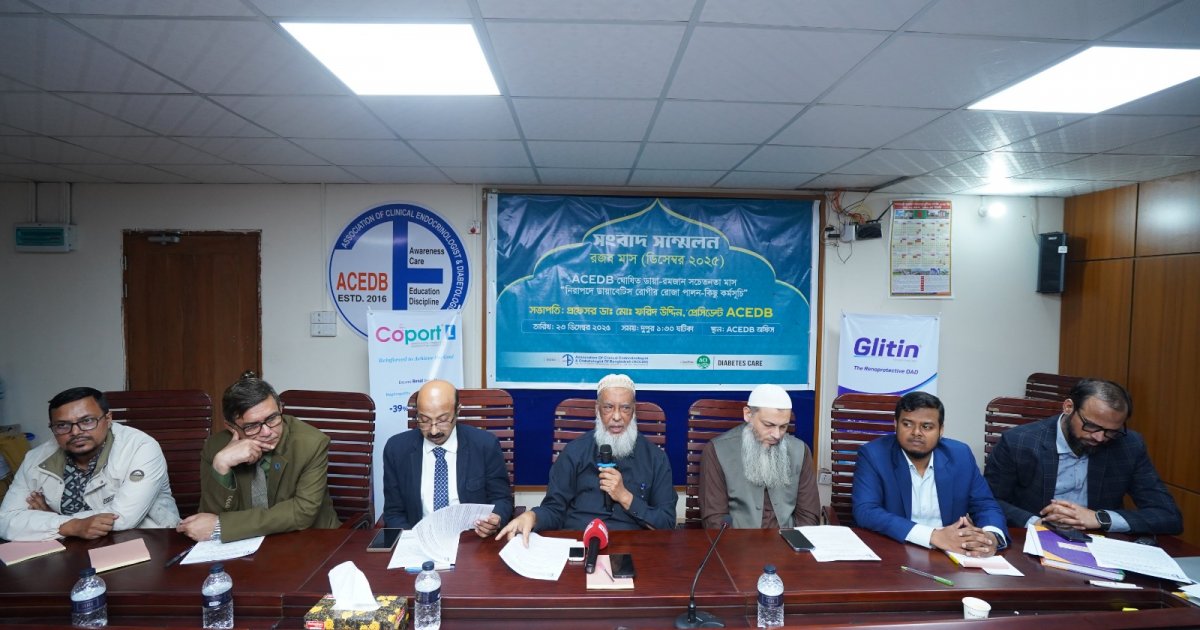
People with diabetes can observe fasting during Ramadan safely by following certain guidelines and taking proper prior preparation. Diabetic patients are advised to consult a physician at least two to three months before the start of Ramadan to adjust their lifestyle and treatment plans accordingly.
This information was shared at a press conference organized by Association of Clinical Endocrinologist & Diabetologist of Bangladesh (ACEDB) on December 23, in anticipation of the upcoming month of Ramadan.
The press conference was held at the organization’s office located at Motaleb Tower in Paribagh.
The event was presided over by Professor Dr. Md. Farid Uddin, president of ACEDB and founding chairman of the Department of Endocrinology at Bangabandhu Sheikh Mujib Medical University (BSMMU).
Speakers at the press conference stated that blood glucose testing can be performed while fasting, and insulin injections may be taken if necessary. According to Islamic scholars, these actions do not invalidate fasting.
Therefore, diabetic patients can observe fasting by following proper medical guidelines. In case of doubt, patients are advised to consult experienced, religiously knowledgeable physicians or qualified Islamic scholars.
Research shows that nearly 80% of people with diabetes in Bangladesh observe fasting during Ramadan.
According to global statistics, approximately 50 million people with diabetes worldwide fast during Ramadan.
However, diabetic patients who fast without medical consultation may face several complications, particularly (1) hypoglycemia (low blood sugar), (2) hyperglycemia (high blood sugar), (3) diabetic ketoacidosis, and (4) dehydration.
ACEDB emphasized that diabetes is not a barrier to fasting for those who are physically able. Proper preparation is essential.
Diabetic patients should consult their physicians and take preparatory measures at least two to three months before Ramadan (during the month of Rajab).
Recent studies indicate that patients who prepare in advance experience significantly fewer complications, including hypoglycemia, during Ramadan compared to before.
Modern medical management has made fasting safer and more feasible for people with diabetes. Various studies have also proven that fasting offers multiple health benefits.
Experts at the event noted that fasting encourages a disciplined lifestyle, which is essential for diabetes management.
Diabetic patients who consult their doctors in advance and maintain good blood sugar control while fasting can benefit further.
It would not be an exaggeration to say that the intention to fast motivates diabetic patients to take greater initiative in managing and controlling their condition.
They further stated that the Department of Endocrinology at Bangabandhu Sheikh Mujib Medical University has long been implementing various awareness programs nationwide to promote safe fasting practices among diabetic patients.
Ahead of Ramadan, endocrinologists from the hospital regularly conduct awareness activities across the country.
To further emphasize the importance of this issue, the Clinical Endocrinologist and Diabetologist Association of Bangladesh declared the month of Rajab as “Diabetes and Ramadan Awareness Month” in October 2023.
Among others present at the press conference were Professor Dr. Indrajit Prasad, head of Department at Dhaka Medical College Hospital and General Secretary of ACEDB; Professor Dr. Mir Mosharraf Hossain, head of Department at Holy Family Red Crescent Medical College; associate professor Dr. Moinul Islam of Dhaka Medical College; associate professor Dr. Mohammad Atikur Rahman of the National Institute of Neurosciences and Hospital; resident physician Dr. Md. Ashikur Rahman of Dhaka Medical College; and Dr. Md. Mahmud Hasan consultant endocrinologist Dhaka Medical College.