
Ahead of the upcoming national parliamentary election, civil society representatives in Khulna have urged political parties to include clear and specific commitments in their election manifestos for structural reforms in the power and energy sector, with a strong focus on transitioning to renewable energy.
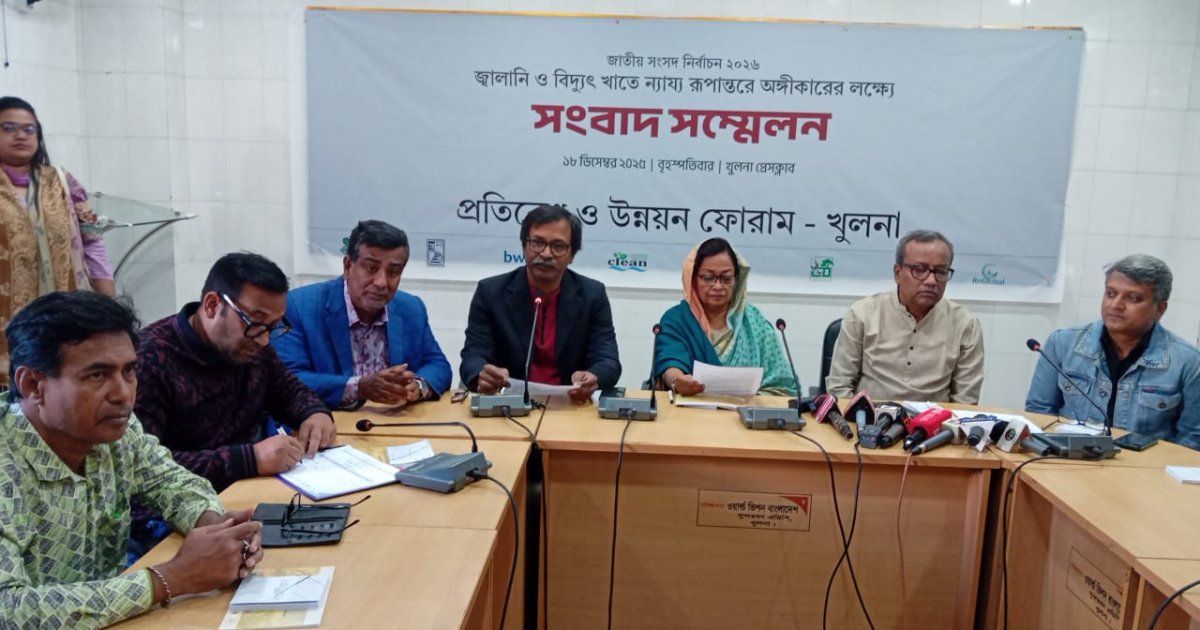
The call was made at a press conference held at 11am on Thursday at the Khulna Press Club, where the Environment and Development Forum, Khulna placed a 13-point set of demands aimed at ensuring a just and sustainable transition in the country’s energy sector.
Senior journalist and forum member Gauranga Nandi read out a written statement at the event. He said that fulfilling international commitments, particularly under the Paris Agreement to limit global temperature rise to between 1.5°C and 2°C, requires Bangladesh to reduce its dependence on fossil fuels and accelerate the shift towards renewable energy.
The statement reviewed the current state of Bangladesh’s power and energy sector, noting that despite a significant increase in electricity generation capacity over the past one and a half decades, the sector is now facing a severe financial and structural crisis. It said around Tk 1.72 trillion has already been paid as capacity charges, while total sectoral debt has climbed to approximately Tk 2.53 trillion. In addition, large-scale annual imports of fossil fuels are putting increasing pressure on foreign exchange reserves, posing a serious threat to national energy security.
Speakers at the press conference also highlighted long-standing corruption, irregularities, and policy inconsistencies in the power and energy sector. They said the lack of transparency and accountability has caused confusion among citizens, even in basic services such as electricity connections, which they described as contrary to democratic principles and good governance.
Among the key demands placed before political parties were the immediate formulation of a comprehensive national renewable energy policy, repeal of indemnity laws in the power and energy sector—including those related to quick rental power plants—and the introduction of open, transparent, and competitive tendering processes.
The forum also demanded that renewable sources account for at least 30 percent of electricity generation by 2030 and 40 per cent by 2041, while calling for a halt to new coal-, gas- and oil-based power plants and LNG terminals. A long-term roadmap to achieve 100 percent renewable energy by 2050 was also proposed.
Other demands included reducing duties on electric vehicles, upgrading the national grid into a smart grid, subsidising solar projects, creating green jobs for youth, and ensuring inclusive participation in energy policymaking. Speakers concluded that strong political commitment is essential to end fossil fuel dependence and build a sustainable, people-centred energy system.