
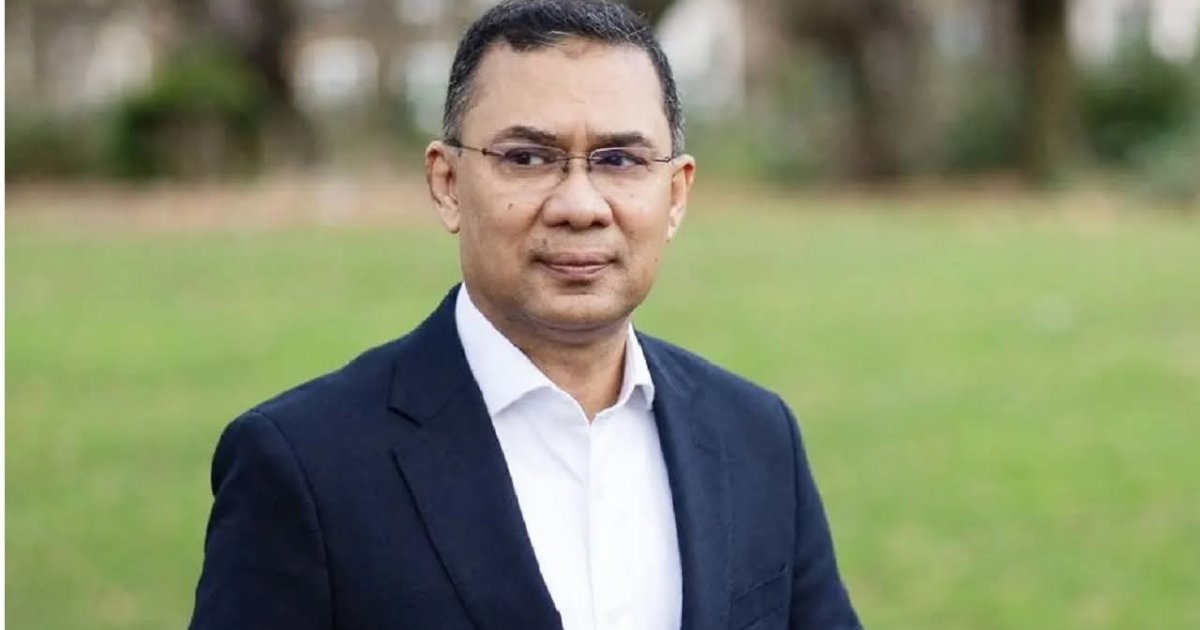
After 17 years in exile, BNP acting chairman Tarique Rahman is set to return to Bangladesh, marking a pivotal moment for the party and the country’s political landscape.
His homecoming comes after almost two decades of political engagement conducted largely from abroad, during which he remained a central figure in BNP decision-making despite living in London.
Tarique Rahman left Dhaka with his family on September 11, 2008, during the tenure of the army-backed caretaker government.
What followed was a prolonged period of exile, shaped by legal battles, political upheaval and personal hardship.
Yet, throughout these years, he did not disengage from politics.
Instead, he steered the BNP remotely – issuing directives, shaping strategy and communicating with party leaders through virtual platforms – ensuring his continued influence on national politics.
Early life and education
Born on November 20, 1965, Tarique Rahman is the eldest son of former president and freedom fighter Ziaur Rahman and former prime minister Begum Khaleda Zia.
He began his education at BAF Shaheen school before studying at St Joseph school and Dhaka Residential Model College.
In 1984, he enrolled in the Department of International Relations at the University of Dhaka, though his political activism soon took precedence over academic pursuits.
Rise within BNP
His first public political appearance came in 1986, during the regime of Hussain Muhammad Ershad, when he evaded house arrest to address a press conference at the National Press Club.
In that speech, he accused state agencies of suppressing opposition movements ahead of what he termed a stage-managed election.
The move brought him immediate attention, and repeated house arrests alongside his mother.
Tarique Rahman formally entered BNP’s politics in 1988 as a primary member in Gabtali upazila of Bogura, his ancestral area.
His role within the party expanded steadily, and in June 2002 he was appointed senior joint secretary general.
From 2001 onwards, he became increasingly visible in national politics during the BNP-led four-party alliance government.
Controversy and crackdown
Critics have long argued that during Khaleda Zia’s premiership, Tarique Rahman emerged as a parallel centre of power within the party.
As political tensions escalated toward the end of that government, widespread unrest culminated in the takeover by the army-backed caretaker government in January 2007.
On March 7 that year, Tarique Rahman was arrested and produced before a Dhaka court wearing a bulletproof jacket and helmet.
During remand, he was subjected to what his party and family described as severe physical and mental torture.
He spent 18 months in prison and was shown arrested in 13 cases, eventually securing bail in all.
He was released on September 3, 2008, and left for London eight days later.
Political analyst Mohiuddin Ahmed later said that his research suggested Tarique Rahman was tortured with the apparent aim of pressuring Khaleda Zia to leave the country.
Leadership from exile
In 2009, Tarique Rahman was elected senior vice chairman of the BNP.
His leadership role became decisive in 2018, when the party named him acting chairman following Khaleda Zia’s imprisonment in a corruption case.
Since then, he has exercised full control over the party’s strategic and organizational decisions.
The period was also marked by personal loss.
In 2007, both Khaleda Zia and Tarique Rahman’s younger brother, Arafat Rahman, were arrested.
Arafat was later released on executive order and went abroad for treatment, eventually settling in Malaysia, where he died of a heart attack in January 2015.
During the Awami League’s tenure, Tarique Rahman was convicted in the August 21 grenade attack case and named in several other cases.
Court orders at one stage barred the broadcast of his speeches, pushing him to rely heavily on social media and online platforms.
Party leaders say this period saw him strengthen direct links with grassroots activists while overseeing policy formulation from London.
The road home
Following the fall of the Awami League government on August 5 last year, questions surrounding Tarique Rahman’s return dominated public discourse.
His remarks on social media – particularly during Khaleda Zia’s recent illness, when he said the decision to return was “neither unlimited nor under sole control”- sparked anxiety within BNP ranks.
The party, however, had already announced that Tarique Rahman would lead the BNP into the 13th parliamentary election and, for the first time, contest a seat himself.
After the Election Commission announced the February 12 election schedule, the BNP confirmed on December 11 that he would return to Bangladesh on December 25.
After the previous Awami League government cancelled his passport and national ID, Tarique Rahman applied for political asylum in the United Kingdom in 2012, which was granted within a year – a fact disclosed publicly in 2018 by BNP Secretary General Mirza Fakhrul Islam Alamgir.
In his personal life, Tarique Rahman married Dr Zobaida Rahman in 1994.
She is a cardiologist and the daughter of the late Rear Admiral Mahbub Ali Khan, a former navy chief and two-time minister.
The couple has one daughter, Zaima Zarnaz Rahman, who also returns to Bangladesh with her father.