

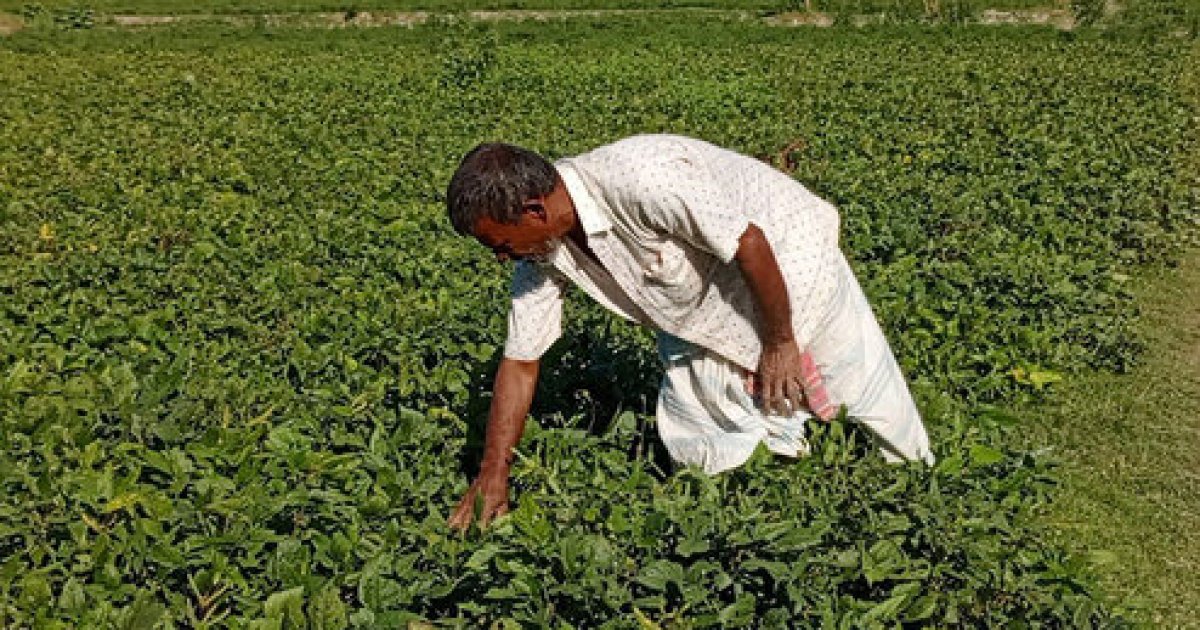
Black gram (mashkalai) has been cultivated on vast tracts of fallow land in Sariakandi upazila of Bogra this year. Though harvest has already begun in some areas, farmers are now worried about low production. According to the agriculture office, high sowing density and untimely heavy rain have reduced its yield.
As char lands lie fallow in Sariakandi upazila, farmers cultivate black gram on these lands every year. This crop requires little labour—farmers only need to sow seeds. The seeds sprout, the plants grow, and eventually the pods develop. In some areas, the crop has matured, and farmers have already begun harvesting black gram.
As compared to previous years, this time the yield is lower. While farmers typically harvest 5-6 maunds of black gram per bigha, they are now getting only 3-4 maunds. Farmers believe that untimely heavy rainfall, pest attacks, and the absence of flooding this year are responsible for the poor yield. Although the plants grew well, they did not produce the expected number of pods.
Abdul Baki, a farmer from Batiya char in Sariakandi upazila, said he cultivated black gram on 10 bighas of land in Mathurapara char under Kornibari union. The plants grew well, but they did not produce the expected number of pods. Due to untimely rainfall and pest attack, his yield was low. As a result, he sold black gram plants for Tk40,000 to a buffalo owner, and the buffaloes are now grazing on the crop.
According to the Sariakandi agriculture office, black gram was cultivated on 530 hectares of land this year, although it set the target at 550 hectares. So far, black gram has been harvested from 10 hectares of land. Last year, the yield was 1,500kg per hectare. In the market, black gram is being sold for Tk 4,000 to 4,500 per maund.
According to the data available from Sariakandi agriculture office, black gram was cultivated on 535 hectares of land last year. This year, the yield per bigha is 4.5 to 5 maunds. The market price is Tk120 per kg.
Generally, black gram is sown from the Bangla month of Bhadra to the first 15 days of Ashwin, and harvested from the first 15 days of Agrahayan to the first 15 days of Poush.
Sariakandi Upazila Agriculture Officer Mohammad Ali Jinnah said that farmers have greatly benefited from cultivating black gram on fallow lands in char areas with low investment. This year, there have been reports of low yields in some places because farmers sowed the seeds too densely.
Dr. Tanvir Hasan, Senior Scientific Officer at Agricultural Research Institute in Bogra, said that compared to previous years, the number of pods per black gram plant is slightly lower this time. It appears that improper and untimely care may be the reason.