

Despite severe cold and dense fog over the past few days, mango trees have started producing buds in Rajshahi, particularly in Paba upazila.
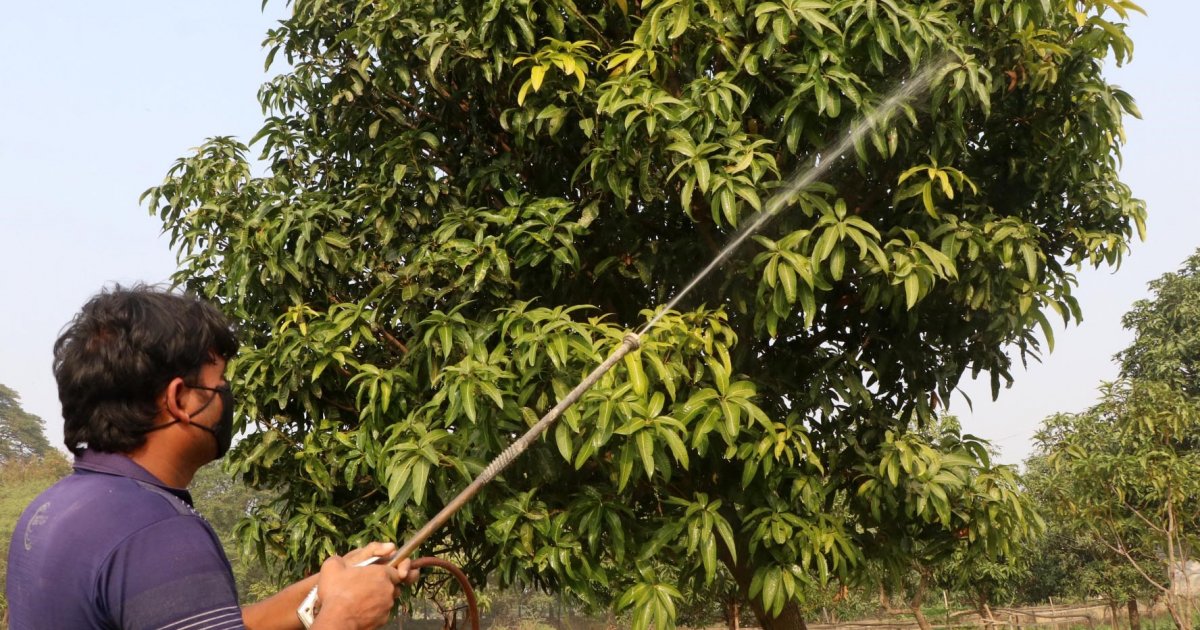
As it has increased the risk of fungal attacks on mango buds, farmers are now passing busy time irrigating trees, applying fertilisers, and spraying insecticides. Alongside local varieties, Bari-4, Bari-11, Amrapali, Ashwina, and Langra mango trees are now coming into bud.
During a recent visit to mango orchards in Paba upazila and near Shimla Park in Rajshahi city, it was seen that farmers were irrigating trees and spraying pesticides. They were also busy removing weeds and loosening soil.
Farmers said that without early preparations, there is a high risk of blossom drop prematurely. This is why they have intensified orchard care even before full flowering begins.
Mango farmer Shahidul Islam of Paba upazila said that although his trees flowered last year, he could not retain blossoms due to fog and disease, resulting in losses.
“This year, I started early by applying fertiliser and irrigation at the base of trees. I hope this will strengthen the blossoms and lead to better yields,” he said.
Another farmer Shaheen Mia said that while the intensity of cold and fog has been relatively high this year, overall weather remains favourable.
“Early blossoms have started appearing. We are digging around tree bases, irrigating, and spraying regularly. Based on last year’s experiences, we are being extra cautious,” he added.
According to Department of Agricultural Extension (DAE) in Rajshahi, the mango cultivation target for the current season has been set at 19,188 hectares, with an expected production of 245,606 metric tons.
In the previous fiscal year, mangoes were cultivated on 19,603 hectares, producing 249,952 metric tons. Although this year’s target area is slightly lower, early flowering and improved preparedness by farmers indicate the possibility of a good harvest.
Nasir Uddin, Deputy Director of Rajshahi DAE, said that farmers are being provided with necessary advice to ensure good production. “Each mango tree requires at least two applications of pesticides annually. Our field-level officers are working closely with farmers.”
Last year’s average yield was about 12.75 metric tons per hectare while the target for this year has been set at 12.8 metric tons per hectare, raising expectations of increased output, he added.
Dr. Shafiqul Islam, Chief Scientific Officer of Rajshahi Fruit Research Centre, said that blossoms currently visible are at a preliminary stage.
“Full flowering usually occurs in February and March. If proper care is taken from now and diseases are controlled, both flowering and fruit will be good. This year’s weather is comparatively favourable, so we are optimistic,” he said.
Paba Upazila Agriculture Officer M.A. Mannan said that mango production target in the upazila has been set at 12,487 metric tons from 925 hectares of land this season.
“So far, weather is favourable, and farmers have already begun orchard management. Some trees have just started to show blossoms. If there are no adverse weather conditions, there is a strong possibility of a bumper harvest,” he said.
Early mango budding in Rajshahi has infused farmers with renewed optimism. With proper care and continued favourable weather, early blossoms could form the foundation for a good mango harvest this season.