

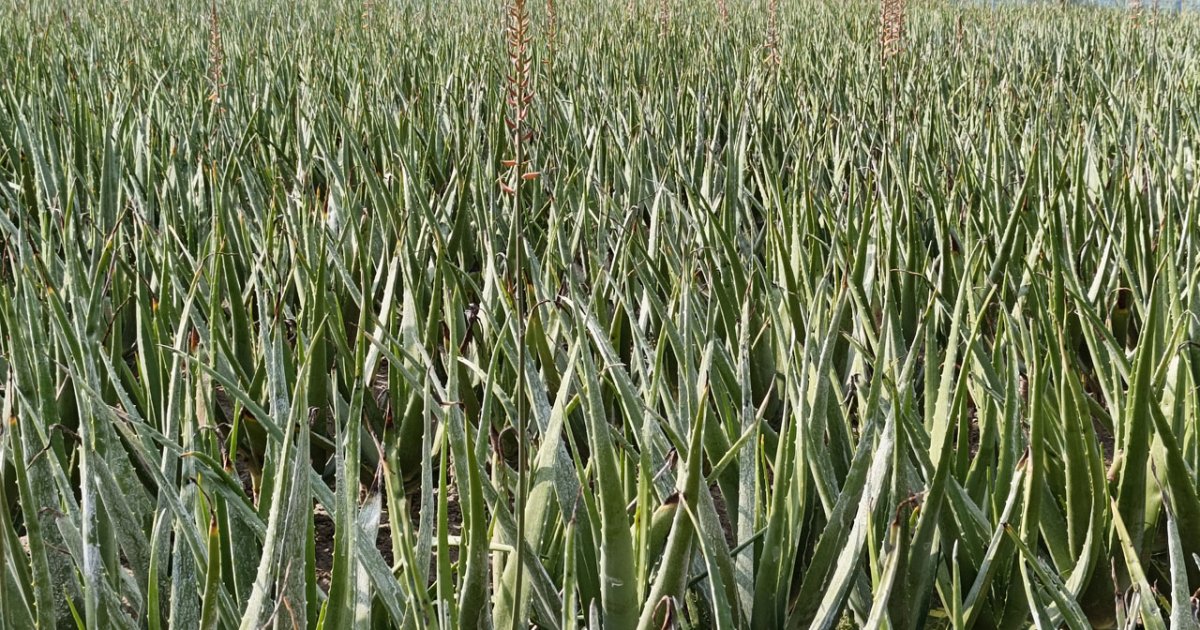
Just a few kilometresaway from Sadar upazila in Natore, Lakshmipur–Kholabariavillage stands out as the country’s only medicinal village, where vast tracts of land have been transformed into a thriving herbal hub. Nearly 150 varieties of medicinal plants are cultivated on about 155 hectares of land at Lakshmipur–Kholabaria village.
However, medicinal plant cultivation has changed the fortunes of thousands of people in Natore. A wide range of herbs, including aloevera, Ashwagandha and Shimul root, are grown here.The market value of these herbal products is estimated to be over Tk 100 crore.
Local residents said that the herbal revolution began about three decades ago when Afaz Pagla of Kholabaria started growing medicinal plants in his courtyard to support his traditional healing practice. His initiative gradually spreads to neighbouring households and eventually across the entire village. Today, medicinal plants grow everywhere—on farmlands, in homesteads, and even beside village roads.
The local agriculture office reports that medicinal plants are now cultivated on about 155 hectares of land in Lakshmipur–Kholabaria. Aloe vera alone covers nearly 70 hectares, with an annual production of around 15,000 tonnes. More than 2,000 farmers are directly involved in herbal farming, collectively producing medicinal products worth Tk 100 crore.
The peak season for aloe vera cultivation runs from November to February, when about 10,000 saplings are planted per bigha. Leaves are harvested three months after planting and continue to yield for up to two years. Farmers use organic fertilisers along with controlled amounts of urea, TSP and MOP. Lime is applied to prevent leaf spots and rot, while bio-fungicides such as Trichoderma and sex pheromones are increasingly used to control pests.
Herbal farming has generated employment for at least 10,000 people in Lakshmipur–Kholabaria and nearby areas, engaging workers in planting, irrigation, weeding and harvesting.
However, farmers say they face a major challenge as aloe vera plants are damaged due to heavy rain. Continuous rain this year has damaged many plants, though growers arehopeful of recovering losses since the plants continue to yield for two years.
Another major constraint is the lack of storage and processing facilities. Fresh aloe vera leaves cannot be preserved for long, forcing farmers to transport them quickly to the factories of pharmaceutical companies in Dhaka and other regions. Companies such as Hamdard are among the major buyers. A juice company inBhalukaupazila of Mymensingh also collects medicinal plants every day. Dried herbs are traded at local markets, including New Bazar, Amirganj, Hajiganj and Lakshmipur.
Atiqur Rahman, director of Ibrahim Herbal Store, said his shop alone sells herbal products worth around Tk 50,000 every day, attracting traders from across the country.
Farmers and cooperative leaders are now demanding the establishment of a modern cold storage facility for aloe vera, along with factories to produce herbal cosmetics such as soap and shampoo. They believe such initiatives would significantly boost the local economy.
Shahidul Islam, president of Kholabaria Herbal Cooperative Society, also called for a full-fledged herbal research centre. “If quality testing and standard control are ensured here, big companies will come directly to us, guaranteeing fair prices for farmers,” he said.
Local agriculture officials say that herbal cultivation is expanding rapidly, with new entrepreneurs joining the sector.
Habibul Islam, Deputy Director of Department of Agricultural Extension in Natore, said that the establishment of cold storage, processing units and a research centre could transform Lakshmipur–Kholabaria into a major industrial and economic hub for the country.