

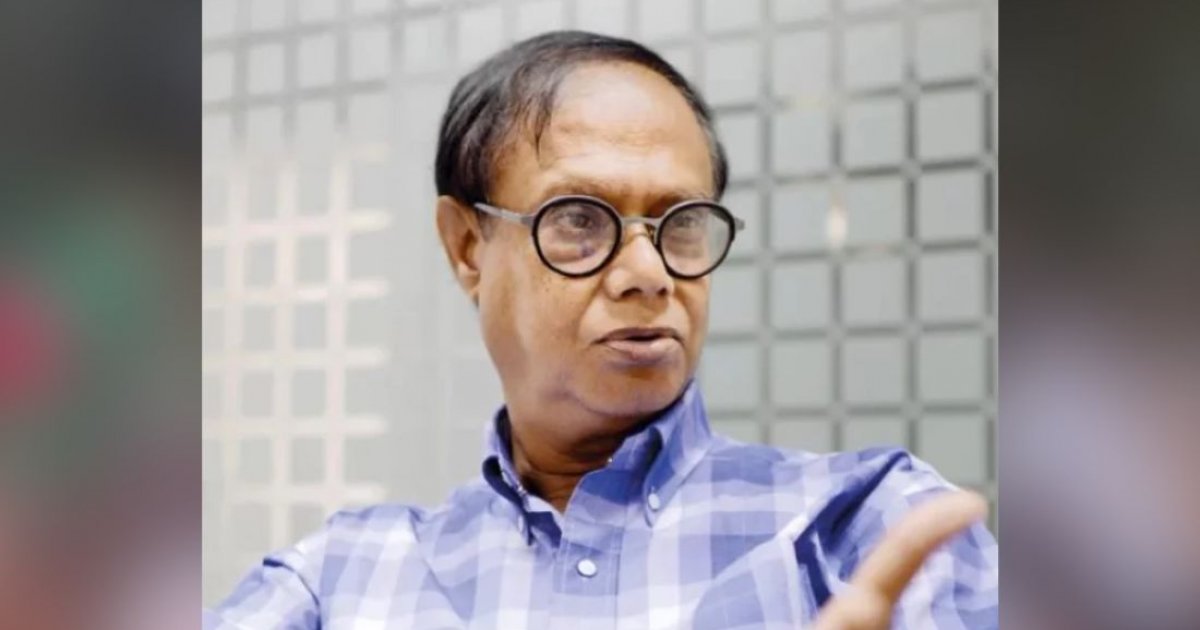
Bangladesh Bank Governor Ahsan H Mansur said that the financial sector has shrunk in the last few years due to huge money laundering from the country. At one time, the country’s foreign exchange reserves were $48 billion, but they had fallen below $20 billion.
Although the reserve situation has improved at present, if the economy is to grow sustainably, money supply should be increased not by printing money, but through natural and practical means.
He made these remarks as the chief guest at the inaugural discussion meeting of the public awareness program on cashless transactions organized by Bangladesh Bank in Cox’s Bazar on Monday.
The governor said that currently the country’s gross foreign exchange reserves have increased to more than $32 billion. As a result, the money supply in the market has increased slightly.
However, the central bank’s goal is to increase money supply in a way that does not put pressure on inflation.
He said that Bangladesh’s money supply is still much lower in proportion to GDP than many countries including China, India and Vietnam. To fill this gap, there is no alternative to increasing remittance flow, attracting foreign loans and investments.
Mansur further said that if the supply of foreign currency can be increased, the flow of money into the economy through banking channels will increase and the entire banking sector will be strengthened.
Otherwise, a few banks may grow in isolation, but the desired benefits will not come to the overall sector. If there is not enough money supply in the economy, the deposits of the banks will not increase either.
He also said that if the huge amount of money that was laundered abroad in the past was in the economy, much of today’s crisis could have been avoided. Initiatives should be taken to bring that money back to the country gradually and following a specific method.
Regarding cashless transactions, the governor said that there is no alternative to digital transactions to reduce the use of cash. For this, Bangladesh Bank wants everyone to have a smartphone.
Addressing the banks, he said that emphasis should be placed on the use of credit cards along with debit cards and credit card limits should be increased. Fintech and financial inclusion are closely related to each other. In the next 10 to 15 years, the country’s conventional banks will gradually transform into digital banks. For this, the necessary investment needs to be made now.
The seminar, held at Sayeman Beach Resort in Cox’s Bazar, chaired by Bangladesh Bank Executive Director Arif Hossain Khan, was attended by managing directors of various banks and financial institutions.
The keynote presentation was delivered by Bangladesh Bank’s Payment System Department Director Rafeza Akhter Kanta and Additional Director Md. Parvez Anjam Munir.
The article highlighted the potential and challenges of cashless Bangladesh. At the same time, it was proposed to reduce the Merchant Discount Rate (MDR) or make it temporarily free through incentives to encourage cashless transactions.
Saiful Islam, managing director of SSL Commerz, the lead partner of the cashless campaign, said that their organization is not a competitor of the bank, but a collaborator. It is necessary to determine a clear framework for merchant acquisition between banks, financial institutions, payment service providers (PSPs) and payment system operators (PSOs) through the central bank.
He said that there is great potential for cashless transactions in tourist areas. It is possible to arrange for digital payment for vans, small shops and even beach chair rentals.
Earlier, a rally was held on Monday morning with the participation of various banks and financial institutions.
The two-day program concluded with the distribution of pamphlets on cashless transactions in the afternoon.
Bangladesh Bank said that the cashless campaign has already been launched in 11 places outside Dhaka and the program will be expanded to other areas of the country in phases.