

Most often, the discussion on climate change revolves around plantation, switching to clean energy, or advocacy. However, it is equally important to discuss the attribution science of climate change that encompasses algorithms, data dashboards, satellites, sensors, and mobile apps. Digital technology, also known as Digitech, is not just a helpful but an important element in climate action as a frontline tool.
Digitech in climate change can be used in forecasting a flood, tracking deforestation, mapping urban heat zones, or measuring carbon footprints. In many cases, digital tools are not just accelerating the response but making action possible in the first place.
In a world where every degree of temperature matters, being able to measure change with accuracy isn’t optional; it’s essential.
Satellites today can monitor the health of our forests and coastlines in real time. Remote sensing and open Application Programming Interface (APIs) from platforms like NASA Earth Data allow access to this data and use it for local climate assessments. However, Digitech can be more effective when it connects global tools with local realities. Early warning systems and dashboards now predict floods with far greater accuracy.
Connecting data with reality
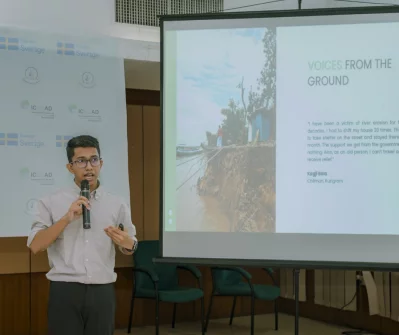
In Bangladesh, digital platforms distribute weather alerts to provide an instrumental value. In low-lying, vulnerable areas like Feni, where I recently worked with my team to assess flood impact, including health data, migration patterns, through satellite observations, the layered data dashboard helped the local authorities act faster and effectively.
We built the dashboard to spotlight the health risks faced by climate-displaced women. Using open-source tools and NASA climate APIs, we visualized the risks on a map. The outcome? A conversation that shifted from vague concern to targeted policy interest when we showcased it in the NASA Space Apps Challenge 2024. That’s what tech does: it translates complexity into action.
Another important thing is that young people are not just users of this technology. We’re builders, coders, and creators. Many of us already know how to design websites, scrape datasets, build apps, or create interactive visualizations. The skills are already there. What we need is recognition that these digital contributions matter just as much as physical activism. Climate hackathons, open-source challenges, and data storytelling are today’s protest marches, just in a different form.
From my experience building Mindy (a mental health platform) and GreenBay (a plastic-scanning application to reduce waste), I have learned that tech allows ideas to travel, to scale, to cross borders. It breaks down the barrier of “too local to matter” and instead asks, what if your hyperlocal solution is exactly what someone halfway across the globe is looking for?
But we cannot talk about Digitech without talking about digital divides. Access to the internet, devices, and training is still not equal. Especially in rural or marginalized communities. This is a major risk. If tech-based climate solutions are only usable by the urban elite, we are widening the very gap we set out to close. That is why inclusion has to be built into every stage. From the language of the interface to the availability of offline modes. If a flood warning system is not understandable to the person living by the river, it doesn’t matter how “smart” it is.
Digitech is not a silver bullet. It will not fix everything. But it is a force multiplier. It amplifies what works, reveals what’s broken, and gives us the tools to act faster and more fairly. It turns climate action from something abstract into something measurable and real.