
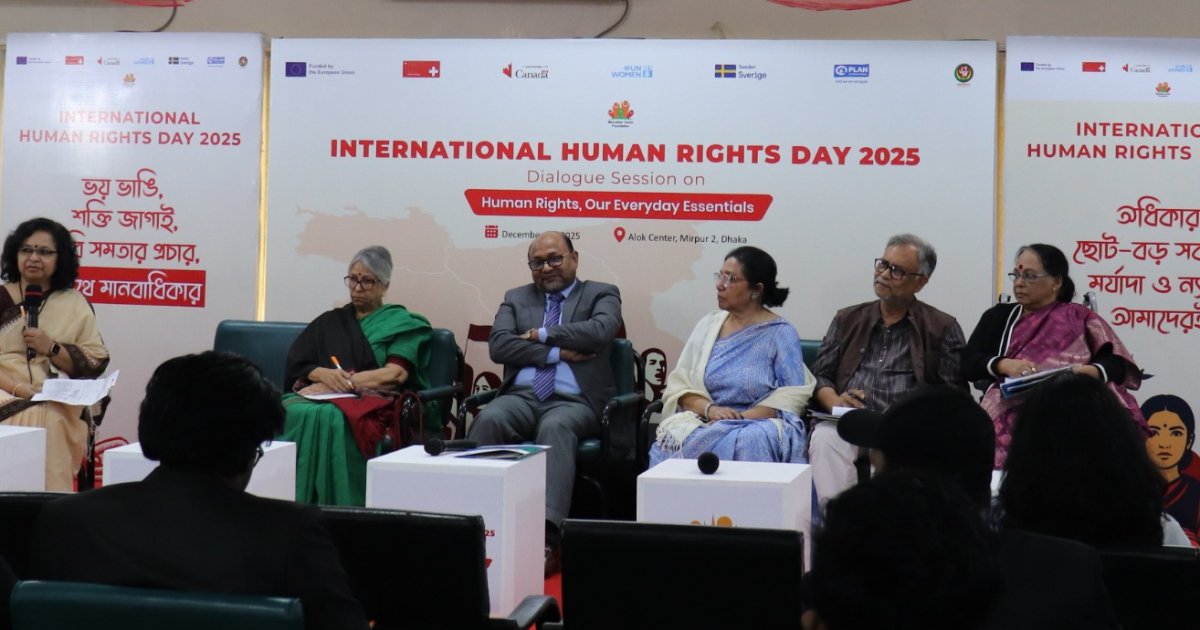
Speakers at an International Human Rights Day discussion on Thursday expressed serious concern over growing human rights violations in Bangladesh, warning that women, children, minority groups, and marginalized communities are increasingly the most affected.
The event, organized by Manusher Jonno Foundation (MJF), was held at the Alok Training Center in Dhaka as the closing program of the 16 Days of Activism Against Gender-Based Violence. This year’s Human Rights Day theme, “Human Rights, Our Everyday Essentials,” emphasized that human rights must be protected daily, not only on special occasions.
Participants highlighted recent incidents, including comments and online harassment directed at the late Begum Rokeya, describing them as signs of growing societal intolerance and violations of human dignity. They called on citizens to speak out against injustice and demand accountability from state institutions.
Md Daud Miah, director general of the NGO Affairs Bureau, said Bangladesh must foster both sympathy and empathy. He stressed that development organizations should work with communities, not merely for them, to ensure genuine empowerment.
“If beneficiaries are empowered to choose what is right, we will see real progress,” he said.
Delivering the keynote paper, Banasree Mitra Neogi, director of Rights and Governance Programs at MJF, said human rights were closely tied to everyday dignity, safety, and equality.
“No development or digital advancement can be sustainable without justice and equal rights,” she added, urging support for marginalized voices amid global crises and climate vulnerabilities.
Rights activist Sultana Kamal noted that ensuring freedom of expression does not always require new laws but proper implementation of existing responsibilities. “Human rights violations are happening every day. Citizens must raise their voices; silence is not an option,” she said, warning that growing intolerance puts children and vulnerable groups at risk.
Shaheen Anam, executive director of MJF, emphasized that human rights must be practiced and protected every day. She urged citizens to remember Bangladesh’s history of fighting injustice and to stand against wrongdoing. Condemning the online attacks on Begum Rokeya, she called them “a worrying decline in values and respect for women.”
Participants also raised concerns about the lack of accountability within state institutions, particularly law enforcement agencies, noting that when freedom of expression is not protected, people feel unsafe speaking up, weakening democracy and community trust.
The program was attended by representatives from youth groups, civil society, development partners, journalists, and marginalized communities, including persons with disabilities, indigenous peoples, Dalits, and the Hijra community. They jointly called on the state to enforce laws properly, guarantee justice for victims, and uphold institutional accountability. They also stressed the need to cultivate respect, empathy, and equality in families, workplaces, and communities.
Rights activists Moshuma Paul, chairperson of Access Bangladesh Foundation, and Zakir Hossain, chief executive of Nagorik Udyog, highlighted the urgent need for stronger legal protections and more responsible governance.
The event was coordinated by Wasiur Rahman Tanmoy, coordinator of Media and Communication (Youth and Social Cohesion), along with the MJF media team.