
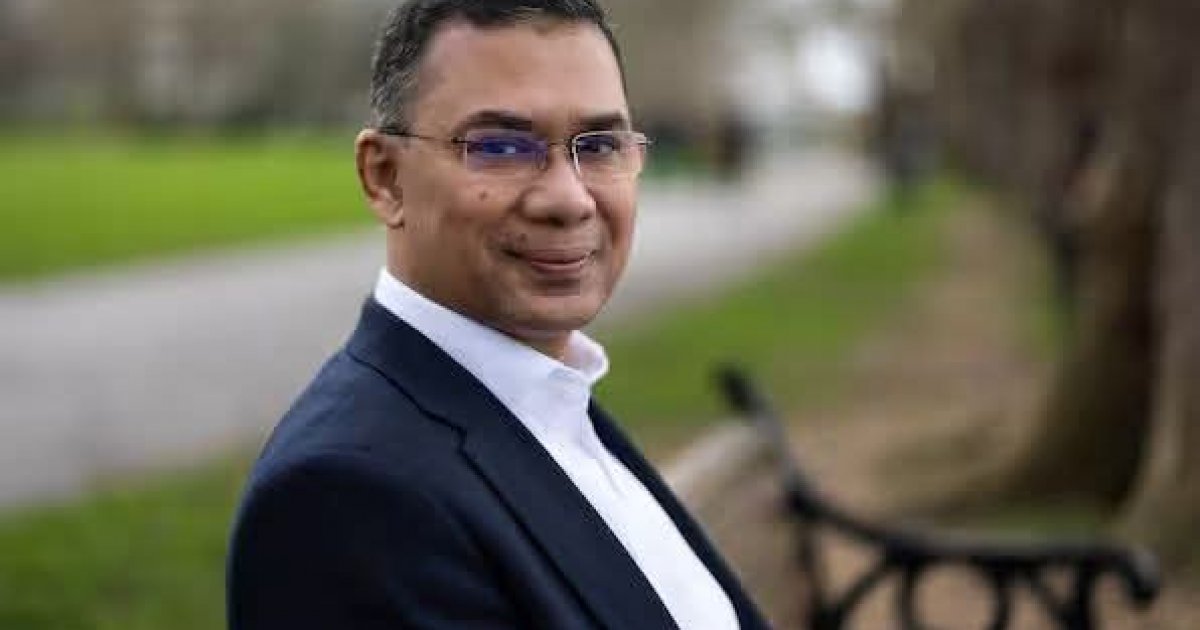
After 17 years in exile, BNP acting chairman Tarique Rahman returns to Bangladesh on Thursday, marking one of the most consequential moments in contemporary national politics.
His homecoming, following years of political activity conducted from London, comes at a time of deep uncertainty, high public expectations and mounting challenges ahead of the next parliamentary election.
Tarique Rahman left the country in September 2008 during the tenure of the army-backed caretaker government, after being released from prison under conditions that barred him from political activity for three years.
Now, after almost two decades abroad, the BNP has made extensive preparations to accord him a large public reception, with a massive stage erected on a 300-foot stretch on the outskirts of the capital.
Party leaders say his return has generated unprecedented enthusiasm among BNP activists, while many political observers believe his presence could play a decisive role in steering the country toward a more competitive and credible election.
Return amid political uncertainty
Political analysts caution, however, that Tarique Rahman is returning at a moment of exceptional volatility.
Following the fall of the Awami League government on August 5, 2024, the country has been governed by an interim administration led by Nobel laureate Dr Muhammad Yunus.
Questions remain over the timely holding of elections, the rise of extremist and non-state actors, and the weakened condition of law enforcement institutions.
“Tarique Rahman is not returning in a moment of relief or celebration alone, he is returning amid deep uncertainty,” said political analyst Dr Zahed Ur Rahman.
“This is perhaps the most challenging political moment Bangladesh has faced since the mid-1970s.”
Dr Zahed argued that while a fair election could potentially propel Tarique Rahman to the highest office, reaching that point will require navigating threats ranging from anarchic forces to institutional fragility.
“The election will happen, but getting there safely and credibly is the real challenge,” he said.
Immediate challenges before the polls
According to analysts, one of Tarique Rahman’s foremost challenges will be maintaining internal discipline within the BNP while preventing violence or fragmentation during the campaign period.
Concerns have been raised about non-state actors, criminal networks and extremist groups attempting to disrupt the electoral process.
“Security forces are not in ideal shape,” Dr Zahed said.
“Controlling chaos, ensuring internal party cohesion and preventing infiltration will be among his most urgent responsibilities.”
Reaching voters directly will also pose logistical and security challenges.
Analysts say his movements are likely to be restricted, limiting spontaneous public engagement.
“This will affect how he connects with the electorate,” Dr Zahed said, adding that while his return offers strategic advantages, it also exposes him to new vulnerabilities.
Post-election expectations
Beyond the election, expectations could rise sharply if the BNP returns to power.
Analysts warn that public frustration, especially among young voters, could quickly translate into political instability if economic recovery, employment generation and public security are not addressed swiftly.
“People expect change, but change cannot happen overnight,” Dr Zahed said.
“Managing expectations will be one of his biggest tests.”
Several BNP policymakers also point to the challenge of managing rebel candidates and seat-sharing arrangements, particularly if the party seeks an absolute majority amid ongoing uncertainty over constitutional reforms and a potential referendum.
From right-wing image to broader alliances
Since becoming acting chairman in 2018, Tarique Rahman has overseen a notable shift in BNP’s political positioning.
Following the 2001 alliance with Jamaat-e-Islami, political polarization deepened.
However, after 2018, the BNP gradually distanced itself from Jamaat and deactivated the 20-party alliance.
Under Tarique Rahman’s leadership, the party initiateddialogue with progressive, left-leaning and democratic forces, culminating in the announcement of a 27-point reform agenda in 2022, later expanded into a 31-point consensus framework with allied parties.
BNP Standing Committee member Iqbal Hasan Mahmud Tuku said Tarique Rahman played a key role in repositioning the BNP within mainstream democratic politics.
“From the Liberation War to the fall of authoritarian rule, BNP has been central to Bangladesh’s political struggles,” he said.
“Tarique Rahman has demonstrated leadership in uniting progressive forces.”
A political legacy shaped by exile
Born in 1965, Tarique Rahman entered politics during the anti-Ershad movement and formally joined the BNP in 1988.
He rose through the ranks, becoming senior joint secretary general in 2002 and later senior vice chairman in 2009.
Despite widespread criticism during the BNP’s 2001–2006 tenure, particularly allegations surrounding the “Hawa Bhaban,” he avoided holding ministerial office, focusing instead on organizational politics.
His arrest in 2007, imprisonment and subsequent exile marked a turning point.
From London, he led the party through prolonged political suppression, digital restrictions and legal challenges, eventually becoming acting chairman after Khaleda Zia’s imprisonment in 2018.
A historic homecoming
Political historians note that after Bangabandhu Sheikh Mujibur Rahman and Sheikh Hasina, Tarique Rahman is among the few major leaders to return after such a long exile.
BNP leaders say his return is symbolically significant and politically transformative.
According to party sources, the interim government’s chief adviser met Tarique Rahman in London earlier this year and assured that elections would be held in February.
Mirza Fakhrul Islam Alamgir is expected to host the reception, while Tarique Rahman will deliver his first address on home soil in 17 years, outlining his political direction and thanking supporters.
He will later visit Evercare Hospital to see his ailing mother, Khaleda Zia, and pay tribute at Ziaur Rahman’s mausoleum.