
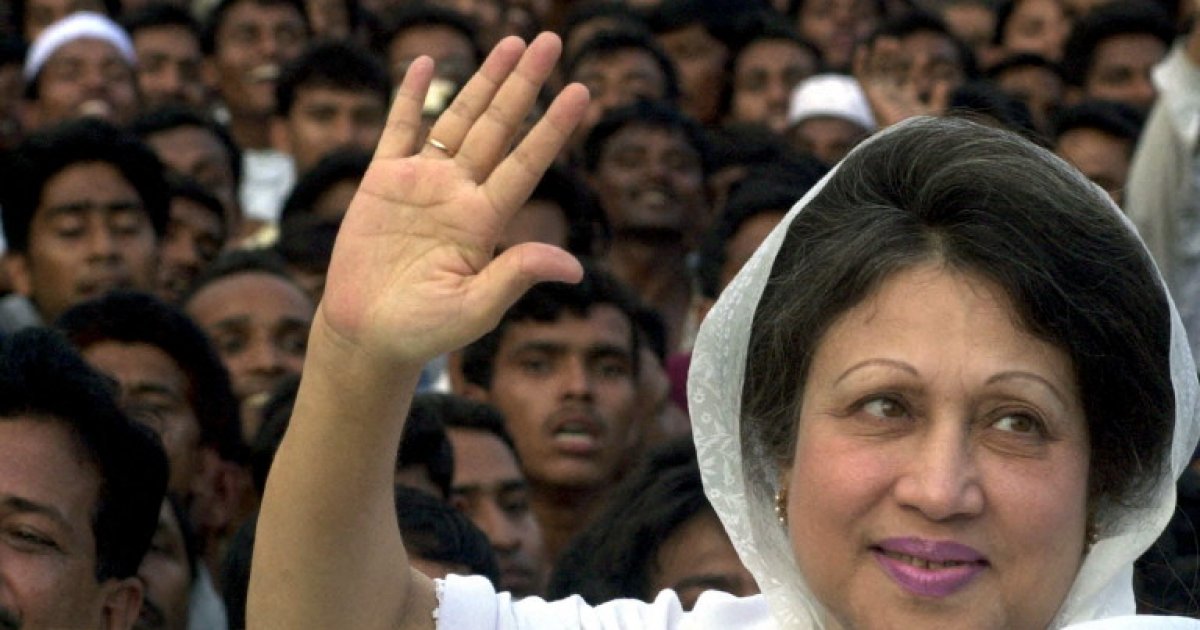
BNP Chairperson and three-time former prime minister Begum Khaleda Zia died at 6am on Tuesday (December 30). She was 80.
A dominant figure in Bangladesh’s politics for more than four decades, Khaleda Zia rose from a largely private life to become the country’s first female prime minister and one of the most influential leaders in its post-independence history.
Her political career was shaped by military rule, mass movements, electoral politics and prolonged legal and political battles.
Early life and background
Khaleda Zia was born in 1945 in Jalpaiguri, India – then part of Greater Dinajpur in British India.
Her mother was Tayyaba Majumdar, and her father, Iskander Majumdar, was a businessman.
She spent her childhood and adolescence in Mudipara village in Dinajpur, while her family’s ancestral home is in Fulgazi upazila of Feni district.
She passed her matriculation examination from Dinajpur Government School in 1960 and later enrolled at Dinajpur Surendranath College.
During her college years, she married then Pakistan Army officer Ziaur Rahman.
Following her marriage, she discontinued her formal education.
In official state records, her educational qualification is listed as “self-educated”.
Marriage and the Liberation War
Khaleda Zia married Ziaur Rahman in 1960, a union that later placed her at the centre of key moments in Bangladesh’s history.
During the Liberation War in 1971, she initially went into hiding.
On May 16, she returned to Dhaka by boat and stayed at her elder sister Khurshid Jahan’s residence until June 17.
On July 2, Pakistani forces detained Khaleda Zia and her two sons from a house in Siddheshwari and imprisoned them at Dhaka Cantonment. She remained in captivity until December 15, just before Bangladesh achieved victory.
Entry into politics
Despite being the wife of president Ziaur Rahman, Khaleda Zia remained outside active politics during his lifetime.
Following Ziaur Rahman’s assassination in 1981, senior BNP leaders and activists urged her to assume a leadership role in the party.
With no prior political experience, she accepted the challenge and soon emerged as a central figure in opposition politics.
She joined the Bangladesh Nationalist Party as a primary member on January 2, 1982.
In March 1983, she was appointed senior vice-chairperson.
On January 12, 1984, she became acting chairperson of the BNP after President Justice Abdus Sattar fell ill, and was elected chairperson unopposed on May 10 the same year.
She later retained the position through successive party councils in 1993, 2009 and 2016, serving as BNP chairperson for nearly 41 years.
Movement against military rule
Khaleda Zia’s political prominence grew during the anti-Ershad movement.
In 1983, she led the formation of a seven-party alliance and launched a sustained movement against military rule.
The agitation continued in phases until 1986 and later intensified into a one-point movement demanding the resignation of president HM Ershad.
Despite political setbacks and disagreements among opposition forces, Khaleda Zia maintained an uncompromising stance against the regime.
The movement eventually contributed to the fall of Ershad and paved the way for the restoration of parliamentary democracy.
Premiership and electoral record
Khaleda Zia became prime minister for the first time in 1991 after the BNP won the parliamentary elections, marking the return of democratic governance.
She was re-elected briefly on February 15, 1996, and later returned to power for a third term in 2001 through a coalition government.
She contested 23 parliamentary seats across five general elections and won all of them, a record often cited as unique in Bangladesh’s electoral history.
Imprisonment and legal battles
Khaleda Zia was arrested on September 3, 2007, during the military-backed caretaker government that followed the declaration of emergency.
After prolonged detention and legal proceedings, she was released on bail.
During that period, attempts were reportedly made to send her into exile, which she refused.
After the Awami League came to power, she was evicted from her cantonment residence on November 13, 2010.
On February 8, 2018, she was sentenced in the Zia Charitable Trust corruption case and sent to prison.
At the time of her death, 37 cases had been filed against her.
She was on bail in 35 cases and convicted in two.
She was serving a 10-year sentence in the Zia Charitable Trust case, though she had been released on bail under an executive order.
During the 2007–08 emergency period, 13 cases were filed against her, including corruption, defamation, treason, murder, arson and sabotage.
Proceedings in those cases were later stayed by the High Court.
Legacy
Khaleda Zia’s life spanned Bangladesh’s major political transitions, from the Liberation War and military rule to democratic restoration and intense partisan rivalry.
Supporters regard her as a symbol of resistance and democratic struggle, while critics point to controversies and governance challenges during her tenure.
Her death marks the end of an era in Bangladeshi politics, closing a chapter defined by fierce competition, mass movements and the enduring influence of two rival political dynasties.