
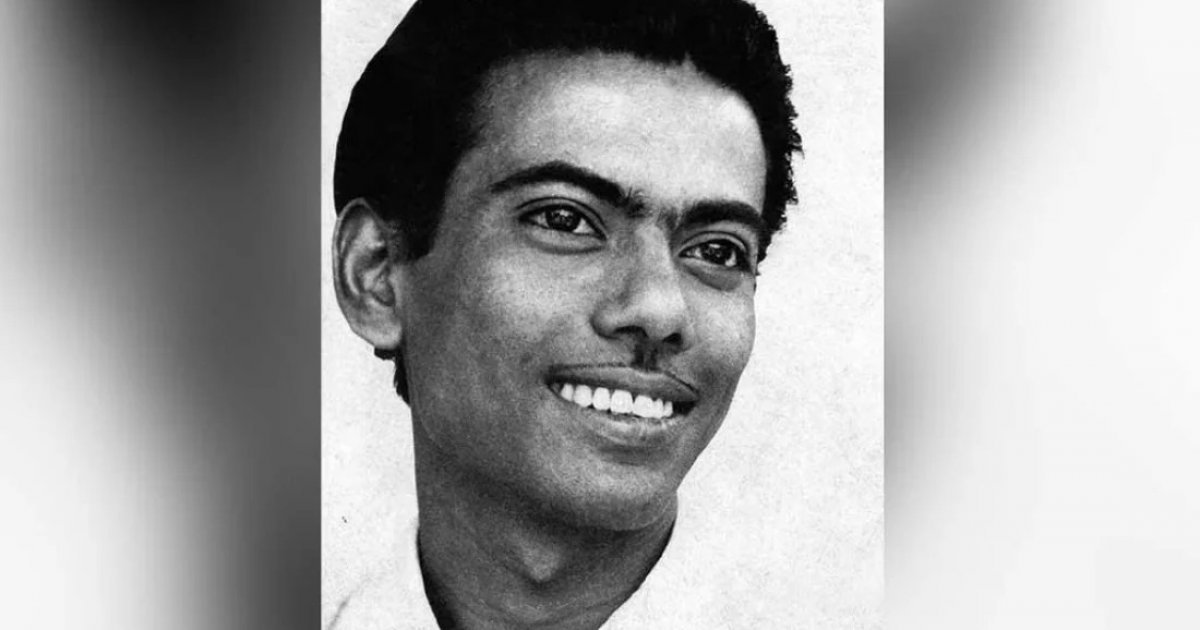
If filmmaker and writer Zahir Raihan had lived, many believe post-independence Bangladeshi cinema would have reached an entirely different height.
Al-Badr forces selectively killed intellectuals on December 14, 1971 – but the loss of Zahir Raihan came later, in independent Bangladesh, under circumstances that remain one of the most painful and unresolved chapters of the nation’s history.
In a life of only 37 years, Zahir Raihan left an indelible mark on literature, film, political activism and the Liberation War.
Then, on January 30, 1972, just six weeks after independence, he disappeared during a military operation in Mirpur.
His body was never recovered.
Zahir Raihan’s son, Tapu Raihan, says he has no clear memory of his father because he was so young at the time.
“But being Zahir Raihan’s son is certainly a source of pride, and also a responsibility,” he told Dhaka Tribune. “I have carried a longing for my father since childhood, and it will remain until my death.”
He believes his father’s values shaped him.
“I understand it is not possible for me to commit unjust or corrupt acts. I got this character from my father.”
What he feels most deeply is the void: “If he had been there, he could have answered so many of my questions. He could have removed a lot of darkness.”
The unfinished dream
Zahir Raihan’s dream project was the film “Let There Be Light,” Tapu said.
But the outbreak of the Liberation War halted the production.
“During the war my father was busy day and night shaping global opinion, collecting funds and making films. After the war, he returned home – and then disappeared on January 30.”
When the war began, Raihan went to Kolkata to campaign for independence.
There he made “Stop Genocide,” now regarded as one of the world’s most powerful documentaries on genocide and forced displacement.
The film captured the atrocities committed by the Pakistani army, the suffering of refugees and the activities of the Mujibnagar government.
Its first screening was attended by acting president Syed Nazrul Islam, prime minister Tajuddin Ahmed and members of the wartime cabinet.
It played a critical role in shaping global opinion in favour of Bangladesh’s cause.
While in Kolkata, Raihan also screened his celebrated film “Jiban Theke Neya” before legendary directors Satyajit Ray, Ritwik Ghatak, Mrinal Sen and Tapan Sinha.
Ray later remarked: “This is a unique talent, the beginning of a new journey in cinema.”
Despite severe financial hardship, Raihan donated all proceeds from the screening to the Freedom Fighters’ Fund.
A disappearance shrouded in mystery
Even after independence, Mirpur remained under the control of Pakistani collaborators, Razakars and Biharis.
They were heavily armed and hostile.
On January 30, 1972, Zahir Raihan received several suspicious calls claiming his missing brother, journalist Shahidullah Kaiser, and other abducted intellectuals were alive in Mirpur and could be rescued if he went himself.
That morning he set out for Mirpur with family members and colleagues.
Near Mirpur Section 2, he was asked to proceed alone for “security reasons.”
He vanished shortly after.
On the same day, an operation by the East Bengal Regiment was underway to liberate Mirpur.
It is widely believed that Raihan was killed in an ambush by armed Bihari groups.
His body has never been found.
From the Language Movement to the Six-Point Movement, the Mass Uprising of ’69 and finally the Liberation War, Raihan was a frontline cultural and political activist.
As a filmmaker and writer, he helped define the intellectual and artistic consciousness of a nation on the brink of freedom.
In only 37 years, Zahir Raihan produced a lifetime’s worth of achievement, so much so that he continues to define the artistic, political and moral imagination of Bangladesh more than five decades after his disappearance.