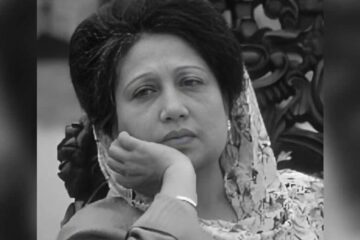

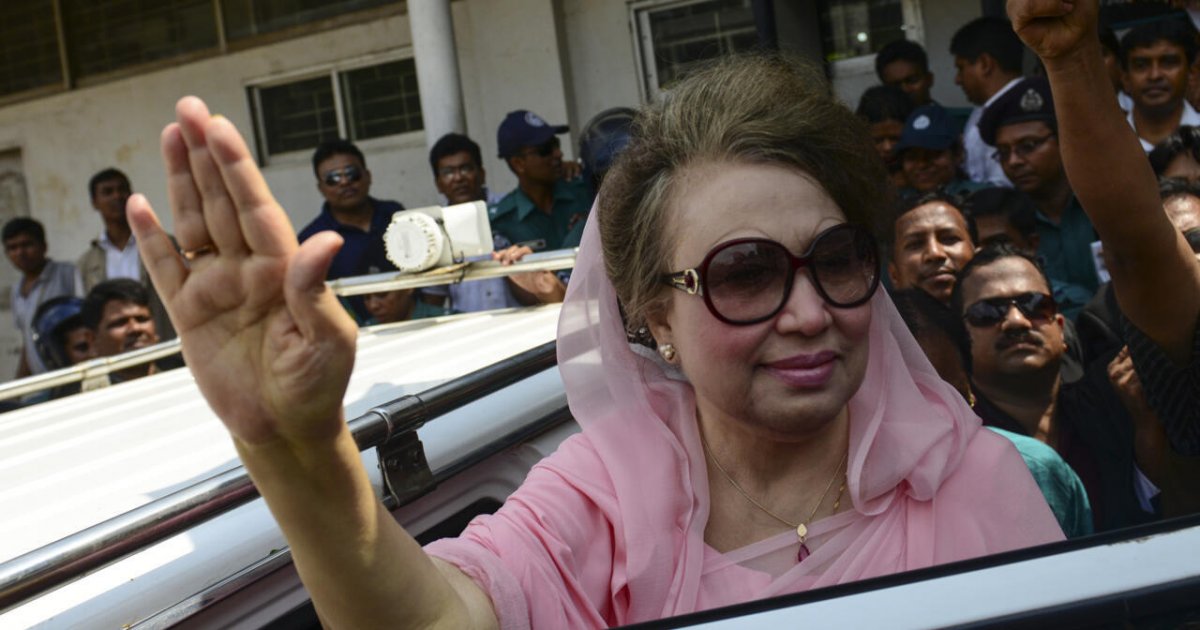
There are moments in a nation’s political life when an individual ceases to be merely a political leader and becomes something far larger. Memory. Resistance. Ache. Continuity.
With the death of Begum Khaleda Zia, Bangladesh has entered one of those moments.
Her passing marks not simply the end of a life but the closing of a long, weather-beaten chapter of the country’s democratic struggle, written by a woman who paid for politics with her body, her freedom, and, ultimately, her health and life.
Khaleda Zia died at 6 am on Tuesday, December 30, at Evercare Hospital in Dhaka. She was 80. For nearly a month, she had been undergoing treatment for kidney and heart disease, complicated by a fresh bout of pneumonia.
Her final moments were surrounded by family. Her son and BNP acting chairman Tarique Rahman, his wife Zubaida Rahman, granddaughter Zaima Rahman, and BNP secretary general Mirza Fakhrul Islam Alamgir were present as Bangladesh’s most consequential female political figure breathed her last.
In the days leading up to her death, anxiety had gripped the party she led for decades. BNP leaders and activists gathered outside the hospital, holding vigil in uncertainty. Rumours circulated, amplified by social media and fear.
Yet the truth arrived quietly, as history often does, with finality rather than spectacle.
Her name had long outgrown partisan boundaries. She was no longer simply the chairperson of the Bangladesh Nationalist Party or a former prime minister.
She had become a fixture in the country’s democratic imagination, a reminder of a time when the struggle for political rights was neither abstract nor rhetorical but lived daily, often at immense personal cost.
Even those who disagreed with her politics understood that she belonged to a generation of leaders who shaped Bangladesh’s post-authoritarian trajectory with flesh-and-blood sacrifice rather than curated slogans.
To understand her political significance, one must return to the night in 1981 when her life was irreversibly altered by the assassination of President Ziaur Rahman.
What followed was not a planned ascent but an extraordinary collision between grief and political responsibility.
She entered public life almost reluctantly, initially perceived as a symbolic placeholder. Yet over time, that reluctant beginning evolved into an assertive form of agency that scholars of gender and politics continue to study.
Her rise marked not just a change in party leadership but a rupture in a deeply patriarchal political order that had rarely allowed women more than ceremonial presence.
In a society structured to doubt women’s authority, she stepped directly into the battlefield of power. During the years of military rule in the 1980s, as street movements intensified, she emerged as a symbol of civilian resistance.
Arrests, house arrests, and constant state pressure followed. What made her defiance distinctive was not only her opposition to authoritarianism but the fact that she embodied it as a woman in a political culture that questioned her very right to stand there.
Her leadership during that era expanded the boundaries of what was politically imaginable for Bangladeshi women.
When military rule collapsed in 1990, she stood at the centre of the uprising through endurance rather than entitlement. Upon entering office, she confronted institutions hollowed out by years of authoritarian governance.
Her governments were imperfect, shaped by the confrontational nature of Bangladesh’s political culture, but they were rooted in a belief that power carried responsibility toward ordinary people.
Her contribution to education remains one of the most transformative yet underacknowledged elements of her legacy. At a time when girls’ schooling rates were alarmingly low, her government introduced free education for girls up to the secondary level and significantly increased education spending.
These were not isolated policy gestures but part of a deliberate national shift. International development studies continue to identify that period as a turning point in gendered access to education in South Asia. A generation of women professionals emerged from classrooms widened during her tenure.
Her political life, however, was also defined by relentless persecution.
On February 8, 2018, during the Awami League era, she was sentenced to prison in the Zia Orphanage Trust case. The trial, widely criticized for its procedural flaws, marked a turning point in her physical decline.
From prison cells to hospital beds, she remained under state custody even as her health deteriorated. Additional sentences followed in other corruption cases, deepening public concern over the politicization of justice.
Over the years, her illnesses multiplied. She suffered from liver cirrhosis, diabetes, arthritis, kidney, lung, and eye complications. She was diagnosed with Covid-19 in May 2021 and required treatment in a coronary care unit due to persistent breathing difficulties.
In June 2024, doctors implanted a pacemaker in her heart. She already had multiple cardiac blockages and an earlier ring insertion. That same month, her liver was treated through a specialised Porto Systemic procedure performed by doctors brought from abroad. Each intervention prolonged her life, but none restored her health.
In August 2024, following dramatic political upheaval, she was fully released from all sentences through a presidential executive order. It was a legal liberation that arrived too late to restore her strength.
She spent her final months moving between her Gulshan residence and hospital wards, her body weakened but her political symbolism undiminished.
What distinguished Khaleda Zia within South Asian politics was her transformation from marital identity to individual agency. While she entered public life as a widow, she long outgrew that role.
Her legacy does not rest on her husband’s memory but on decades of confrontation with state power, political violence, and institutional hostility.
She became one of the first democratically–elected female heads of government in a Muslim-majority country, not as an exception but as a challenger to entrenched norms.
As misogyny intensifies in digital spaces and women in public life face routine degradation, her story gains renewed relevance.
It reminds younger generations that women’s leadership in Bangladesh was not gifted by history but carved out through courage.
In her final days, something rare occurred. A deeply divided nation found itself united in anxiety and prayer. Muslims and Hindus, rich and poor, BNP loyalists and political opponents all expressed concern.
Such unity emerges only around figures who have woven themselves into the national soul. With her death, that collective moment has transformed into collective grief.
Her absence leaves a vacuum that no immediate successor can fill. Within BNP, the loss is seismic.
A party built around her moral authority must now navigate an uncertain future without its matriarch.
For the nation, her passing removes one of the last living anchors to an era when politics still carried a sense of personal risk and ethical weight.
History will record her titles. Two-time prime minister. Leader of the opposition. Chairperson of the BNP.
Yet the public memory will be shaped by something less formal.
A woman forged in loss who refused retreat.
A leader who returned home knowing imprisonment awaited her.
A political life marked as much by suffering as by power.
Begum Khaleda Zia is no longer a political actor. She has become a narrative of resistance, sacrifice, and stubborn love for a nation that often wounds those who serve it.
Her death forces Bangladesh to confront not only what she represented but what it has done to its leaders and to itself.
A leader does not become the mother of a nation through proclamation. She earns that place through scars, storms, and endurance.
Bangladesh produced two women prime ministers. One became a crisis. The other became a conscience.
And that conscience, weathered yet unbroken, belonged to Begum Khaleda Zia.
With her passing, a chapter closes. The story of Bangladesh continues, but it now does so without one of its most defining voices.
The silence she leaves behind is not empty. It is heavy with memory.
HM Nazmul Alam is an Academic, Journalist, and Political Analyst based in Dhaka, Bangladesh. Currently he is teaching at IUBAT. He can be reached at [email protected]