

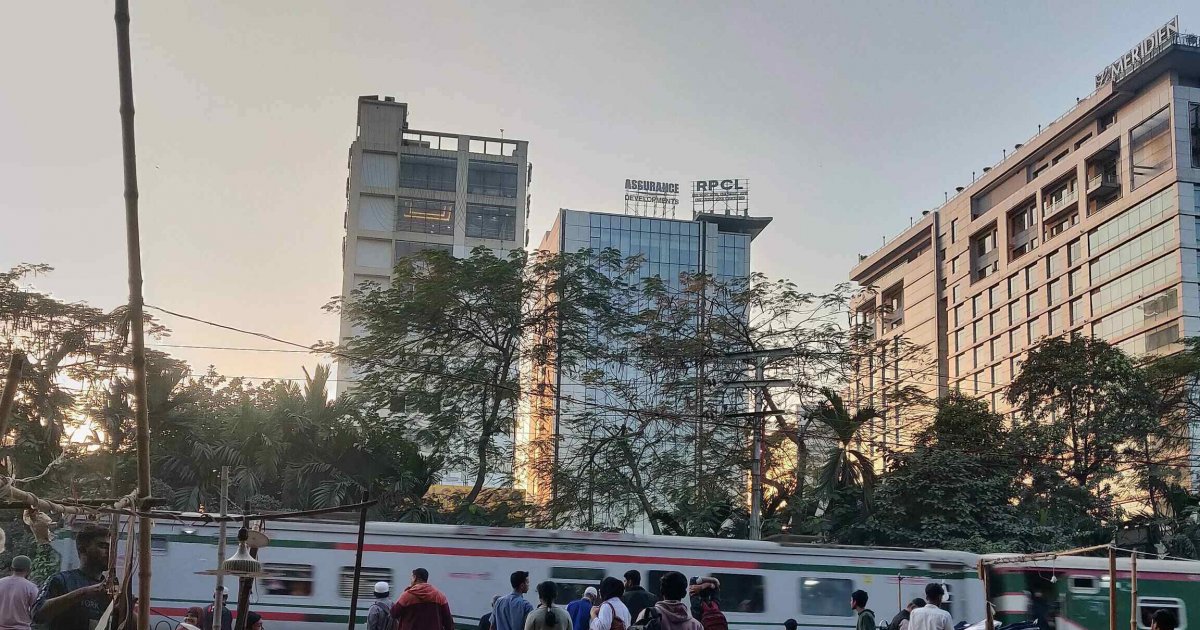
From rural Bangladesh to the edges of its cities, railway crossings are a familiar sight. Somewhere the tracks bend sharply, somewhere they slice through busy intersections.
One such place lies between Khilkhet and Kawla, beside Le Meridien in Dhaka. Although a foot overbridge exists, there is no properly established railway signal point. Even so, countless people risk their lives here every day. Deaths caused by train accidents are nothing new in Bangladesh; they have become a grim part of everyday reality.
Around this informal crossing, livelihoods have taken root. People from different walks of life run small businesses here. Yet there is another, quieter dimension to their presence, a sense of silent social responsibility.
When a train approaches, they warn passers-by, often preventing disaster. Peanut seller Saad Mia says that whenever a train comes, he blows a whistle to alert people. Profit is not his concern. His business feeds his family, and that is enough. What matters to him is that people return home safely at the end of the day.
On the other side of the tracks sits Rahim Mia, a beggar holding a bamboo barricade. When he hears Saad Mia’s whistle or spots a train approaching from afar, he lowers the barricade so that no one crosses in front of it. Rahim Mia, too, expects no reward. Whatever people give is how his household survives.
These people quietly serve society without seeking recognition. When asked whether anyone ever thanks them, they say appreciation is rare, and they do not expect it either.
Yet, unknowingly, they have saved many lives. As a writer, it feels necessary to acknowledge them. Society needs more such silent altruists, because their role has become indispensable, especially where institutions fail.
Whenever news of a train accident breaks, one question almost always arises: How could someone fail to hear something as large and noisy as a train?
In search of an answer, on April 1, 2017, American news channel NBC aired an experimental report by journalist Jeff Rossen. The question was simple yet unsettling: Can you really not hear a train approaching from behind while standing on the tracks?
Rossen stood on a railway line facing away from the direction of the train, with all necessary safety measures in place. After a while, a train approached from behind. Astonishingly, he detected no sound until the train was dangerously close.
Later calculations showed that the time between first hearing the train and it passing him was barely five seconds. This was a slow train, travelling at just 25 miles per hour. Had it been moving at 70 miles per hour, the available time would have dropped to less than two seconds.
After this experiment, even NBC had to admit that hearing an approaching train is not as straightforward as we assume. There is science involved, and there is psychology.
In Bangladesh, we often blame headphones, mobile phones, or sheer carelessness. But mobile phones and headphones have been around for only 15 to 20 years. Did such accidents not happen before that? They did, frequently.
Railway police data show that over the past decade, more than 9,200 people have died due to careless and unauthorized use of railway tracks. In the last three years alone, deaths crossed 3,100, nearly three lives lost every day. About 77% of these deaths occurred while people were crossing tracks unsafely or walking and sitting on them.
Headphone-related negligence does exist, but it explains only a fraction of the problem. Even last year, when the number rose noticeably, it remained a small share of the total. The highest number of fatalities occurred while people were sitting on tracks, walking along them, or rushing across railway crossings. In many incidents, multiple people died together. Were all of them wearing headphones? That question deserves serious reflection.
Science offers some explanations. Thick metal rails absorb certain sounds and vibrations. The sound of a train often travels forward in a V-shaped pattern, meaning that unless someone is directly facing it, the full sound may not reach their ears. Surrounding trees, buildings, and urban noise further distort perception. But more convincing than these physical explanations is the psychological one.
On city streets, pedestrians remain alert because traffic is constant and unpredictable. Railway tracks, however, are perceived differently. Only one vehicle runs there, and it comes at long intervals. As a result, people unconsciously relax. Checking a phone, chatting briefly, or filming a passing train feels normal. This is where another powerful factor comes into play: Habitual confidence.
Recent tragedies reflect this pattern. On May 2 at Kuril Bishwaroad in Dhaka, Ishtiaq Ahmed, a graduate student of Rajshahi Government College, stood on one track filming a train on the adjacent line when another train struck him from behind, killing him instantly.
His cousin later said repeated warnings went unheard. Similar incidents have occurred across the country. In each case, familiarity with the railway environment proved fatal.
Those who live or work near railways cross tracks daily and look back countless times to find no train coming. Over time, repeated near-misses create a false sense of safety. Confidence dulls the senses; habit replaces caution.
Dhaka remains the worst affected. The five-kilometre Banani-Airport rail corridor has emerged as the deadliest stretch, marked by sharp bends, heavy traffic noise, lack of fencing, and the absence of pedestrian bridges. Between 2021 and 2024, roughly one-third of all railway deaths nationwide occurred in Dhaka alone.
Bangladesh has more than 3,100 railway crossings, nearly 40% of them unauthorized. Many lack gates or gatekeepers. Although railway tracks are legally restricted spaces under the Railway Act of 1890, enforcement remains weak.
Deaths are routinely classified as unnatural, and responsibility is placed on victims rather than authorities. Meanwhile, unprotected crossings, institutional negligence, and infrastructural gaps persist.
There is also a darker dimension. Railway police report that murders are sometimes staged as train accidents. Over recent years, dozens of such cases have been recorded, adding another layer of complexity to an already grim landscape.
In this context, the roles of people like Saad Mia and Rahim Mia become even more meaningful. Where the state fails, ordinary citizens quietly step in and shoulder responsibility.
Train accidents are not merely stories of individual negligence. They are the combined outcome of habit, flawed perception, and systemic neglect. Unless this reality is acknowledged, alongside urgent structural and institutional reforms, the procession of preventable deaths will not stop.
Alongside that recognition, it is our social duty to remember, with gratitude, those who stand silently by the tracks every day, saving lives without ever being noticed.
Nafew Sajed Joy is a researcher, writer, and environmentalist.