

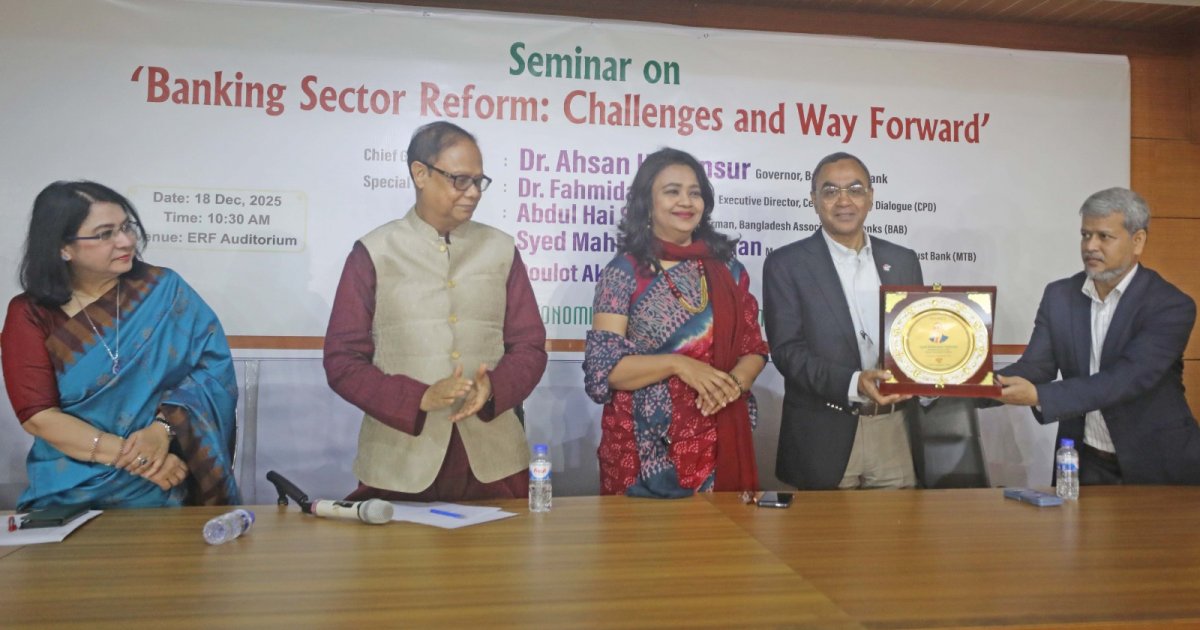
Bangladesh Bank has set a target to increase the country’s foreign exchange reserves to $34-35 billion within the current FY26. For this, there is no need to take new loans from international lending institutions, said central bank governor Dr. Ahsan H Mansur.
He made these remarks as the chief guest at a seminar titled “Banking Sector Reforms: Challenges and Ways Out” organized by the Economic Reporters Forum (ERF) in the capital on Thursday.
The governor also said: “We are not buying dollars by creating any pressure to increase reserves. Dollars are being bought through market-based auctions. The target is to increase reserves to $34-35 billion by the end of the fiscal year.”
He claimed that there is currently no major concern about the balance of payments or dollar situation. “We are slowly moving from a bad situation to a better one. Confidence has returned to the banking sector and the overall economy has stabilized,” the governor said.
However, the Bangladesh Bank governor also frankly admitted the deep crisis in the banking sector. He said that many banks have serious capital shortages and the rate of non-performing loans has increased alarmingly.
“I thought that the non-performing loans would be 25% to 27%, but in reality is around 36%. We will not hide any information. Whatever is true will be revealed,” he said.
The governor also said that an initiative has been taken to merge five banks as part of the banking reform. Assuring depositors in this regard, he said: “The deposits of the merged banks will be completely safe. Up to two Tk2 lakh will be protected under deposit insurance.”
He also said that there is no risk of loss if Tk20,000 crore is invested in the new bank.
Regarding the appointment of the governor at the seminar, Dr. Ahsan H. Mansur said that appointing a governor through the conventional method results in a ‘yes man’, which is not effective for good governance in the banking sector.
“Like in developed countries of the world, the governor should be given the rank of minister so that he can make independent decisions. Legal protection is needed so that the governor of Bangladesh Bank cannot be removed over a phone call,” he said.
Syed Mahbubur Rahman, managing director of Mutual Trust Bank, said that commercial banks have gone beyond their core business and engaged in long-term investments because an effective capital market has not been developed in the country.
He said: “Since the takeover of Islamic banks, the mafia system has started in the banking sector, and the crisis has intensified from there.”
However, he mentioned the increase in reserves, the stability of the dollar market and the introduction of a market-based dollar rate after the political change as positive progress. At the same time, he said that banking reforms alone will not solve the problem without political will.
At the same event, CPD executive director Dr Fahmida Khatun said that while the banking sector once played a major role in creating entrepreneurs, the sector is facing destruction due to policy weaknesses, political interference and unscrupulous lending.
She said: “Currently, the amount of defaulted loans is almost equal to the national budget. Earlier, the defaulted loan rate was shown low because the real picture was hidden. Now, the rate has increased because it is calculated according to the rules.”
Referring positively to the recent reform initiatives of Bangladesh Bank, including the Bank Resolution Act, she said that these activities must be continued. At the same time, she emphasized on ensuring full autonomy of the central bank if the banking sector is to turn around.
She also said that it is important for political parties to have specific commitments on banking sector reforms in their manifestos ahead of the upcoming February elections.